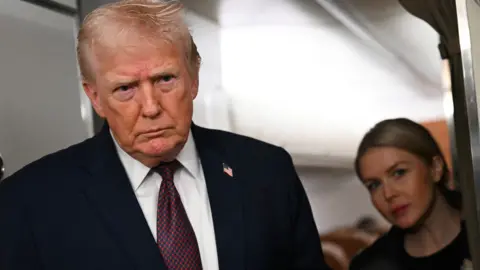
Donald Trump told the world the US was ready to go to the “rescue” of Iranian protesters. He said America was “locked and loaded and ready to go.” Then the crackdown in Iran intensified, and the White House’s message turned into a tease: keep waiting.
Now comes the part that matters. Not the soundbites, not the chest-thumping, not the doomscrolling. The decision itself. And the biggest question hanging over Washington is not what Trump can do. It is what Trump actually wants to do, and how far he is willing to push it.
A White House that wants the suspense to linger
According to the BBC, senior officials were expected to brief Trump on possible courses of action, after he told reporters he was looking at “some very strong options.” The administration is also floating a second, parallel storyline: that Iran wants to talk, just not in public.
White House Press Secretary Karoline Leavitt put the uncertainty on purpose. “Nobody knows what President Trump is going to do except for President Trump,” she said. “The world can keep waiting and guessing.”
That is a flex, but it is also a trap. When the White House markets unpredictability as strategy, it still has to land somewhere. And Iran has said it would respond to any American attack, which means the clock is not only political. It is operational.
The menu of options is broad, and not all of it looks like war
The BBC report lays out a range of possibilities, with a clear implication: Washington has levers that do not require US troops on Iranian streets. The story notes Pentagon officials, quoted by CBS News, discussing actions that could include covert methods such as cyber operations and covert psychological campaigns intended to disrupt and confuse Iran’s command structures.
US leans toward covert and military escalation as Iran signals readiness for war
——
US President Donald Trump has been briefed on an array of covert and military options against Iran, according to two US Department of Defense officials cited by CBS News. These options reportedly… pic.twitter.com/TDgmCpbjhM— The Cradle (@TheCradleMedia) January 13, 2026
That kind of approach has two selling points inside any administration. It is deniable, and it can be scaled up or down without the public spectacle of a major deployment. It also has a downside. It rarely delivers a clean, camera-ready “result,” which is often what political leaders want when they decide to “do something.”
Then there is the more visible option: kinetic strikes. The BBC points to what it describes as a proven US capability to attack from distance, including B-2 stealth bomber missions that it says previously dropped bunker-busting bombs on Iranian nuclear sites.
In other words, Trump does not have to choose between doing nothing and launching a full-scale intervention. The middle lanes are crowded.
The Venezuela victory lap and the Iran temptation
One reason the Iran decision is getting extra heat is the political mood music around Trump right now. The BBC reports that Trump has been “flushed with success in Venezuela,” and that he described the capture of Nicolas Maduro as “one of the most successful operations in US history.”
Even if Iran is a very different target than Venezuela, that kind of claimed win can change the internal balance of any White House. Success tends to breed appetite. It also tends to breed overconfidence, especially when the next challenge is bigger, more complex, and far more likely to punch back.
Diplomacy in public, diplomacy in private, and a contradiction in the middle
Trump, per the BBC, has said elements of the Iranian regime have reached out, anxious to negotiate, presumably to keep a dialogue going on the country’s nuclear programme.
Leavitt framed it as a two-track Iran, one for the microphones and another for private channels. “What you’re hearing publicly from the Iranian regime is quite different from the messages the administration is receiving privately,” she said, adding that diplomacy was “always the first option.”
This is where the contradiction sharpens. The president’s posture, at least in his own words, is readiness for action. The press secretary’s posture is that talks are alive. Both can be true, but they point to different outcomes. And every day the crackdown continues, the administration faces the same question from different corners: if diplomacy is first, how long before the next option becomes the plan?
The protesters, the regime, and the risk of turning a revolt into a rally
The core moral argument for intervention is simple: if violence is escalating, outside pressure might save lives and accelerate change. The strategic argument is not simple at all, and the BBC report uses one expert to show why.
Bilal Saab, an associate fellow in the Middle East and North Africa Programme at Chatham House, described a view held by some advocates of limited strikes. “All Trump has to do is shoot to cause panic inside the regime,” Saab said. “A US strike could embolden the protesters and distract the regime,” he added.
But Saab also warned about the reverse effect, especially if US action looks like theater instead of a campaign. “It could harden the resolve of the regime and its still-large support base across the country. A rallying around the flag wouldn’t be shocking,” he said. “That’s more likely… if the strike is symbolic or a one-off.”
That is the nightmare scenario for anyone who claims to act on behalf of protesters. An outside strike that gives the government a unifying storyline, while protesters absorb the blowback.
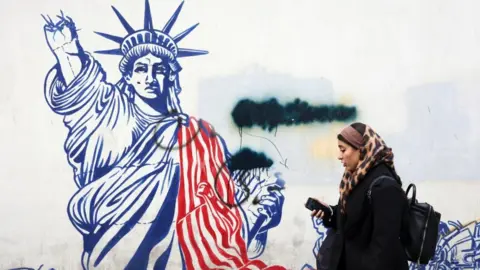
Iran’s response options are not theoretical
The BBC notes that Iran has threatened to respond to any American attack and that, despite damage inflicted by Israeli and American attacks described in the report, Iran still has a significant arsenal of ballistic missiles.
The regional picture is also messy. The BBC says Iran’s allies and proxies have been weakened or displaced in some places, citing Syria’s former President Bashar al-Assad and Hezbollah’s reduced strength in Lebanon, but adds that the “Axis of Resistance” is not yet a spent force. The Houthis in Yemen and Shiite militias in Iraq are still capable of action, according to the report.
For Washington, that is not an abstract map. It is a list of possible retaliations, and a reminder that even a “limited” strike can quickly become an expanding problem once regional actors start freelancing.
A would-be alternative leader is urging speed, and the White House hears a warning
Among the most politically loaded voices urging Trump to move is Reza Pahlavi, the exiled son of Iran’s last monarch. In comments cited by the BBC from an interview with CBS News, Pahlavi pressed for intervention as a way to reduce casualties and accelerate collapse.
“The president has a decision to make fairly soon,” Pahlavi said. “The best way to ensure that there will be less people killed in Iran is to intervene sooner,” he said. “So this regime finally collapses and puts and end to all the problems that we are facing.”
That pitch lands differently depending on who is listening. To supporters, it sounds like a roadmap. To skeptics, it reads like a familiar promise that toppling a regime will neatly solve what comes after. US officials have learned, repeatedly, that the “transition” phase is where simple slogans go to die.
What to watch next: not the bravado, the target choice
The clearest tell will be what kind of target set the administration signals, if it signals anything at all. A move focused on command-and-control disruption, cyber activity, and behind-the-scenes pressure suggests Washington wants leverage without a public escalation spiral. A limited kinetic strike suggests a desire to change the regime’s calculations fast, at the risk of giving it a propaganda gift.
And if the White House keeps emphasizing private messages and “first option” diplomacy, watch for what it asks Iran to do in return, and how quickly those asks harden into deadlines.
Leavitt’s line was designed to keep adversaries off balance. But it also captures the bind. The longer “waiting and guessing” becomes the policy, the more the world assumes the decision is being made by events, not by strategy.