The Middle East runs on connections, and when the skies snap shut, the fallout does not stay regional. In the latest wave of airspace closures tied to U.S.-Israeli strikes and Iran’s retaliation, the real question for travelers and airlines is how long the dominoes keep falling.
What You Should Know
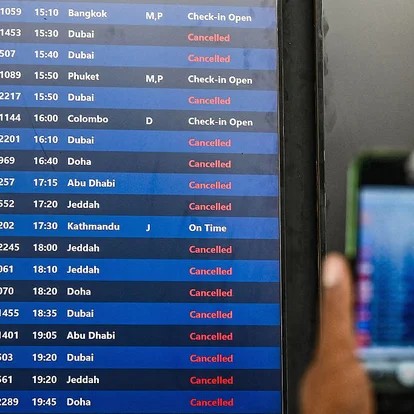
Airspace closures across parts of the Middle East disrupted international travel, with FlightAware reporting more than 2,400 canceled flights in the region. Major airlines, including Emirates, Qatar Airways, and United, suspended or canceled routes as airports and air corridors restricted operations.
The closures hit the Gulf’s high-throughput hubs, the places designed to turn long-haul travel into a clean two-stop machine. Dubai, Abu Dhabi, Doha, and Manama were among the airports affected, according to CBS News, as carriers scrambled to pause operations, reroute planes, and manage stranded passengers.
The Hub Cities That Went Dark
Flight data tracked by FlightAware showed cancellations stacking up fast, a blunt indicator that this was not a handful of delayed departures. In a region where schedules are built around tightly timed connections, a single closure can create a chain reaction that lasts longer than the airspace restriction itself.

Airline announcements underscored the breadth of the disruption. CBS News reported that Emirates suspended flights to and from Dubai for a period, Qatar’s airport faced a closure window cited by Qatar Airways, and Israeli airspace remained closed as Israel’s El Al prepared a recovery effort to bring citizens home when reopening allowed.
The Reroute Bill Is Coming
Even when flights are not outright canceled, detours are not free. Airlines routing around conflict zones often add hours in the air, burn more fuel, and lose the cushion that keeps fleets on schedule, which is why carriers have to choose between eating the cost or quietly pushing it into future fares.
Cirium, an aviation analytics firm cited by CBS News, has previously pegged the major Gulf carriers’ hub traffic at roughly 90,000 passengers per day through those airports, before counting additional point-to-point travelers headed into the region. When that volume gets jammed, the leverage shifts fast from consumers to carriers, and from carriers to governments controlling the airspace.
Henry Harteveldt, an airline industry analyst and president of Atmosphere Research Group, put it plainly in remarks carried by CBS News: “There’s no way to sugarcoat this.” The immediate result is travelers chasing rebookings while airlines triage aircraft and crews that are now in the wrong city, at the wrong time.
United, for example, canceled U.S. departures to Tel Aviv through March 6th, 2026, with corresponding returns, and it also canceled flights to and from Dubai through March 4th, 2026, CBS News reported. Across the region, airlines urged passengers to check flight status before going to the airport, and some issued waiver policies to allow changes without extra fees.
The next signal to watch is not just when airspace reopens, but whether reopening stays stable long enough for airlines to rebuild normal rotations. In air travel, a closure ends in minutes, but the backlog can take days to unwind.