The White House just unveiled the names behind President Donald Trump’s new Gaza “Board of Peace.” The list answers one question fast: who has the seats? It leaves another hanging: who is not even in the room?
According to the White House, Trump will chair a founding Executive Board that will oversee a separate committee of technocrats charged with temporary governance in Gaza and reconstruction. But the portfolios are still undefined, and the composition is already drawing attention for what it signals about priorities, power, and perception.
A New Board, a Huge Mandate, and an Immediate Optics Problem
The White House says each executive board member is expected to lead a portfolio “critical to Gaza’s stabilisation.” Who handles security, aid coordination, rebuilding contracts, border access, or political transition has not been publicly spelled out.
What is clear from the initial rollout is this: the top-level announced so far includes no women and no Palestinians. The White House says additional members will be announced in the coming weeks.
Even with that caveat, the founding lineup sets a tone. It is heavy on political veterans, Trump loyalists, dealmakers, and finance, with a parallel Palestinian technocratic structure placed one level down.
🗒️ The White House has announced the members of the Gaza “Board of Peace” and its supporting Executive Board under Donald Trump’s post-war Gaza plan
➡️ Head of the National Committee for the Administration of Gaza: Dr. Ali Sha’ath
➡️ Executive Board members: Hakan Fidan, Steve… pic.twitter.com/cxXoSDozBo— Anadolu English (@anadoluagency) January 17, 2026
The Blair Pick Is the Loudest Signal
Former UK Prime Minister Sir Tony Blair is the highest-profile non-American on the list, and the only founding executive board member who is not a US citizen, according to the White House details reported by the BBC.
Blair’s biography reads like a resume for complicated missions. He served as UK prime minister from 1997 to 2007. His decision to take Britain into the Iraq War in 2003 remains a defining controversy, and it is impossible to separate that history from any new Middle East role.
After leaving office, Blair served as Middle East envoy for the Quartet, the United Nations, European Union, US, and Russia, from 2007 to 2015.
In the BBC report, Blair frames Trump’s plan in sweeping terms, calling it the “best chance of ending two years of war, misery and suffering.” That quote works as both an endorsement and a tell. The Trump team is not marketing this as a small diplomatic tweak. It is positioning a central control structure that expects to steer a post-war Gaza reality.
Rubio’s Job Is Diplomacy, His Record Is War Talk
Secretary of State Marco Rubio’s presence is straightforward on paper. If a US administration is building a formal “Board of Peace,” the country’s top diplomat is going to be on it.
Still, Rubio arrives with a paper trail that shows how fast Washington messaging can shift when plans move from cable-news posture to governing. Before Trump returned to office, Rubio argued against a ceasefire and took a maximalist line on Hamas. Later, he praised the first phase of an Israel-Hamas ceasefire deal signed in October as the “best” and “only” plan, according to the BBC’s summary of his public comments.
Rubio also criticized an Israeli parliamentary move toward annexation of the occupied West Bank in October, another reminder that the board will sit on top of unresolved fights that stretch beyond Gaza’s borders.
Witkoff Brings Real Estate Instincts and a Warning Line
US Special Envoy to the Middle East Steve Witkoff, described by the BBC as a real estate magnate and Trump golf partner, is another centerpiece. He has been tied to the administration’s negotiation and implementation push, including announcing the start of phase two of Trump’s plan to end the war.
That phase, as Witkoff described it, aims at reconstruction and “full demilitarisation” of Gaza, including the disarmament of Hamas. The language is blunt, and so is the enforcement promise. Witkoff said he expects Hamas to “comply fully with its obligations” or face “serious consequences.”
Witkoff’s role also stretches beyond Gaza. The BBC notes he was a central figure in US-led efforts to negotiate a peace deal between Russia and Ukraine, including a five-hour meeting with Russian President Vladimir Putin in Moscow in December. That is not just a scheduling detail. It signals how Trump’s foreign policy circle tends to reuse the same small cast across different conflicts, often emphasizing personal relationships and high-stakes bargaining.
Kushner Is Back in the Mix, and His Old Quote Follows Him
Jared Kushner, the president’s son-in-law, is again part of the foreign-policy machinery. The BBC describes him as playing a key role in negotiations and working alongside Witkoff as a mediator in both the Russia-Ukraine and Israel-Gaza wars.
One detail from Kushner’s recent past is likely to be replayed anytime his name appears near Gaza reconstruction. At a talk at Harvard University in 2024, he said, “Gaza’s waterfront property could be very valuable… if people would focus on building up livelihoods.”
Read one way, it is a developer’s argument for economic opportunity. Read another, it is a reminder that reconstruction talk can quickly collide with displacement fears, sovereignty questions, and the politics of who benefits when rubble turns into contracts.
Billionaire and Banker Energy, Rowan and Banga
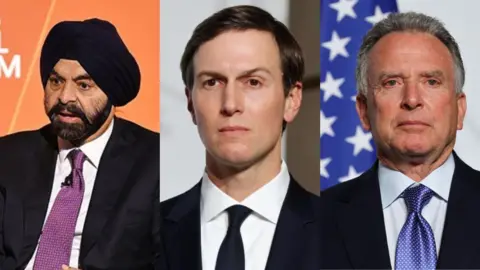
Marc Rowan, a billionaire and CEO of Apollo Global Management, brings pure finance-world weight to the board. Apollo is a major private equity firm headquartered in New York. The BBC reports Rowan was considered a contender to become Treasury secretary for Trump’s second term.
Ajay Banga, president of the World Bank, adds institutional development credentials, along with another political crossover. Born in India in 1959, Banga became a US citizen in 2007. He previously served as CEO of Mastercard for more than a decade. Former President Joe Biden nominated him to lead the World Bank in 2023, the BBC reports.
If the board is serious about reconstruction, having the head of the World Bank in the room is a signal to donors and international lenders. It is also a reminder of the scale of what is being implied. Rebuilding Gaza is not a grant program. It is a multi-year, multi-billion-dollar challenge tied to security control, border policy, and political legitimacy.
A National Security Operator, Plus a Gaza ‘Ground Representative’
The final named founding executive board member is Robert Gabriel, described as a US national security adviser. According to the BBC, he has worked with Trump since the 2016 campaign and, according to PBS, became a special assistant to Stephen Miller after that election. In a board framed as “peace,” a security adviser with close ties to Trump’s hardline inner circle is another hint that enforcement and compliance will be central themes.
Then there is the on-the-ground layer. The White House statement also named Nickolay Mladenov, a Bulgarian politician and former UN Middle East envoy, as the board’s representative in Gaza.
Mladenov is set to oversee a separate 15-member Palestinian technocratic committee, the National Committee for the Administration of Gaza (NCAG), charged with day-to-day governance in post-war Gaza. The BBC reports it will be led by Ali Shaath, a former deputy minister in the Palestinian Authority, which governs parts of the occupied West Bank not under Israeli control.
What To Watch Next, Portfolios, Legitimacy, and the Missing Seats
Right now, the most consequential unknown is not just who else gets added. It is how power is divided between the executive board and the Palestinian technocratic committee, and which member gets which “critical” portfolio.
The early structure also creates an obvious pressure point. The founding executive board is presented as the top decision layer, but it is missing Palestinians and women at the announcement. The administration says more names are coming. Until then, the board’s credibility will be tested against its own mission statement: stabilisation, governance, and reconstruction of a place where legitimacy is not a public relations issue. It is the entire operating system.
The White House has released the names. The next reveal is not a name; it is the power map. And for a body branded “peace,” the first fight may be over who gets to define it.