

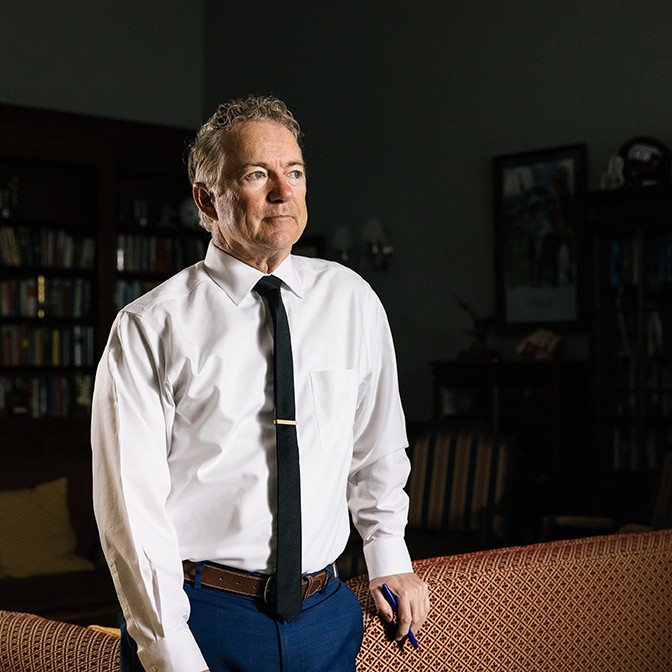
Sen. Rand Paul is teeing up a rare Washington collision: guns, accountability, and money. In one room, lawmakers want answers about a Minneapolis crackdown that damaged trust in ICE. In another, the same fight is threatening to pull the plug on DHS funding.
What You Should Know
A Senate Homeland Security hearing set for February 12th, 2026, will scrutinize ICE conduct tied to the Minneapolis crackdown as DHS faces a February 14th funding deadline. Democrats are pressing reforms, while Republicans are signaling oversight questions about force and agency transparency.
Paul, a Kentucky Republican who chairs the committee, has cast the hearing as a test of whether immigration enforcement leaders will explain themselves on the record or keep ducking behind the words every administration loves: ongoing investigation.
A Chairman Who Smells Blood in the Transcript
Paul did not preview a Kumbaya session. He previewed a deposition with cameras.
In an interview on CBS’s “Mornings,” Paul said the Minneapolis crackdown created “a loss of public trust in ICE and its officials,” and he described “fault on both sides.” That framing matters because it signals two things at once. First, he is not letting ICE take the full fall. Second, he is not letting ICE off the hook, either.
He also tipped his hand about what he thinks the public is owed, which is not a vague promise to “review policies.” He wants specifics: when agents should draw their guns, when they should fire, and what happens when leaders refuse to answer. Paul called that scenario “a real problem,” according to CBS News.
That is the power play. The chairman is setting a standard, in advance, for what counts as cooperation. If the witnesses do not meet it, the hearing becomes less about Minneapolis and more about whether DHS and its enforcement arms can operate with limited congressional patience.
The Minneapolis Flashpoint and the 1 Question Nobody Can Duck Forever
Details around the Minneapolis incident have been handled cautiously by officials, and much of the fact-finding appears to be in investigative channels. CBS News reported that officials have largely declined to comment on the Minneapolis shootings, citing ongoing investigations.
Still, Paul has pushed the conversation into a simpler, more combustible lane: what are the rules when armed federal agents meet a crowd that is angry, loud, and possibly armed, too?
According to CBS News, Paul raised questions about whether someone could be shot for bringing a legally owned weapon to a rally or for yelling at ICE officers. Those hypotheticals are not academic. They are about boundaries, training, and whether the government can articulate, in plain English, what it expects from civilians in tense encounters with federal law enforcement.
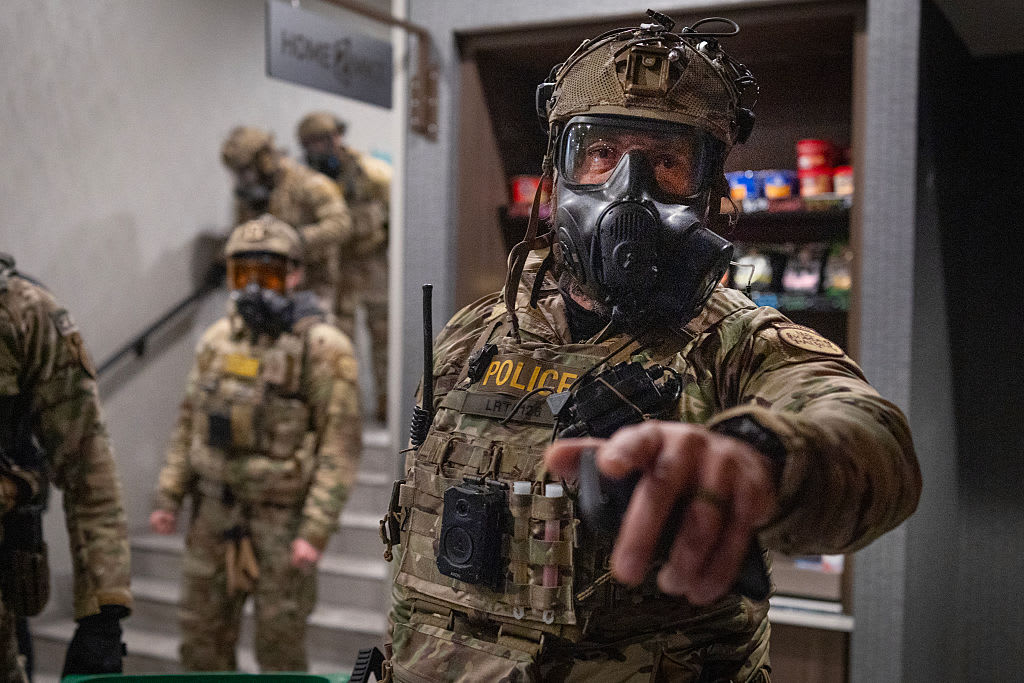
That is also why “use of force” hearings never stay tidy. The agencies want to talk about mission and danger. Lawmakers want to talk about rules, discipline, and whether those rules are being followed when the stakes get hot.
Shutdown Politics Hover Over the Hearing Like a Second Witness
Even if the committee spends hours on policies, one deadline is hard to ignore: the money.
CBS News reported that DHS funding is set to expire at 12 a.m. on Saturday, February 14th, 2026, unless Congress reaches an agreement. Democrats, according to the same reporting, have pledged to oppose a short-term funding measure as they seek reforms aimed at curbing ICE in the wake of the Minneapolis crackdown.
That puts the hearing inside a bigger leverage game. Oversight is supposed to be separate from appropriations, at least in theory. In practice, they travel together. A high-profile incident creates calls for reform. Reform demands get tied to must-pass funding. The agency says it cannot comment while investigations are pending. Lawmakers respond by asking whether the agency should get a clean check anyway.
There is also a wrinkle that keeps the pressure high while limiting the immediate operational impact. CBS News reported that, without action by Congress, a partial shutdown could begin the following week, but immigration enforcement would continue because ICE and CBP received funding in a prior bill.
That is the contradiction Washington does not love to advertise: lawmakers can threaten a shutdown, and the enforcement machinery can keep moving. The political heat rises anyway, because a shutdown headline is still a shutdown headline, and DHS is too central to border politics to be treated like a sleepy back-office department.
Agency Leaders, Sidelined Answers, and the Script Everyone Knows
Part of the tension is that this hearing is not happening in a vacuum. CBS News reported that immigration enforcement leaders defended enforcement at a House hearing earlier in the week, fielding questions while largely declining to discuss the Minneapolis shootings due to investigations.
That creates a familiar dynamic. Members ask about a specific incident. Witnesses talk about general principles. Members ask again, this time sharper. Witnesses talk about “process.” Then, everyone goes outside and claims victory.
Paul appears to be trying to short-circuit that cycle by telling the public, before anyone testifies, what evasion will look like. In his CBS appearance, he suggested that the public deserves clarity on how to behave in these situations, which is a subtle way of saying the government does not get to keep the rules secret and then punish people for guessing wrong.
It also frames the hearing as something bigger than one city and one incident. If trust in ICE is the issue, then transparency becomes the currency. And transparency is exactly what agencies tend to ration when lawyers are in the room.
Tom Homan Gets a Nod, and a Message
Paul also handed out a piece of praise that reads like a marker on a negotiation table. According to CBS News, Paul said that when a mistake of this magnitude happens, the first step should be an apology and a commitment to do better, and he credited Tom Homan with doing better.
That line does two jobs. It signals Paul is open to an institutional reset rather than a purely punitive approach. It also draws a contrast between leaders who show up with an apology and leaders who show up with talking points.
Homan, a familiar name in immigration politics, has been both praised and criticized across the spectrum for his blunt approach. In this context, Paul’s invocation of him is less about personality and more about posture: acknowledge error, commit to change, and keep your answers short enough to quote.
Why This Hearing Matters Beyond Minnesota
The politics of immigration enforcement often gets flattened into slogans. Secure the border. Abolish ICE. Fund DHS. Defund DHS. The hearing Paul is chairing is about the parts that do not fit neatly on a bumper sticker.
First, it is about operational rules. When does an agent draw a gun? What counts as a threat? What counts as a provocation? What is de-escalation supposed to look like when uniforms meet chaos?
Second, it is about institutional accountability. If leadership cannot speak about a high-profile incident because of investigations, what can they speak about? Training? Use-of-force policy? Chain of command? Disciplinary systems? Those are not case-specific, and Congress will likely treat them as fair game.
Third, it is about power. ICE and CBP sit inside DHS, an enormous department that has become a constant battlefield in modern politics. That means every oversight dispute quickly becomes a proxy war between parties that are not just arguing about tactics, but about the legitimacy of the entire project.
Finally, it is about consequences. The Minneapolis crackdown has already had one consequence that matters in Washington: it became a bargaining chip in a funding fight. If lawmakers decide reforms are the price of avoiding a shutdown, the agencies could face policy constraints. If reforms fail, the agencies may still face something else: a deeper trust deficit, now recorded in congressional testimony.
What to Watch When the Cameras Turn On
The questions are not hard to predict. The answers are.
Watch for whether witnesses offer any clear statements about force standards without sliding into legal evasions. Watch for whether lawmakers, including Paul, accept “we cannot comment” as an endpoint or treat it as an opening bid.
Also, watch the calendar. A hearing that ends with no clean answers lands differently when DHS funding is on the brink. In Washington, urgency changes what counts as “oversight,” and it changes what counts as “reform.”
If Paul gets what he says he wants, the public will hear the boundaries spelled out. If he does not, the hearing may still succeed differently: it will put the refusal itself on the record, right as Congress decides whether DHS gets a clean extension, a conditional deal, or a political mess.
References