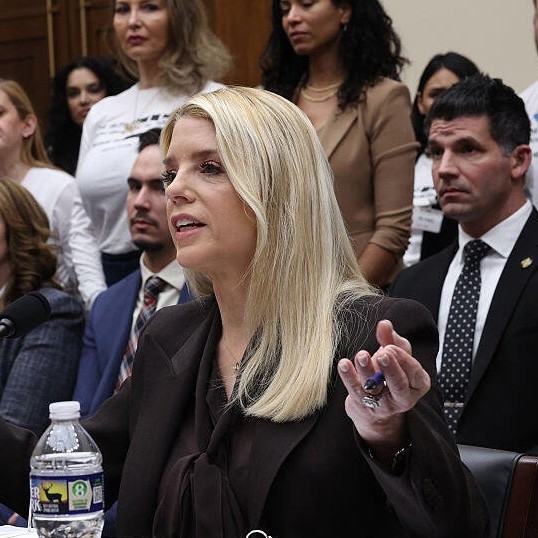
Pam Bondi walked into a House hearing to defend the Justice Department’s handling of the Jeffrey Epstein files. Then cameras caught what looked like a different kind of record in her hands, one that did not come from Epstein at all.
What You Should Know
During a House Judiciary Committee hearing, Attorney General Pam Bondi appeared to hold a document labeled as Rep. Pramila Jayapal’s search history for Epstein-related files. Jayapal and Rep. Jamie Raskin called it improper surveillance and urged an Inspector General review.
The core fight is simple, and it is messy. Congress says it is trying to review sensitive Epstein materials and the DOJ’s redactions. Democrats now claim the DOJ is tracking lawmakers’ activity in a way that looks less like security and more like intimidation.
The Paper That Started the Fight
In images from the hearing, Bondi is seen holding a paper labeled “Jayapal Pramila Search History,” a reference to Rep. Pramila Jayapal, a Washington Democrat. According to CBS News, the list appeared to include multiple Epstein-related files, with file numbers and short descriptions.
Jayapal’s allegation is not that the DOJ had Epstein documents. It is that the DOJ had her trail through them.
In a statement to CBS News, Jayapal said, “It is totally inappropriate and against the separations of powers for the DOJ to surveil us as we search the Epstein files.”
She went further, describing Bondi’s binder as a kind of political prop. “Bondi showed up today with a burn book that held a printed search history of exactly what emails I searched,” Jayapal said. “That is outrageous and I intend to pursue this and stop this spying on members.”
The photo evidence matters here because it turns an abstract complaint into something tangible. This was not a vague suspicion about monitoring. It was a piece of paper with a label, in the attorney general’s hands, in the hearing room.
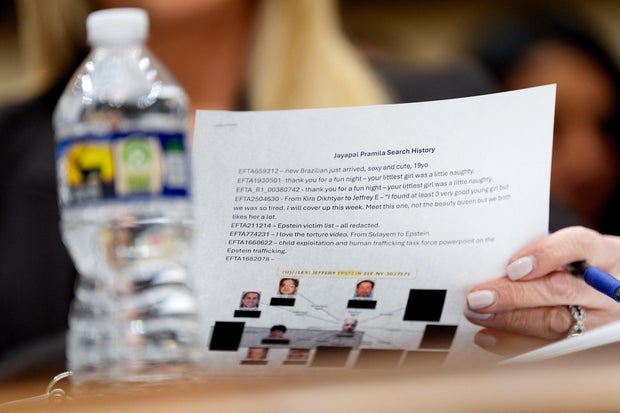
Reuters photojournalist Kent Nishimura captured the moment, and the label is legible in published images.
Audit Log or Political Receipt?
There is a basic technical explanation for how a list like this could exist, and it does not require cinematic spying. Databases commonly log user activity, especially in restricted systems. If the DOJ set up a controlled environment for members of Congress to view unredacted material, it could have ordinary audit logs showing what was accessed.
However, the political question is why such a log, if it was a log, was printed, labeled with a member’s name, and brought into a public hearing as Bondi faced questions about her department’s decisions.
That is where the power dynamic snaps into focus. Congress is supposed to oversee the executive branch. The DOJ, in Jayapal’s telling, is keeping tabs on Congress’s oversight, then waving the receipts when the oversight gets uncomfortable.
CBS News reported that it was not clear how the list was compiled. The DOJ did not immediately provide a public explanation for what the document was, how it was generated, or why it was in the hearing room.
Redactions, Survivor Privacy, and a File Pulled Back
The hearing itself was already charged because it centered on how the DOJ has handled Epstein-related records, including the redactions used to protect survivors and sensitive information.
According to CBS News, the DOJ recently made millions of records public with redactions, drawing criticism from some lawmakers who argued the blackouts were excessive. Jayapal, during the hearing, pointed to documents she said illustrated problems in the redaction process.
One flashpoint, as described by CBS News, involved an email exchange between Epstein and a high-profile Emirati sultan, with an email address blacked out. Another involved an email with the subject line “Epstein victim list” that, according to CBS News, named dozens of people with few redactions. CBS News reported that this file was later removed from the DOJ’s public database.
Jayapal pressed Bondi to apologize to survivors for what she described as a failure to shield personal information, and she asked survivors in the room to raise their hands if they had not met with the DOJ, according to CBS News.
Bondi’s response was not to concede an error. Instead, she aimed her fire at her predecessor. CBS News reported Bondi criticized former Attorney General Merrick Garland and said, “I’m not going to get in the gutter for her theatrics.”
That line, delivered as survivors were present and lawmakers argued over privacy, is part of what makes this fight bigger than a binder. Democrats are framing the department as both sloppy with sensitive data and combative with the people tasked with reviewing it.
Four Computers, No Phones, and a Question of Control
Jayapal is not alone in questioning how the DOJ structured lawmakers’ access to the unredacted database. Rep. Suhas Subramanyam, a Virginia Democrat, described a setup that sounds like a security lockdown, with just enough inconvenience to raise eyebrows.
According to CBS News, Subramanyam said the department “set up four computers in a really tiny room” and created “a unique log-in and password for each one of us.” He also said lawmakers could not bring phones into the room and could only take written notes in a standalone notepad.
Then came the line that explains why the search history sheet landed like a grenade. “They were trying to make it as hard as possible for us to connect dots,” Subramanyam told streaming host Aaron Parnas, according to CBS News.
From the DOJ’s perspective, strict controls can be justified by the sensitivity of unredacted files, especially where survivors’ identities and private details may appear. From the Democrats’ perspective, the controls look like friction by design, and the alleged tracking looks like leverage.
Raskin Calls It Orwellian, and the IG Door Swings Open
Democrats did not keep the dispute at the level of rhetorical outrage. They moved to formal escalation.
Rep. Jamie Raskin, the top Democrat on the House Judiciary Committee, said he would ask the DOJ’s Inspector General to investigate what he called an “outrageous abuse of power,” according to CBS News.
On the record with reporters, Raskin added, “This is just getting Orwellian with these people.” He followed with a blunt warning: “They better cut it out immediately, now that they’ve been caught.”
The Inspector General angle matters because it is one of the few pathways that can compel answers without relying on the DOJ to police itself in public. If an IG inquiry advances, the questions get more precise: Was member activity logged? Who had access to those logs? Were they printed? Who authorized bringing them to a hearing? Were they used for security, briefing prep, political theater, or something else?
Jayapal’s office, according to CBS News, said she is organizing a letter seeking to investigate what she alleges is improper surveillance of lawmakers.
What to Watch Next
The immediate next step is whether the DOJ offers a clear explanation for the “search history” sheet. The department could argue that it is standard auditing for a restricted database. Democrats are signaling they will not accept a generic answer, especially if the document was used to counter-question a member during oversight.
Meanwhile, the broader Epstein files battle keeps boiling. Lawmakers want fewer redactions. Survivors and privacy advocates want careful protection. The DOJ, caught between transparency demands and legal obligations, is now also battling a new accusation: that it is monitoring the monitors.
In Washington, that is never just a process dispute. It is a control dispute. And the paper in Bondi’s hand turned it into a headline.