

Everyone walked into the hearing expecting a fight over paper. They got a fight over power, control, and who gets protected when the Epstein name lands on a federal document.
What You Should Know
Attorney General Pam Bondi faced pointed House Judiciary Committee questions about the DOJ’s handling of Epstein-related documents, including redactions and survivor privacy. Democrats accused the department of shielding names, while Bondi declined to answer many specifics, and Republicans defended DOJ priorities.
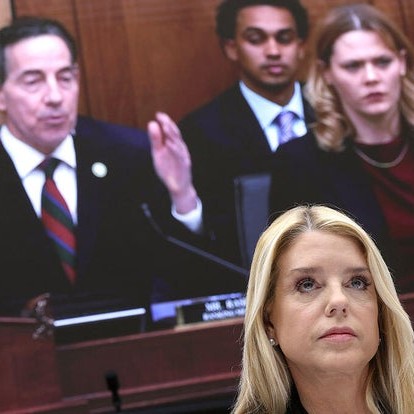
Attorney General Pam Bondi took heat at a House Judiciary Committee hearing over how the Justice Department has handled Epstein-related records, with Democrats framing the redactions as selective protection for the connected and Republicans framing the whole clash as political theater.
CBS News, reporting the hearing in live updates dated February 11th, 2026, described a tense exchange in which Democrats pressed Bondi on redactions and process, and Bondi mostly refused to engage on the details. The flashpoint was not just whether the government should release more material. It was who got exposed when the government did.
That is where the hearing got sharp. Democrats argued the department redacted too much when it came to people whose names appeared in documents, but failed to safeguard survivors from being identified in public proceedings. Bondi pushed back on multiple fronts, including by challenging lawmakers’ premises and declining to provide straightforward yes-or-no answers, according to CBS.
The Redaction Fight Was Not Just About Black Ink
On paper, the dispute sounds technical. Redactions happen. Agencies make calls. Lawyers argue about what the public can see.
In practice, redactions are a form of control. They decide which names get a protective fog and which names get blasted into a permanent record. That is why this subject keeps getting dragged back into the spotlight. Epstein is not just a criminal case in the public imagination. It is a map of proximity to wealth, access, and status.
Democrats used the hearing to argue that the DOJ was protecting the wrong people. They accused Bondi of orchestrating a cover-up by redacting identities tied to Epstein documents, CBS reported. Bondi rejected the premise and characterized the questioning as theatrics. CBS also reported that she referred to the hearing itself as a circus.
The hearing’s structure mattered, too. CBS reported that several Republicans ceded their time to Bondi so she could answer Democrats’ criticism at length. That is not a neutral procedural choice. In a made-for-TV oversight session, time is the currency. Handing it over is a message about whose narrative gets oxygen.
Survivors in the Room, and the Privacy Problem
The most combustible detail in the CBS account was not a partisan exchange. It was the allegation that survivors’ names were not adequately protected in the hearing environment, even as other names were being shielded through redactions.
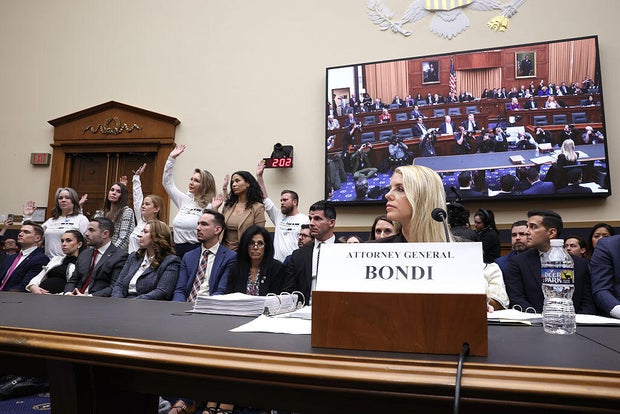
If that happened, it would land in a sensitive legal and ethical zone that exists regardless of the party.
In federal court filings, privacy protection is not optional window dressing. Federal Rule of Criminal Procedure 49.1 sets out privacy protections in filings, including limits on certain personal identifiers. The rule is designed to reduce harm from unnecessary exposure in public records, a point that becomes especially relevant when proceedings, transcripts, and exhibits spread far beyond the courtroom.
Separately, federal law recognizes specific rights for crime victims. The Crime Victims’ Rights Act, codified at 18 U.S.C. Section 3771, includes a right for victims to be treated with fairness and respect for dignity and privacy. Those words get argued over in practice, but the direction is clear: public processes are not supposed to casually grind victims into the gears.
That is why the privacy allegation carries stakes beyond the day’s sound bites. It is one thing for lawmakers to weaponize a notorious case for political advantage. It is another for survivors to become collateral damage in a public clash over transparency.
CBS reported that the hearing also touched on how survivors were treated and how redactions were applied across different documents. That matters because selective redaction can look like a pattern even when it is justified by narrow legal categories. It also matters because inconsistent privacy protection is one of the easiest ways for public institutions to lose trust fast.
Bondi’s Strategy Was Process, Not Answers
CBS described Bondi as repeatedly sidestepping questions and giving nonresponsive answers, including by answering questions with questions. That approach can be frustrating to lawmakers, but it is a recognizable legal and political strategy.
It keeps officials from getting pinned to an absolute statement that can be replayed later, compared against a document dump, or tested against a future disclosure. It also shifts the battleground from facts to framing. Instead of debating what the department did and why, the argument becomes whether the questioner is acting in good faith.
From a power standpoint, that is the point. If you cannot win the details, you try to win the legitimacy of the conversation itself.
Bondi’s dismissal of the questioning as performance, as CBS reported, also served a secondary purpose. It signaled to allies that she would not validate the premise that the department was on the defensive. The message was that DOJ was the institution being attacked, not the institution that owed an explanation.
Democrats, meanwhile, tried to lock the hearing onto a single track: redactions, names, and whether DOJ was protecting the well-connected. If the public hears the phrase cover-up often enough, the department’s motives become the story, even if the underlying redactions are defensible.
That is the contradiction at the heart of this kind of hearing. Oversight is supposed to produce clarity. A hearing like this can produce the opposite, an even thicker fog, because both sides treat ambiguity as a weapon.
Republicans Made It About Crime and Immigration
CBS reported that some Republicans used their time to praise the administration’s crackdown on crime and illegal immigration. That pivot tells you what kind of hearing this was becoming.
Instead of treating the Epstein-related questions as a narrow accountability issue, the defense broadened it into an argument about the DOJ’s overall mission. If DOJ is framed as effective and tough, then attacks on its document handling can be portrayed as distractions.
It is a classic committee-room move. When the core allegation is uncomfortable, widen the lens. Debate the department, not the document.
That also set up a neat asymmetry. Democrats were pressing on specifics, like who was redacted and why. Republicans were praising broad priorities, like enforcement posture. One side was demanding receipts. The other side was selling a brand.
Bondi benefited from that split. The less time spent on particulars, the less risk of being forced into a concrete commitment about what will be released, what will stay sealed, and who is making the calls.
What Happens Next Is a Paper Trail, Not a Mic Drop
The immediate consequence of a hearing like this is not one viral exchange. It is what gets demanded next.
If Democrats believe redactions were used to shield powerful figures, they are likely to keep pushing for document production, unredacted review in secure settings, or written explanations of redaction criteria. If Republicans believe the hearing was a partisan trap, they are likely to keep re-centering DOJ on crime and immigration and treating Epstein-related oversight as a sideshow.
For DOJ, the risk is not just political. It is institutional. If the department is perceived as inconsistent, redacting aggressively in one direction while failing to protect survivors in another, it can lose credibility with both transparency advocates and victim-rights advocates at the same time.
And for anyone watching the Epstein saga as a proxy for elite accountability, this hearing reinforced a blunt reality. The government can release pages. The fight is over what the pages mean, who gets named, and who pays the price for the naming.