

First, the feds surged into Minneapolis. Then a U.S. citizen ended up dead. Now, according to CBS News, the Border Patrol commander overseeing the operation is expected to pull some of his people out.
That is the public posture, anyway. The harder question is what the pullback actually means when the political players are trying to look coordinated, the street is still boiling, and two Americans have been killed by federal forces in the same city in the same month.
A Federal Pullback, but No Clean Exit
CBS News reported on January 26, 2026, that U.S. Border Patrol commander Gregory Bovino and some of his agents were expected to soon leave the Minneapolis area, citing two sources familiar with the move.
On paper, that sounds like a de-escalation. In practice, it reads like a tactical retreat after a political mess.
The same CBS report says President Trump and Minnesota Gov. Tim Walz both described themselves as working together to scale back the surge in federal immigration enforcement in Minnesota. That kind of joint messaging is rare in this era, which is precisely why it matters. When political rivals suddenly sound like partners, it usually means the downside risk has gotten too big to carry alone.
Minneapolis Mayor Jacob Frey, per CBS, also spoke with Trump and relayed the president’s position in a sentence that leaves little wiggle room: the president agrees “that the present situation cannot continue.”
Those are not the words of an administration bragging about a hardline crackdown. They are the words of officials looking for an off-ramp.
The Killing That Changed the Math
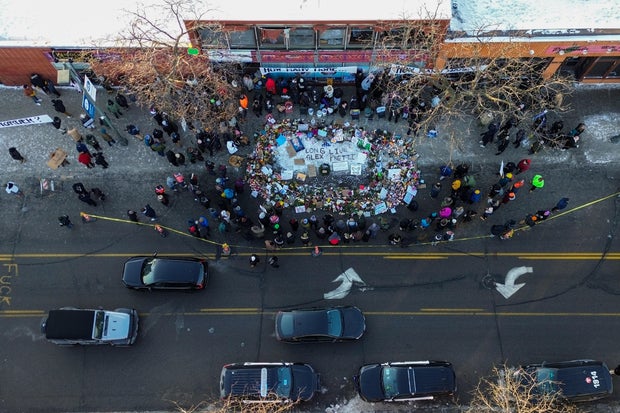
The pressure point is the fatal shooting of Alex Pretti, an ICU nurse who worked at the Minneapolis VA hospital, according to CBS News. CBS reported that Pretti was killed by a Border Patrol agent on Saturday morning.
That detail alone would be combustible. But CBS also reported something even more politically dangerous: Pretti was the second U.S. citizen killed by federal forces in Minneapolis in January, following the shooting of Renee Good.
Two citizens dead in one month is not just a tragedy. It is a governance problem. It forces every public official in the chain, federal, state, and city, to answer the same question: Who is in charge, and what rules are they using?
And it forces a second question that tends to drive investigations, lawsuits, and resignations: What evidence exists that can settle disputes about what happened in the moment?
Body Cameras, and the Fight Over What the Public Sees
CBS reported that two U.S. officials said some of the Border Patrol agents involved in the fatal shooting had body cameras.
That one line changes the entire power dynamic. With body-worn video, this becomes less about competing narratives and more about who controls the release, the timeline, and the interpretation.
For city leaders, quick disclosure can calm a crowd or inflame it, depending on what the footage shows. For federal leadership, release can mean accountability or exposure. For lawyers, it is potential evidence. For the public, it is a test of whether the government is serious about transparency or just serious about managing headlines.
Even the phrasing matters. CBS reported that some agents had cameras. That implies some did not. If multiple agents were present, the gaps become a story of their own. What was recorded, what was not, and why?
Lawful Gun Owner, No Record, Still Dead
CBS News also reported that Minnesota officials described Pretti as a lawful gun owner with a permit to carry, and said he had no criminal record.
That set of facts undercuts an easy justification some officials might reach for in a crisis. It also creates a problem for anyone trying to frame the killing as a clean, simple story where the victim was obviously dangerous or obviously out of bounds.
None of that proves what happened in the seconds before the shooting. But it raises the stakes on the fundamental question of policy and training. If the federal government brings immigration enforcement into a major American city during a surge, what are the engagement rules when agents encounter armed citizens who are, on paper, acting within state law?
And if state and city officials are now publicly negotiating a drawdown, how much of that decision is about actual strategy, and how much is about the political cost of another funeral?
The Politics: Trump, Walz, and a Mayor Trying to Stop the Bleeding
The most interesting part of the CBS reporting might be the choreography.
Trump and Walz both said they are working together to scale down the surge. Frey said he spoke to Trump. A Border Patrol commander is expected to leave with some agents. In the background, activists are calling for a “National Shutdown” on Friday to protest U.S. Immigration and Customs Enforcement, according to CBS.
That is three separate arenas, federal enforcement, state-level political management, and street-level protest pressure, converging at once.
When that happens, officials tend to prioritize control of the next 72 hours over control of the broader narrative. It becomes less about who is right and more about who can prevent the next flashpoint.
There is also an uncomfortable contradiction sitting in plain sight. A surge of federal immigration enforcement signals toughness and authority. A rapid public push to scale it down signals concern about consequences. Officials can call it coordination. Critics will call it a scramble.
What People Are Really Fighting Over
This is not only a dispute about a single shooting. It is a fight over jurisdiction, legitimacy, and accountability.
At the center is federal power operating inside a city that did not ask to become the stage for a national immigration confrontation. When that power produces lethal outcomes involving U.S. citizens, it forces the question of whether the operation was efficiently scoped, adequately supervised, and properly constrained.
It also forces political leaders to pick between two bad options:
- Defend the surge and risk owning the consequences if more violence occurs.
- Scale it back and risk looking like the federal government lost control of its own operation.
The CBS reporting suggests leaders are trying to choose a third path: scale down while insisting it is mutual, orderly, and still consistent with broader enforcement goals.
What to Watch Next
The next phase will likely hinge on three tangible questions, not slogans:
- Body camera disclosure: Will any footage be released, by whom, and on what timeline?
- Command accountability: If leadership is rotating out, is it routine or a response to the shooting and protests?
- Operational changes: What does “scaling down” mean in numbers and tactics, and how quickly do residents feel it?
For now, CBS reports a drawdown is coming. But Minneapolis is still stuck with the central contradiction: a federal surge that projected control, followed by a political sprint to contain the fallout after a U.S. citizen was killed.