

Washington just handed international adoption families a familiar kind of answer. Not yes, not no, but maybe, if you ask nicely, and if the right person stamps the right form.
President Trump’s latest travel ban expansion and a sweeping immigrant-visa freeze left hundreds of American families in limbo, not because their adoptions were rejected, but because the government did not build in a blanket exception for adoption visas this time. After days of pressure from advocacy groups and bipartisan lawmakers, the State Department circulated guidance saying adoptive children may qualify for a National Interest Exception on a case-by-case basis.
For families who have already burned years and savings on paperwork, court steps, and overseas logistics, the new posture turns one of the final steps, the visa, into another discretionary gate.
A Policy That Says ‘High Priority’ While Hitting Pause
According to CBS News, the State Department’s guidance says children being adopted by U.S. citizens may qualify for an exception under the National Interest Exception, and requests will be considered “on a priority basis.” The document also states, “Intercountry adoption remains a high priority for the administration, and adoption-related visas will continue to be processed as expeditiously as possible.”
That language is doing two jobs at once. It reassures families that adoption is still a priority, and it also keeps the administration’s hands free. A categorical exemption is a rule. A case-by-case exception is leverage.
Adoption groups and lawmakers are not asking for rhetorical support. They are asking for a line in the policy that prevents families from having to plead for an exception in the first place.
What Changed From Earlier Restrictions
The friction point is not whether intercountry adoption exists. It is how it moves through the U.S. visa system, and how quickly that system can freeze when immigration policy gets rewritten for other fights.
CBS News reported that Mr. Trump expanded his travel ban in December, barring or heavily restricting travel to the U.S. from 39 countries. A month later, the administration indefinitely froze immigrant visas for nationals of 75 countries, including Somalia, Yemen, and Jamaica, arguing that nationals from those countries are deemed likely to rely on public assistance.
In prior rounds of restrictions, adoption-related visas were often carved out explicitly, allowing children to travel to the U.S. to join their adoptive families. This time, CBS reported, the superseding travel ban and visa freeze did not include blanket exceptions for adoption-related visas, including IR-3, IR-4, IH-3, and IH-4.
The practical consequence is simple. Families can have an approved adoption path and still get stuck at the border of bureaucracy, waiting for an exception that is not guaranteed, and that cannot be planned around.
The Quiet Number Behind the Politics
The National Council for Adoption estimates the latest restrictions are halting the cases of more than 1,000 children in over 40 countries, according to CBS News. That estimate has become the pressure point for advocates, because it reframes the fight from abstract immigration policy to a very specific population: children already matched to American parents, already in process, already in line.
The administration has not publicly explained why the categorical adoption exemption disappeared when the new restrictions were issued, CBS reported. In the vacuum, families have been left to interpret policy through rumors, rushed calls to agencies, and whatever guidance can be obtained.
The update from the State Department is a step toward clarity, but it is not the clarity families are asking for. A family cannot budget a case-by-case exception. They cannot schedule travel on a maybe. They cannot reassure a child with a policy that changes depending on which consular office is handling the file.
A Bipartisan Letter, and a Clock That Does Not Stop
The pushback is not coming from one party. CBS News reported that the co-chairs of the Congressional Coalition on Adoption Caucus, Republican Sen. Kevin Cramer, Democratic Sen. Amy Klobuchar, Republican Rep. Robert Aderholt, and Democratic Rep. Danny Davis, wrote to Secretary of State Marco Rubio and Assistant Secretary of State Mora Namdar requesting immediate guidance and permanent visa exemptions for adoptions.
The letter drew a direct contrast between the earlier policy and the newer order. “In June 2025, the administration placed travel restrictions on several countries with explicit exemptions for adoption visas,” the lawmakers wrote. “On December 16, 2025, a new order was issued, superseding the previous directive and no longer including these exceptions for adoption visas.”
That is the contradiction families keep pointing to. If adoption is a “high priority,” why does it need a workaround?
And there is another tension inside the government’s own rationale. The administration’s visa freeze was tied, at least in part, to a claim about the likelihood of relying on public assistance. Adoption visas, by design, are not a back door into benefits. They are tied to vetted processes and to American citizens who are already accepting legal responsibility for a child.
Meet the Snyders, and the Part Nobody Budgeted For
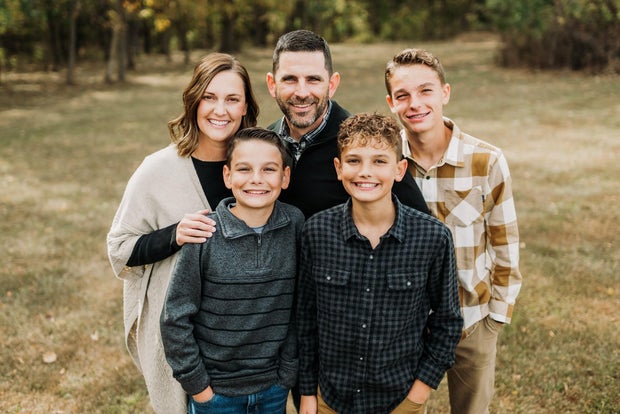
Caption: Heidi and Kenton Snyder with their three boys. The Snyders are in the process of adopting a girl from Côte d’Ivoire in West Africa. (Haylie Ogalat Photography and the Snyder family)
Kenton and Heidi Snyder of Illinois have spent years inside the adoption maze. CBS News reported they previously tried to bring home a child they were matched with in China, only to be derailed by pandemic-era disruptions and later changes to adoption pathways. In 2024, they began the process to adopt a now-3-year-old girl from Cote d’Ivoire, hoping to finally move from paperwork to parenting. They’ve named her Eden.
Heidi Snyder told CBS News that when they heard about the visa suspensions, they assumed adoption would be spared. “We heard about it, but we both kind of blew it off and said, ‘Well, that won’t apply to adoptions,'” she said. “We just couldn’t believe that it would.”
Then they learned Cote d’Ivoire is among the countries affected by the visa suspensions, CBS reported.
Heidi Snyder described what came next in human terms, not political ones. “That brought a whole tornado of emotions,” she said, adding that they still hoped it was an oversight because, in her words, “the administration has always been very supportive of foster care and adoption.”
The State Department’s updated guidance gave the family a reason to breathe, even if it did not guarantee an outcome. Kenton Snyder told CBS News it was a “huge relief,” but he also described being “a little bit hesitant,” and “not wanting to speculate too much on what it is and what it is not.”
Heidi Snyder was more explicit about what families want written down. “I think if there is one thing that we could ask for, we would love for there to be a categorical exemption listed on the proclamation so that there is no doubt,” she said. “The adoption visas should not be included or bundled with all of these other visa bans or pauses.”
Why the Visa Codes Matter
To outsiders, IR-3, IR-4, IH-3, and IH-4 look like alphabet soup. To families, those letters are the last mile.
According to U.S. Citizenship and Immigration Services, intercountry adoption is governed by specific immigration pathways and eligibility requirements. These are not casual tourist approvals. They are structured categories tied to an adoption process that already requires extensive documentation, screening, and legal steps.
The State Department, which plays a central role in intercountry adoption cases abroad, describes intercountry adoption as a process that intersects with foreign legal systems, U.S. immigration requirements, and consular processing. That intersection is where policy shocks land the hardest. A single proclamation can turn a scheduled appointment into an indefinite delay.
The Real Fight: Discretion vs. Guarantee
The administration’s guidance leans on discretion. Families and adoption advocates want a guarantee. That gap is the story.
A case-by-case exception can move fast for families with the right help, the right timing, or the right member of Congress making calls. It can also move slowly, or not at all, for families without those advantages. That is why advocates are pushing for a categorical exemption that does not depend on who gets heard.
Meanwhile, the administration can point to the National Interest Exception mechanism as proof that it is not slamming the door. Critics can point to the lack of a blanket adoption carve-out as proof that the door is still under guard.
The next pressure point is whether the administration rewrites the policy to make the exemption automatic, or whether it keeps adoptions inside the same discretionary channel as other exceptions. For families already matched to children abroad, the practical question is even narrower: When will the consular appointment actually happen, and will the visa actually print?