

The FBI showed up at a Georgia elections hub with a warrant, and suddenly, the quiet part of election politics got loud again. What, exactly, is the federal government trying to collect, and who gets to say no?
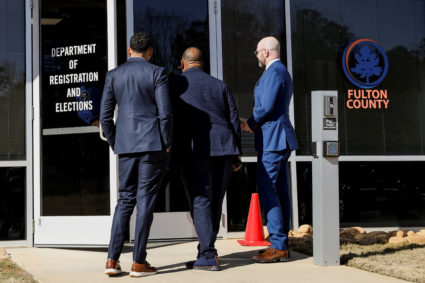
According to PBS NewsHour, federal agents searched the Fulton County Election Hub and Operation Center as part of a 2020 election-related investigation. The timing matters. The raid landed as the Trump administration is also requesting voter data from states, forcing officials who run elections to navigate two pressures at once: cooperate with federal law enforcement, and protect voter information from becoming political fuel.
A Raid, a Warrant, and a Message
PBS NewsHour described the search as a court-authorized action at the Fulton County elections center tied to records from the 2020 election. Fulton County, home to Atlanta, has been a recurring pressure point since 2020, partly because it sits at the intersection of high turnout, close margins, and relentless scrutiny from national politicians.
In the PBS transcript excerpts, the action is described as a “court-authorized law enforcement action.” That phrase does a lot of work. It signals this is not a casual records request. It is the federal government saying it has enough basis to ask a judge for authority, and enough urgency to execute it.
What were agents looking for? PBS reports the requested materials included “ballots, envelopes, provisional ballots, ballot images, and voter rolls.” That list is not rhetorical. It is the mechanics of an election, in physical and digital form.
- Ballots and envelopes: The core paper trail and chain-of-custody questions.
- Provisional ballots: A category that often triggers fights over eligibility and processing rules.
- Ballot images: Digital records that can become central in audits and recount disputes.
- Voter rolls: The most politically combustible dataset of all.
The Other Fight: Washington Wants Data
The search in Georgia did not happen in a vacuum. PBS tied the raid to a broader push: the Trump administration requesting voter data from states. That puts secretaries of state and local election administrators in a bind. They do not just answer to federal agencies. They answer to state law, state constitutions, and a public that has watched voter information become a weapon in narrative wars.
Voter data is not one thing. Some portions are public by design because elections require transparency and verifiable registration systems. Other portions, depending on the state, can include sensitive identifiers and protected information, particularly for voters with safety concerns.
Even when a request is lawful, the politics around it can still be explosive. A federal investigation looks like accountability to one audience, and intimidation to another. A federal data request looks like modernization to some, and a nationalized voter file to others. The same action can be read as security or control, depending on who is holding the megaphone.
2 Secretaries of State, 2 Parties, 1 Shared Problem
PBS NewsHour brought in two officials who live inside the machinery of elections: Democratic Maine Secretary of State Shenna Bellows and Republican Kentucky Secretary of State Michael Adams.
The pairing is the point. Election administration is often presented as red vs. blue. But secretaries of state, regardless of party, are typically protective of their lane. They run statewide systems, manage vendor contracts, oversee county offices, and deal with lawsuits when rules get contested. A federal request for data, especially one tied to a national political brand, is not just an administrative question. It is a jurisdictional test.
According to PBS, the discussion focused on election security and data privacy, and how states are handling Justice Department requests while protecting voter information. That phrasing matters. It frames the current moment as a balancing act, not a clean yes-or-no standoff.
Still, the pressure is obvious. When Washington asks, the headline writes itself. When Washington raids, the headline writes itself in all caps.
What Makes Voter Rolls So Dangerous in the Wrong Hands?
Voter rolls are essential for running an election. They are also uniquely capable of being misread, misused, or sensationalized.
A mismatch in a database can be routine. A change of address can look suspicious to outsiders who do not know how list maintenance works. A clerical error can be framed as a conspiracy. A legitimate provisional ballot can be sold as a smoking gun. When the political incentive is to cast doubt, ordinary administrative noise gets promoted as evidence.
And when the incentive is the opposite, officials can be tempted to offer broad reassurance without detailing the messy reality of how elections get administered. That is the contradiction voters keep getting served: elections are either totally rigged or perfectly frictionless, depending on who is talking.
PBS explicitly described the 2020 voter fraud claims as baseless. The raid and the data push land on top of years of claims and counterclaims, with state officials now being asked to operate in a climate where every spreadsheet can become a viral exhibit.
Law Enforcement vs. Election Administration
Here is the line that keeps getting blurred: a criminal investigation is not the same thing as a policy review, and a policy review is not the same thing as election administration.
If the FBI has a warrant, that suggests a judge found a legal basis to authorize a search. But a warrant does not, by itself, answer the political question the public will ask next: why now, and to what end?
Meanwhile, a Justice Department request for data can exist for multiple reasons, including oversight, enforcement of federal voting law, or investigative support. But in a country where election fights routinely turn into loyalty tests, intent gets assumed long before facts get published.
State officials are left defending two principles that can collide in public perception:
- Cooperation with legitimate investigations.
- Protection of voters and the integrity of state-run systems.
That collision is the story. Not just the raid, and not just the request, but the attempt to pull election authority closer to Washington while states insist they are the firewall.
What to Watch Next
In the near term, the most important details are likely to be procedural, not theatrical. What was seized, what was copied, and what was requested, and under what authority? How do Fulton County and Georgia state officials describe their cooperation? Do states publicly disclose the scope of federal voter data requests, or do they fight them in quiet legal channels?
The second question is political. If the administration is building a broader strategy around voter data, states will need to decide whether they treat this like routine federal-state coordination or an escalation that demands pushback.
And then there is the trust problem. A raid can produce evidence. It can also produce a new wave of suspicion, regardless of what evidence shows. The more elections become a battlefield for power, the more every investigative step becomes part of the campaign itself.