The most revealing part of the Liam Conejo Ramos case might not be the photo that raced across the internet. It might be the fact that, after a five-year-old ended up in an ICE facility in Texas, the government and the community in Minnesota are still arguing over a basic question. Who, exactly, was the target?
Because a federal judge ordered Liam and his father released, and they are back in Minnesota. But the fight over the narrative is only getting louder, with the Department of Homeland Security pushing one version, neighbors and school officials pushing another, and a paper trail that now includes a blistering judge’s order.
Liam, 5, and his father, Adrian Conejo Arias, were detained in a Minneapolis suburb on January 20, 2026, then taken to a detention facility in Dilley, Texas, according to reporting distributed by The Associated Press and published by PBS NewsHour. On February 1, 2026, Texas Rep. Joaquin Castro said the two had returned home to Minnesota.
A Release Order, Then a PR War
On paper, this is a clean ending. The boy and his father were detained, a judge intervened, and they were released.
In practice, it is a collision between enforcement power and public perception, with both sides staking out claims that cannot both be true in the way they are being presented.
Liam Conejo Ramos, 5, and his father were held in the South Texas Family Residential Center in Dilley. They were released Saturday by order of a federal judge. https://t.co/laAdIOeTM4 pic.twitter.com/PzhAnG1HaV
— Houston Chronicle (@HoustonChron) February 2, 2026
In a statement, DHS Assistant Secretary Tricia McLaughlin said ICE did not target or arrest Liam, and she offered a justification that flips the moral weight back onto the family. McLaughlin said Liam’s mother refused to take him after his father’s apprehension, and that his father wanted the child to stay with him.
“The Trump administration is committed to restoring the rule of law and common sense to our immigration system, and will continue to fight for the arrest, detention, and removal of aliens who have no right to be in this country,” McLaughlin said.
That is the government’s frame. Liam was not the focus. Liam was, in their telling, an unavoidable byproduct of an adult enforcement action.
The community’s frame is the opposite. Neighbors and school officials said federal officers used the preschooler as “bait” by telling him to knock on the door so his mother would answer. DHS called that description “an abject lie,” and said the father fled on foot and left Liam in a running vehicle in the driveway.
The stakes are not rhetorical. They are legal, political, and operational. If a child was used as leverage, that is a story about tactics. If the child was not used as leverage, it is a story about what happens when a parent is detained, and a child is present. Both are ugly, but only one suggests intent.
The Judge Who Put the Word ‘Traumatizing’ on the Record
The government is not just battling neighbors. It is battling the language of a federal order.
U.S. District Judge Fred Biery granted the release and did not do it quietly. He framed the case as a symptom of a larger push, and he made clear he thought the push was distorting judgment.
“The case has its genesis in the ill-conceived and incompetently-implemented government pursuit of daily deportation quotas, apparently even if it requires traumatizing children,” Biery wrote.
🚨Minnesota ICE Raid#ICE detained 5‑yo Liam Conejo Ramos (from John A Johnson Elementary) & his dad Adrian Conejo Arias in Columbia Heights/North Minneapolis, flew them to Dilley
Judge Biery ordered release, condemning quota-driven raids & child trauma#AO26 #Minnesota #paobc pic.twitter.com/IuM1RjSIyr
— The Wonk (@thewonkin) February 1, 2026
That sentence matters because it does two things at once. It names an alleged motive, quotas, and it names an alleged cost, a child being traumatized. It also makes the case harder to spin as a routine enforcement action that accidentally went viral.
The order also created a pressure point for DHS. If the government’s version is that Liam was not targeted, the judge’s language invites a follow-up: why did the situation escalate to the point that a federal judge is writing about children and quotas in the same breath?
The Father, the Asylum Claim, and the Missing Hearing
DHS said the government believes Conejo Arias entered the U.S. illegally from Ecuador in December 2024. The family’s lawyer, according to the same AP reporting, said Conejo Arias has an asylum claim pending that allows him to remain in the United States while it is adjudicated.
Here is where the bureaucracy gets interesting. The Justice Department’s Executive Office for Immigration Review, which runs the immigration court system, shows case information through its online portal. AP reported that the online court docket showed no future hearings for Conejo Arias at the time.
That detail is not a verdict on the merits of any claim, but it is a window into the machinery. Immigration enforcement is often sold as a clean chain. Arrest, detain, hear the case, remove. In reality, it is a maze with backlogs, shifting priorities, and administrative dead ends.
TRAC, the Transactional Records Access Clearinghouse at Syracuse University, has documented the scale of immigration court backlogs and the uneven outcomes asylum seekers can face depending on nationality, court, and judge. In the AP reporting, TRAC data were cited showing Ecuadorians have fared poorly in immigration court in recent years.
If enforcement is speedy, and courts are slow, detention becomes the bridge. That is why a five-year-old in Dilley became a symbol. Not because the public suddenly learned detention exists, but because the public saw the cost of detention in a child’s face.
The Photos That Made This Case Unavoidable
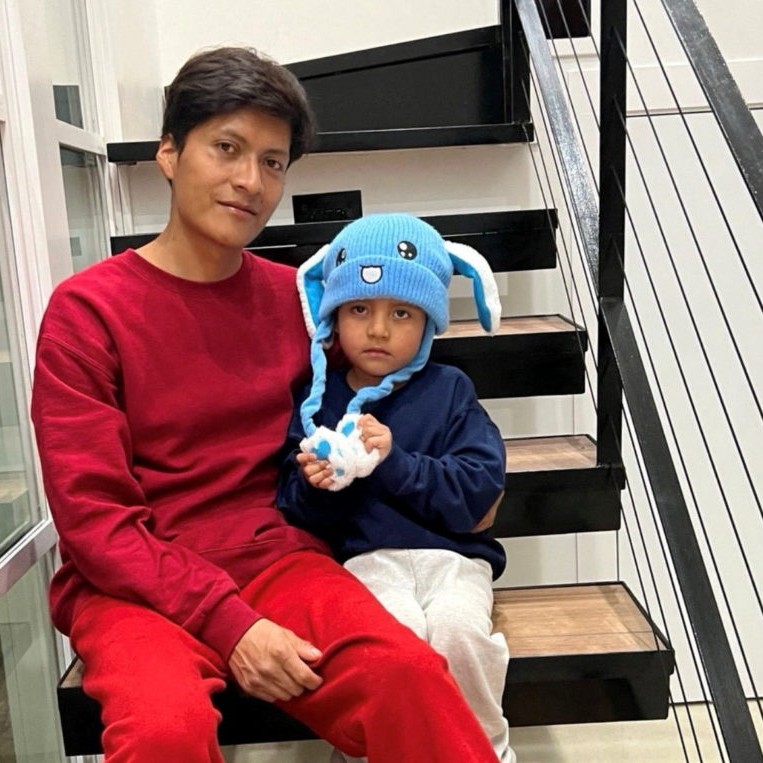
Images of Liam wearing a blue bunny hat and carrying a Spider-Man backpack circulated widely, according to AP, and helped drive attention to the case. Those visuals became the community’s evidence that whatever happened in the driveway, the outcome was a child in custody.
Calling all artists: Draw something that would make Liam feel happy & loved and submit to https://t.co/NgIostaKEV using #Comics4Liam
Liam Conejo Ramos, 5, taken by ICE in MN. He and his dad were just released from a detention camp in Dilley, TX.https://t.co/jolPZhoQ2l pic.twitter.com/KxxNvOHINY
— Hae-Lin Choi 최혜린 (@HaelinChoi) February 2, 2026
When outrage is fueled by imagery, officials tend to argue process. When outrage is fueled by process, officials tend to argue outcomes. In this case, DHS leaned on process. Liam was not targeted, they say. He was not arrested, they say. The problem is that the photo, to many viewers, looks like the opposite of that distinction.
That contradiction is why the release does not close the story. It opens a new chapter about accountability and tactics, and about what the government thinks it can do without losing the narrative.
Columbia Heights Celebrated, Then Pointed to the Next Names
On February 1, 2026, residents in Columbia Heights gathered outside the house where Liam was detained to celebrate his release and to draw attention to others still in ICE custody, AP reported.
Lourdes Sanchez, the owner of a cleaning business, told AP the moment hit home because her son is the same age and has the same name.
“We cried so much when we heard that he was coming back,” Sanchez said.
Nearby, Luis Zuna held photographs of his 10-year-old daughter, Elizabeth, and said she and her mother, Rosa, had been detained while driving to school on January 6, 2026, and remained in custody at the Dilley Immigration Processing Center, according to AP.
That is the part officials do not control. One highly visible case becomes a flashlight. It does not just light up that one situation. It sweeps across a community and finds other families who say they are living versions of the same story, only without the viral photo.
A Congressman, a Letter, and a Political Line in the Sand
Castro, who said he escorted Liam and his father home, wrote a letter to Liam on the flight back to Minnesota, according to AP. The letter, later shared on social media, leaned into the case’s symbolism and pushed directly against the idea that the child is an outsider.
“Don’t let anyone tell you this isn’t your home,” Castro wrote.
Other Minnesota Democrats amplified the same point. Sen. Amy Klobuchar said in a social media post that the boy “should be in school and with family, not in detention,” according to AP. Rep. Ilhan Omar posted a photo welcoming Liam home.
It is also a reminder of the power dynamics here. DHS gets the badges, the vehicles, and the detention network. Members of Congress get visibility, letters, and cameras. The courts get the final word, at least on release. Families get whatever the system leaves them.
What to Watch Next
The immediate question is what comes next for Conejo Arias. Release does not necessarily mean the case disappears. It means the terms change, and the spotlight remains.
The broader question is whether this case becomes a template, either for reformers trying to curb aggressive tactics or for officials trying to draw a line between “targeting” a child and ending up with a child in custody anyway.
Either way, the contradictions are now part of the record: DHS says no child was targeted. Neighbors and school officials say the child was used to draw out a parent. A federal judge wrote that deportation quotas, as he described them, were being pursued “even if it requires traumatizing children.”
The government won the power to act. The community won the power to be seen. The courts, for now, are the referee.