

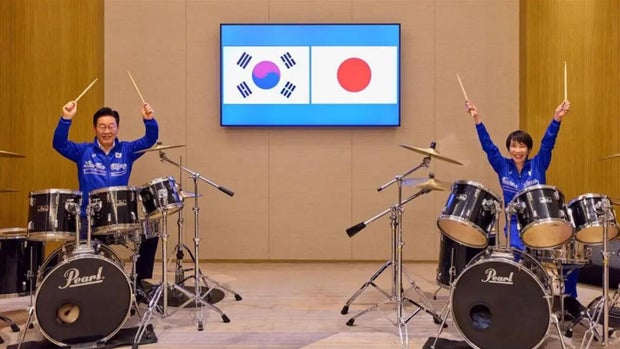
The summit photo-op was supposed to be handshakes and talking points. Instead, Japan’s prime minister and South Korea’s president sat shoulder to shoulder behind a drum kit and played K-pop. The obvious question is the one their teams want you asking: was this just a viral moment, or a deliberately staged signal that Tokyo and Seoul are trying to lock in a new rhythm?
According to CBS News, Japanese Prime Minister Sanae Takaichi and South Korean President Lee Jae-myung capped their meeting in Nara with a surprise drum-set duet to pop tracks including BTS’ “Dynamite.” The performance, posted to the official Instagram account of Japan’s prime minister’s office, arrived wrapped in a clear message from both leaders: cooperation, continuity, and more direct leader-to-leader contact.
The Scene in Nara That Governments Usually Avoid
The drumming followed a summit in Nara, the ancient Japanese capital and also Takaichi’s hometown, CBS reported. That location matters. Leaders do not casually invite counterparts into a home-based setting unless they want to telegraph comfort, control, and personal investment.
In the video clip highlighted by CBS News, the two leaders wore personalized athletic jackets, sat side by side, and played along to K-pop hits. The post was shared through the official Instagram account of Takaichi’s office. (Receipt: the Instagram reel is publicly viewable at https://www.instagram.com/kantei/reel/DTd-yx8keDz/.)
It was also, by the account of both sides, not Lee’s idea. CBS reported it was arranged as a surprise by Takaichi, described as a longtime heavy metal fan and former college drummer. In other words, this was a curated contrast: a conservative Japanese leader with metal credentials choosing Korean pop as the bridge music for a rival-turned-partner next door.
What Lee and Takaichi Said Publicly, and Why It Reads Like Strategy
Leaders can do a goofy cultural moment and still be deadly intentional about the caption. Lee posted on X: “Playing the drums has been my longtime dream,” thanking Takaichi for arranging the session, CBS reported.
He went further, tying the jam to national policy in a way politicians rarely do unless they want the clip to travel: “Like we respected our differences and harmonized our rhythms, I hope that Korea and Japan would deepen cooperation and move closer to each other step by step,” Lee wrote, adding that he was “a little clumsy,” according to CBS.
Takaichi’s version of the origin story positioned her as the host who listened and delivered. “When we met at APEC last year, [Lee] said it was his dream to play the drums, so we prepared a surprise,” she wrote later in a social media post, CBS reported.
Then came the line aimed less at fans and more at bureaucracies that worry about momentum disappearing after the cameras go away. In a message on X, Takaichi said: “In order to develop Japan-South Korea relations in a forward-looking way and stably, we will continue our close communication between the two governments, including by proactively carrying out our shuttle diplomacy,” according to CBS.
The Real Backstory: Two Allies With Old Wounds and New Threats
Japan and South Korea have maintained relations for decades, but the relationship has never been simple. CBS noted lingering animosity connected to Japan’s actions as a former imperial power, plus ongoing territorial disputes. Those issues do not vanish because a video went viral.
That is why the drumming clip functions as more than a novelty. It is a public attempt to normalize closeness, especially at a time when both countries are leaning on shared security and economic priorities with the United States.
CBS reported that South Korea and Japan are important U.S. allies for defense and economic purposes. Both host major U.S. military bases and troop deployments, and both have pledged to work closely with Washington to balance China’s growing influence and to counter regional threats from North Korea. CBS also pointed to Beijing’s determination to take control of Taiwan as part of the larger strategic picture.
Those are hard, expensive realities. They also help explain why leaders might choose a low-stakes, high-shareability gesture that can sell “getting along” to domestic audiences that sometimes prefer fighting to compromise.
Soft Power With Receipts: The Instagram Post and the X Statements
This was not a rumor leaking from a friendly aide. It was posted by official channels, then reinforced by direct statements on X from the leaders themselves, as CBS reported. In diplomatic terms, that is a decision to place the moment on the record and attach names to it.
The CBS report also described how some social media users in both countries responded warmly to the clip. That reaction matters because Seoul-Tokyo cooperation often gets tangled up in domestic politics, where opponents can attack outreach as weakness or betrayal. A light cultural exchange can give officials cover to say, in effect, this is normal, even popular.
There is also a subtle layering here. Takaichi is described by CBS as a conservative politician with a reputation that includes being a motorcycle enthusiast and heavy metal fan. Pairing that persona with a K-pop playlist is a calculated contrast that signals flexibility without requiring either side to concede anything substantive on history disputes in the same breath.
What to Watch Next: Will the ‘Shuttle Diplomacy’ Match the Soundtrack?
For all the attention on the drumsticks, the measurable test is in what comes next. Takaichi’s reference to “shuttle diplomacy,” as quoted by CBS, is a promise of frequent top-level engagement, the kind that can produce real coordination on security, trade, and regional crisis response.
But the same underlying landmines remain: historical grievances, territorial disputes, and the domestic politics that can turn any diplomatic overture into a campaign weapon. A shared beat does not automatically equal shared policy.
Still, both leaders chose to put a public symbol of harmony into circulation and to frame it as intentional. Lee called it a dream fulfilled. Takaichi called it a planned surprise rooted in their prior meeting. In diplomacy, that combination is not accidental. It is a signal, and the next round of concrete cooperation will show whether it was also a commitment.