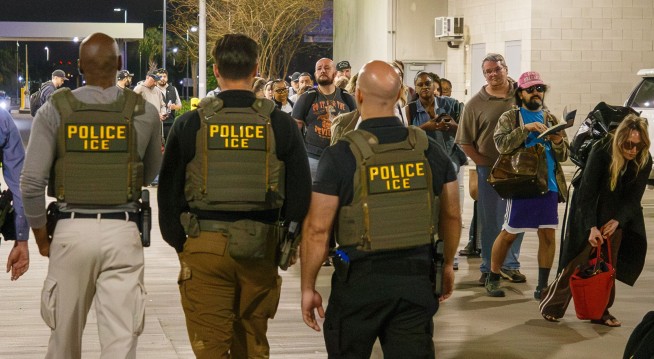
Hundreds of ICE agents showed up at major airports, and the White House sold it as help for strained TSA checkpoints. The catch is buried in the fine print of who is trained to do what, and what happens when a security fix doubles as a political message.
What You Should Know
On March 23rd, 2026, the Trump administration deployed ICE agents to more than a dozen U.S. airports to assist TSA amid shutdown-related staffing shortages. A former acting ICE director said ICE cannot replace TSA screening functions.
The move hit airports in New York, Chicago, Houston, and Atlanta, according to PBS NewsHour.
It also landed right in the overlap of two hot zones for this administration: airport delays and immigration enforcement.
Why ICE at the Airport Gate Is a Power Move
TSA is the face at the checkpoint, but it is not the only badge in the building. By inserting ICE into the passenger flow, the administration effectively expands the visible footprint of immigration enforcement into a space most travelers associate with routine screening rather than deportation work.
That matters because airports are not just infrastructure. They are live television for government competence, and long lines turn into blame fast when shutdown politics squeeze federal staffing.
What ICE Can and Cannot Do at TSA Checkpoints
PBS NewsHour interviewed John Sandweg, a former acting ICE director under President Obama, who argued the plan runs into a basic operational wall: TSA screening is specialized, and ICE agents are not trained to perform core checkpoint tasks.
Sandweg put it bluntly: “There are real limitations on what those ICE agents can do.” In the same conversation, he described TSA work as highly skilled, including duties such as running X-ray screenings and conducting pat-down searches.
That leaves ICE in supporting roles, at least as described by Sandweg, such as added presence and perimeter security. It is helpful of a kind, but it is not the kind that magically turns non-screeners into screeners when lines are backed up.
The Optics vs. Outcomes Problem, and the Next Test
Officially, the justification is staffing pressure and airport throughput. Unofficially, the deployment risks looking like a workaround that spotlights toughness while side-stepping the harder question of how TSA staffing gets stabilized if shutdown conditions persist.
There is also a chain-of-command tension. TSA and ICE are under the Department of Homeland Security, but they serve different missions. Mixing missions in a high-friction public setting creates room for confusion over roles, traveler expectations, and what enforcement looks like at the point of entry to a domestic flight.
What to watch next is simple: whether TSA wait times materially change, and whether DHS clarifies, in writing, the exact duties ICE personnel are authorized to perform in and around checkpoints. If the lines stay, the administration owns the optics and the outcome.