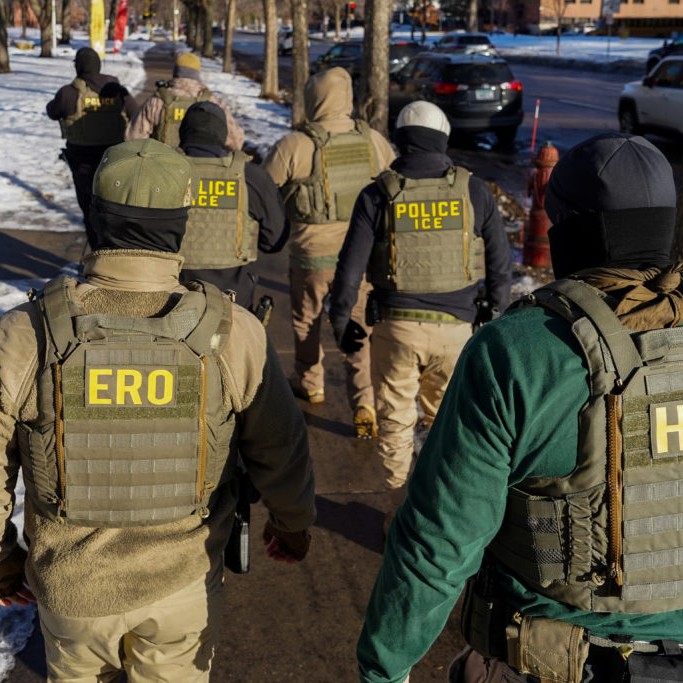
First, the government said a federal officer was ambushed. Then, a judge wiped the charges off the board for good. Now, ICE is saying video evidence suggests two officers may have lied under oath, and the scramble has moved from the defendants to the agents.
What You Should Know
ICE Director Todd Lyons said a joint ICE and DOJ probe is examining whether two officers made untruthful statements under oath tied to a Minneapolis shooting. A federal judge dismissed charges against two Venezuelan men with prejudice, meaning prosecutors cannot refile the case.
The case centers on Julio Cesar Sosa-Celis, a Venezuelan man shot in the leg during an encounter with U.S. Immigration and Customs Enforcement officers in Minneapolis, and Alfredo Alejandro Aljorna, another Venezuelan man who was also charged. The government had accused them of assaulting an officer. Court action and ICE’s own words now point the spotlight in the opposite direction.
That reversal is the story’s engine: a public-facing narrative about violent attackers and a defensive shot, followed by a quiet but devastating concession that key sworn testimony may not hold up against video. In federal court, that is not a messaging problem. It is an exposure problem.
A Case That Went From Accusations to a Locked-In Dismissal
According to reporting published by PBS NewsHour, federal authorities opened a criminal probe into whether two immigration officers lied under oath about the shooting. Lyons said ICE opened a joint investigation with the DOJ after video evidence revealed that “sworn testimony provided by two separate officers appears to have made untruthful statements.”
At roughly the same moment, the prosecution’s case against Sosa-Celis and Aljorna collapsed in a way defendants rarely get to see. U.S. District Court Judge Paul A. Magnuson dismissed the charges with prejudice. That phrase matters. It means the charges cannot be refiled.
In an unusual motion to dismiss dated February 13th, 2026, U.S. Attorney for the District of Minnesota Daniel N. Rosen said “newly discovered evidence” was “materially inconsistent with the allegations” in the criminal complaint and what was presented at a prior hearing. Rosen did not, at least publicly, spell out the evidence in detail. He did not have to. The dismissal with prejudice is the loud part.
For Aljorna and Sosa-Celis, the practical stakes were not theoretical. Their lawyer said a conviction could have meant years in federal prison, before any immigration consequences even came into play.
The Government’s Story Met Video, Eyewitnesses, and a Judge
The original allegations, as described in the reporting, leaned heavily on an officer’s account: ICE officers attempted a traffic stop in Minneapolis on January 14th, 2026. Aljorna crashed and fled, an officer chased him, and the situation escalated into a struggle outside an apartment duplex. The complaint alleged the officer was attacked with a snow shovel and a broom handle. During the confrontation, the officer fired, striking Sosa-Celis in the right thigh.
But by January 21st, 2026, the government’s version was already under pressure in court. The officer’s account differed significantly from the testimony given by the two defendants and three eyewitnesses, according to the same reporting. The claim that the officer was assaulted with a broom and a snow shovel was also not corroborated by available video evidence.
That is the pivot point: When prosecutors build a case around an officer’s narrative, video can either reinforce it or detonate it. Here, it appears to have done the latter, at least enough for prosecutors to seek dismissal and for ICE leadership to publicly raise the possibility of untruthful sworn statements.
Noem Went Big, and the Paper Trail Went Another Direction
After the shooting, Homeland Security Secretary Kristi Noem went on offense against Minnesota’s Democratic leadership. In a statement dated January 15th, 2026, she accused Gov. Tim Walz and Minneapolis Mayor Jacob Frey of “encouraging impeding and assault against our law enforcement, which is a federal crime, a felony.”
Noem framed the incident as a near-assassination attempt, saying, “What we saw last night in Minneapolis was an attempted murder of federal law enforcement.” She also said, “Our officer was ambushed and attacked by three individuals who beat him with snow shovels and the handles of brooms. Fearing for his life, the officer fired a defensive shot.”
That is a maximal description, and it has maximal consequences. When a Cabinet secretary publicly alleges an “attempted murder” and an “ambush,” the political machine does what political machines do. It rallies allies, pressures critics, and dares institutions to contradict it.
But courts do not run on dare-based messaging. If video evidence and sworn testimony cannot be reconciled, the rhetoric becomes a boomerang. The reporting said the Department of Homeland Security did not respond to questions about whether Noem stood by her statement.
ICE Is Now Talking About Perjury and Jobs on the Line
Lyons, ICE’s director, did not sugarcoat the stakes. “Lying under oath is a serious federal offense,” he said, adding that the U.S. Attorney’s Office was actively investigating.
He also said the officers, who were not named, were placed on administrative leave pending the completion of an internal investigation. When the director of a federal law enforcement agency publicly raises the possibility of untruthful sworn testimony, it signals more than internal discipline. It signals institutional risk management, the kind that kicks in when leadership fears the record may not survive outside review.
Lyons said the officers could face termination, and they could face potential criminal prosecution. That is an unusually direct set of outcomes for a case that, weeks earlier, was focused on the alleged crimes of two immigrants.
The Defense Says the Case Was Built on a Single Agent
The defense’s argument, as reflected in the reporting, is blunt: the prosecution’s story leaned on the testimony of the agent who fired the gun. Attorney Brian D. Clark, representing Aljorna and Sosa-Celis, said, “The charges against them were based on lies by an ICE agent who recklessly shot into their home through a closed door.” He added, “They are so happy justice is being served.”
Other defense attorneys offered details that aim directly at the credibility fight. One lawyer said Aljorna had a broomstick and threw it while running. Another said Sosa-Celis had been holding a shovel but was retreating into the home when the officer fired.
Even those versions do not automatically resolve the core question of what force was justified. They do something else: they set up a contrast between what officials publicly described and what witnesses and video reportedly indicate.
The Third Man, the Witness Problem, and the Deportation Shadow
The reporting also describes a third Venezuelan man, Gabriel Alejandro Hernandez Ledezma, who lived in the downstairs unit and was arrested. Though not federally charged, a court petition dated January 30th, 2026, seeking his release alleged he was detained without a warrant and flown to an ICE detention facility in Texas within hours.
The petition alleged his removal was meant to prevent him from becoming a material eyewitness who could undercut the federal case and complicate a Minnesota state investigation. Hernandez Ledezma was later returned to Minnesota and discharged from ICE custody after a federal judge ordered his release, according to the reporting.
That part of the story sits at the intersection of enforcement power and litigation strategy. Immigration authority can move people quickly. Criminal cases move slower. When those timelines collide, the question becomes whose process wins, and whether critical testimony survives long enough to matter.
One unresolved pressure point remains: deportation. The reporting said it was unclear whether Aljorna and Sosa-Celis could still be deported, even with federal criminal charges dismissed with prejudice. That is another power dynamic baked into the case. A courtroom win does not always end the government’s leverage.
What Happens Next, and What to Watch
There are now at least three lanes moving at once: the DOJ-linked criminal probe referenced by Lyons, ICE’s internal investigation, and a separate Minnesota state criminal investigation mentioned in court filings. The reporting said the FBI had refused to share evidence, provide the name of the ICE officer, or make him available for an interview in connection with the state probe.
If investigators conclude sworn statements were knowingly false, the consequences can extend beyond employment. Federal perjury and false-statement statutes exist precisely because sworn testimony is not supposed to be negotiable. The practical question is whether this case becomes an example or whether it becomes another file that closes quietly after the headlines fade.
Either way, the record has already been rewritten by outcomes, not commentary: charges dismissed with prejudice, officers placed on leave, and ICE leadership acknowledging that video evidence appears to clash with sworn testimony.