

Jeffrey Epstein did not just want lawyers. He wanted language.
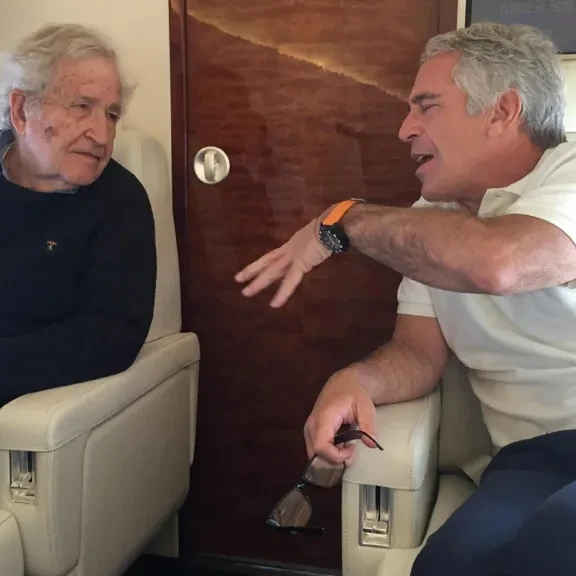
Newly released files from the US government’s investigation into Epstein include a February 2019 email in which the disgraced financier asked linguist Noam Chomsky for advice on managing what Epstein called his “putrid” media coverage. The question is simple, and the stakes are not: Do you fight the press, or starve it?
The reply, which appears in the documents as coming from an account labeled as Chomsky, picks a side. Ignore it. And it does so while lamenting “the horrible way” Epstein was being treated and arguing that public debate had turned into “hysteria” over abuse allegations, according to the BBC.
If the emails are authentic, they read like a private strategy session between a globally famous public intellectual and a man facing allegations that would soon land him in federal custody. If they are not, the question becomes why a document dump would show a Chomsky-labeled account talking like this at all.
Either way, the tension is unavoidable: Epstein is asking for reputation triage, and the answer, in writing, sounds less like disgust and more like media coaching.
The Ask: Op-Ed, Defense, or Silence?
The February 2019 exchange lands in a very specific moment. Epstein was already infamous, but the drumbeat was getting louder again as investigative reporting revisited the 2008 deal that had allowed him to avoid federal prosecution. That renewed scrutiny, first driven hard by the Miami Herald, was colliding with a broader cultural shift in how institutions, media outlets, and the public talked about sexual abuse and power.
In the email quoted by the BBC, Epstein writes: “Noam. I’d love your advice on how I handle my putrid press,” adding that it was “spiralling out of control”.
He workshop-tests options like a man trying to pick the least-bad door.
“Do I have someone write an op ed?” he asks. “Defend myself? Or try to ignore. Realizing that mobs are dangerous.”
The reply attributed to Chomsky does not advise a counterpunch. It warns that responding gives critics oxygen.
“What the vultures dearly want is public response, which then provides a public opening for an onslaught of venomous attacks, many from just publicity seekers or cranks of all sorts.”
Then comes the line that will follow this release anywhere it goes: “That’s particularly true now with the hysteria that has developed about abuse of women,” the email continues, “which has reached the point that even questioning a charge is a crime worse than murder,” according to the BBC.
That framing does two things at once. It paints Epstein as a target of irrational group behavior, and it treats the subject of abuse allegations as a public overreaction problem, not a credibility problem for the accused.
Chomsky’s Public Line vs. the Paper Trail
Chomsky is not a minor name who accidentally wandered into a rich man’s orbit. He is one of the most cited intellectuals alive, a figure with a decades-long record of criticizing state power, propaganda, and elite impunity. Epstein, by contrast, is now a shorthand for elite protection networks, private jets, and gatekeepers who kept showing up anyway.
The BBC reports it contacted Chomsky’s wife, Valeria Chomsky, who serves as his spokesperson, for comment.
What makes the document release especially combustible is that Chomsky has previously used a different posture when pressed about Epstein. In a 2023 interview with The Wall Street Journal, Chomsky described questions about the relationship as outside the public’s right to know.
“First response is that it is none of your business. Or anyone’s. Second is that I knew him, and we met occasionally.”
That quote, also cited by the BBC, is the kind of rhetorical shut door that can work when the record stays fuzzy. The files, by their nature, are the opposite of fuzzy. They are receipts, and receipts do not care about tone.
There is another key qualifier, and it matters. The BBC describes the response as a message that “appears to be from Chomsky” and notes it came from an account labeled as his in the documents. That is careful language, and it is doing real work, because it separates what the files show from what can be definitively proven about who typed what.
But even with that caution, the practical impact is the same: the advice is now part of the public record, attached to a name that carries global weight.
When Reputation Management Meets Money Management
The emails in the latest release do not just show Epstein chasing narrative control. They also show him positioned as a financial counselor to the Chomskys, according to the BBC’s reporting on the documents.
One message, dated September 2017 and attributed to an email address identified as Valeria Chomsky, asks Epstein for input about a letter to their children regarding finances. “N wants to send the letter below to his children,” the email says, according to the BBC. Then it goes further: “Suggestions? Something to add?”
The closing line is the kind of trust statement that is hard to square with the public mythology of Epstein as a man everyone was wary of.
“Feel free to suggest. We trust you,” the email concluded, according to the BBC.
That detail reshapes the power dynamic. Epstein is not merely a notorious person, an intellectual bumped into at a dinner. He is, per the documents described by the BBC, someone the family turned to for guidance about finances and communication, the intimate mechanics of control and perception inside a household.
In elite circles, that is often how influence works. Not by a dramatic ask, but by routine consulting, the drip of small favors that turn into a relationship others are expected to accept.
The Bigger Pattern: Epstein’s Rolodex, Then and Now
Epstein’s network has been litigated in public for years, and it rarely resolves cleanly. Some people insist they barely knew him. Others say they were helping with philanthropy, introductions, travel, or money. Document releases tend to do what rumors cannot: they put names, dates, and wording next to each other and let outsiders evaluate the gap between the story told and the story written down.
The BBC notes that correspondence between Epstein and Chomsky has appeared in previous releases, including messages over the years and invitations from Epstein to stay at his homes. The latest tranche adds a new dimension: explicit coaching on media response to sex trafficking-related coverage, and language that reads like a critique of the cultural climate around accusations.
That is why this release draws attention beyond academia. It is not just about who met whom. It is about who treated Epstein as a person worth advising, and what assumptions were baked into that advice.
What Happens Next, and Why It Matters
Epstein was arrested on federal sex trafficking charges in July 2019. He died in a New York jail cell in August 2019 while awaiting trial, a death that has fueled years of speculation and official scrutiny, and that closed off the possibility of a courtroom airing of his full contact list under oath.
So the remaining battleground is paper, not testimony. Every new file release becomes its own miniature trial, conducted by readers, institutions, donors, and critics.
For Chomsky, the consequence is not criminal exposure. It is reputational gravity. Universities, publishers, and event organizers do not need a court verdict to make decisions about invitations, honors, and platforms. They react to perceived proximity, and the documents, as reported by the BBC, tighten that proximity into readable dialogue.
For the broader public, the issue is consistency. Epstein is routinely described, after the fact, as a man everybody understood was toxic. Yet these emails depict him as someone a world-famous critic of power was willing to counsel, and someone a family, per the files described by the BBC, felt comfortable telling, “We trust you.”
That is not a punchline. It is a reminder that elite insulation is often built from ordinary-seeming interactions, written down, then forgotten until a document dump forces them back into the light.
References