Fulton County is not just asking for its boxes back. It is asking a federal court to tell the FBI, clearly and on the record, what exactly it is doing with a local election’s paper trail, and why.
That is a risky fight for any county to pick with the federal government. It gets riskier when the county is Fulton, the political punching bag of the 2020 election, and the president is Donald Trump, who is again publicly flirting with the idea of the federal government taking control of elections from Democratic-run places.
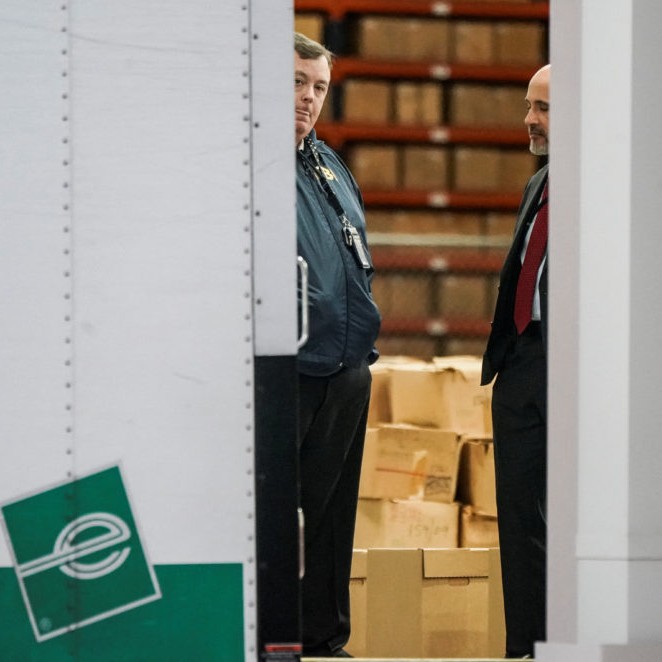
In a motion described by county officials as an urgent defense of election administration, Fulton County said it has asked a federal court to order the FBI to return ballots and other 2020 election records seized during a search of a warehouse near Atlanta. According to The Associated Press, the seizure involved hundreds of boxes of ballots and documents.
Fulton County officials say they were not told why the federal government wanted the materials. They are also asking the court to unseal the sworn statement from a law enforcement agent used to obtain the search warrant, a request that would drag the rationale into daylight.
A County Chairman Puts the Stakes on the Table
Fulton County Chairman Robb Pitts did not frame the dispute as a paperwork misunderstanding. He framed it as a test case.
“This case is not only about Fulton County,” Pitts said. “This is about elections across Georgia and across the nation.”
That is a deliberate escalation. The county is linking a specific seizure to a broader set of fears about federal pressure on elections, with midterm races approaching. According to The Associated Press, county officials referenced Trump’s recent public remarks about targeting Democratic-controlled areas and pushing for a takeover of election administration.
Trump has insisted, again, that states are effectively “agents of the federal government” when they count votes and that, if they cannot do it “legally and honestly,” “somebody else should take over.” That is an argument that collides with how election administration is structured in the United States, where states run elections under constitutional authority, and Congress can set certain rules for federal contests.
That collision is the story. Fulton County is a local government trying to keep custody of the raw material of democracy. Trump is a president who has repeatedly described certain local election systems as corrupt, while audits, investigations, and court rulings after 2020 rejected claims of widespread fraud in the Georgia results.
What the FBI Took, and What Fulton County Wants to See
The warrant cover sheet provided to the county listed specific items agents were seeking related to the 2020 general election, including ballots, tabulator tapes from scanners, electronic ballot images, and voter rolls, according to The Associated Press.
The county says the FBI drove away with hundreds of boxes of ballots and other documents. The county’s motion asks for the return of those materials and, crucially, asks the court to unseal the affidavit supporting the warrant.
The Justice Department declined to comment to The Associated Press on the county’s motion.
Pitts, meanwhile, offered a calm-sounding challenge that doubles as a dare.
“What they’re doing with the ballots that they have now, we don’t know, but if they’re counted fairly and honestly, the results will be the same,” Pitts said.
It is a tight message for a county official: you can take the ballots, but you cannot change what they say.
The Fulton County Problem, Trump Edition
Fulton County has been a fixation point for Trump and his allies since he narrowly lost Georgia to Democrat Joe Biden in 2020. The political logic is obvious. Georgia was close. Fulton is large, heavily Democratic, and home to Atlanta, which makes it a convenient stand-in for every insinuation about big-city election management.
The county, for its part, says it has run elections repeatedly since 2020 without issues. According to The Associated Press, Pitts said Fulton County has conducted 17 elections since 2020 “without any issues.”
The contradiction now is not subtle. Trump publicly argues that certain jurisdictions cannot be trusted to count votes. Fulton County is responding by pointing to routine elections completed since 2020 and by asking why federal agents are removing and keeping the original records at all.
If Fulton County wins, it forces a public explanation for a high-profile federal action. If it loses, it sets a precedent that local election records can be scooped up and held, even as public confidence hangs on transparency and the chain of custody.
Enter Tulsi Gabbard, and a New Question: Why Was She There?
The presence of Director of National Intelligence Tulsi Gabbard at the Fulton County search added a second storyline to the first, and it is the one that makes Washington look over its shoulder.
According to The Associated Press, Democrats in Congress questioned the propriety of Gabbard’s presence because the search was a law enforcement action, not an intelligence operation.
In a letter to top Democrats on the House and Senate Intelligence committees, Gabbard said Trump asked her to be there “under my broad statutory authority to coordinate, integrate, and analyze intelligence related to election security,” The Associated Press reported.
That line matters because it tries to move the seizure into a different category. If the administration can frame an election-record action as an intelligence-adjacent mission, it broadens the political cover for federal involvement and blurs the boundary between criminal process and election oversight.
Fulton County is not just asking for ballots. It is asking for the sworn statement behind the warrant, which would help answer whether this was a narrow evidence-gathering mission or something designed to be felt by every Democratic-run election office watching the midterms.
Trump’s Takeover Talk Meets the Constitution
Trump’s comments about “take over” were also met with distancing, including from Republicans who backed tougher voting rules but did not embrace a federal grab for election administration. According to The Associated Press, Sen. Thom Tillis, a North Carolina Republican, said he supported the SAVE Act but not Trump’s desire for a federal takeover, adding, “Nationalizing elections and picking 15 states seems a little off strategy.”
The White House has said Trump’s remarks referred to the SAVE Act, legislation Republicans have sought to advance that would tighten proof of citizenship requirements for voting in federal elections. That explanation is politically useful, but it does not erase what Trump said publicly about targeted places and takeover authority.
There is also a hard legal reality sitting underneath the messaging war. The Constitution gives states the power to run elections, while Congress can regulate certain aspects of federal elections. That split is why election battles in America are so often fought in state capitols, county offices, and courts, and why federal actions that touch ballots themselves ignite alarms.
Fulton County is betting that a judge will treat those ballots as what they are: official government records that belong in the custody of the election authority, absent a clear, articulated reason to seize and hold them.
Why This Fight Is Bigger Than One Warehouse
On paper, this is a fight about boxes, tapes, images, and rolls. In real life, it is a fight about leverage.
The federal government can seize records. It can also refuse to explain itself in the moment. Local election offices, even large ones, operate on a different clock. They face statutory retention rules, public records pressure, recount demands, and constant political suspicion. If the original ballots are gone, officials cannot simply print new ones.
That is why Fulton County’s demand to unseal the affidavit is more than curiosity. It is a play for narrative control. If the FBI’s rationale is strong and narrow, unsealing helps legitimize the seizure. If it is broad, thin, or politically combustible, unsealing is exactly what the county wants before the next election season turns every administrative question into a conspiracy rumor.
Democrats, including Sen. Mark Warner of Virginia, have also voiced anxiety about what a president can do when he signals he is willing to push past norms. According to The Associated Press, Warner said that while he once doubted Trump would intervene in the midterms, “the notional idea that he will ask his loyalists to do something inappropriate, beyond the Constitution, scares the heck out of me.”
The White House, according to The Associated Press, has scoffed at such fears and noted Trump did not intervene in the 2025 off-year elections despite predictions he would.
That is the tightrope. Critics point to the rhetoric and the federal actions. The administration points to restraint in other moments. Fulton County is trying to force the debate out of vibes and into documents.
What to Watch Next
Two things will determine whether this story fades into procedural noise or turns into a national election flashpoint.
First, whether a judge orders the return of the ballots and records, and on what timeline. Election offices live in deadlines, and midterm planning does not wait for litigation to wrap up neatly.
Second, whether the court unseals the affidavit behind the search warrant. If the affidavit remains sealed, both sides will keep filling the vacuum with their own version of events. If it is unsealed, the public gets a look at what federal agents told a judge, under oath, to justify taking custody of a county’s election history.
Fulton County has made its position plain. It is not acting like a defendant trying to keep secrets. It is acting like an election authority trying to keep control of the evidence that lets it say, with credibility, that the count was the count.