The card is small. The message is not.
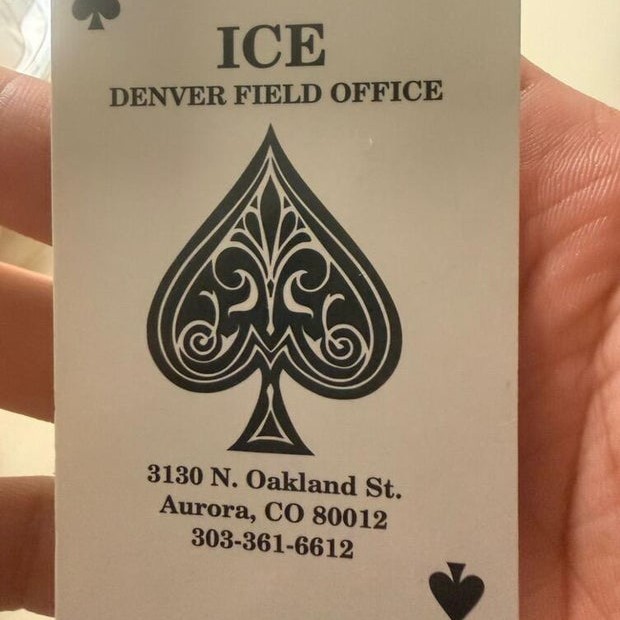
An ace of spades, branded with the ICE Denver Field Office and the contact information for the ICE detention facility in Aurora, reportedly showed up in vehicles after people were detained in Colorado. Family members later found the cards. Then came a second allegation that hits a different nerve: that immigration agents used unmarked vehicles with sirens to conduct fake traffic stops to make arrests.
Colorado Democrats are now treating both claims as a test of federal power, and of whether Immigration and Customs Enforcement can run aggressive operations while still keeping the public’s trust. ICE says it is investigating and condemns the card incident. On the traffic-stop allegation, lawmakers say they are still waiting for answers.
A Calling Card With a Paper Trail
According to CBS News Colorado, the ace-of-spades cards, described by lawmakers and advocates as “death cards,” were left in January in the vehicles of some people detained in Eagle County. The cards were later found by family members of those detained, according to the report.
The design detail that escalated this from rumor to political problem is the branding. The cards, CBS reported, feature an ace of spades with the ICE Denver Field Office name and the address and phone number of the ICE detention facility in Aurora.
That makes the key question less about whether a card exists and more about who authorized it, who printed it, and who thought it was acceptable to place it where families would eventually discover it.
ICE Condemns the Cards, Then the Spotlight Shifts
ICE did not defend the cards. In a statement cited by CBS News Colorado, the agency said it is looking into what happened and tried to draw a hard line between official policy and whatever this was.
“ICE is investigating this situation, but unequivocally condemns this type of action and/or officer conduct. Once notified, ICE supervisors acted swiftly to address the issue.”
That is the agency’s posture on the symbol. The politics heated up because Colorado’s delegation paired the card episode with an allegation about tactics, and tactics are where oversight fights tend to end up.
The Other Allegation: Sirens, Unmarked Cars, and ‘Fake’ Stops
Colorado’s Democratic senators, John Hickenlooper and Michael Bennet, and representatives, Diana DeGette, Joe Neguse, Jason Crow, and Brittany Pettersen, sent a letter to the secretary of the Department of Homeland Security, Kristi Noem, calling for answers, CBS News Colorado reported.
In that letter, the lawmakers called the symbol intimidation, not just bad taste.
“It is unacceptable and dangerous for federal law enforcement to use this symbol to intimidate Latino communities,” the lawmakers wrote. “This behavior undermines public trust in law enforcement, raises civil rights concerns, and falls far short of the professional standards expected of federal agents.”
Then they widened the aperture. The lawmakers said they were alarmed by what the immigration advocacy group Voces Unidas told CBS Colorado: that ICE agents imitated local law enforcement by using unmarked vehicles with sirens to carry out fake traffic stops in order to detain people.
They did not frame it as a branding problem. They framed it as misconduct with consequences for anyone on the road who thinks a siren means they are legally required to pull over.
“We are deeply concerned by the allegations that the federal agents were utilizing sirens to falsely act as local law enforcement. This behavior leads individuals to believe they are lawfully required to pull over for a traffic violation when, in reality, the federal government has no authority over local or state traffic regulations. Federal agents acting in disguise as local law enforcement is misconduct and should be treated as such,” the lawmakers said.
CBS News Colorado reported it contacted both ICE and DHS for a response about the alleged fake traffic stops and did not receive one at the time of publication.
Why the Ace of Spades Lands Different
Symbols are not neutral, especially when they show up at the exact moment a family is trying to figure out where a loved one went, what rights they have, and whether anyone will pick up the phone. CBS News Colorado also noted historians have tied the ace of spades, as a “calling card,” to Vietnam War era psychological operations.
Whether the person who left the cards intended that history or just liked the visual is almost beside the point. When a federal agency is accused of leaving a symbol widely understood as a threat, and doing it in a context defined by fear and limited information, the political cost multiplies quickly. It also hands opponents an easy narrative: not enforcement, but intimidation.
ICE’s statement attempts to cut off that narrative by insisting the behavior is not acceptable and by emphasizing that supervisors “acted swiftly.” But lawmakers are asking for details that would show what “swift” actually means, who was involved, and what disciplinary steps, if any, followed.
The Stakes: Oversight, Civil Rights, and What Happens on Colorado Roads
The lawmakers’ letter, as summarized by CBS News Colorado, asks for four things: a detailed briefing on ICE activities in Eagle County, a written report on the DHS investigation into the card incident, an independent investigation by the DHS Office of Inspector General into the Denver Field Office’s activities, and written confirmation of any disciplinary or corrective actions.
That menu of demands matters because it signals a lack of confidence in an internal review alone. An Inspector General investigation, by design, moves the fact-finding further away from the chain of command that is being questioned.
Then there is the legal edge of the traffic-stop allegation. In the United States, impersonation of an officer is not a rhetorical sin. It is a criminal concept with real statutory hooks, depending on the facts. Federal law, for example, makes it a crime to falsely assume or pretend to be an officer or employee acting under the authority of the United States, and to act as such, under 18 U.S.C. Section 912. The Colorado lawmakers’ argument is narrower and more practical: if federal agents use sirens and the look of local policing to trigger compliance, the public’s ability to distinguish lawful commands from performative ones gets muddied fast.
Even if ICE agents are legally permitted to use certain equipment in certain circumstances, the allegation is about deception and confusion. The political and community impact does not wait for a courtroom.
What to Watch Next
There are two investigations implied here. One is the official inquiry ICE says it is conducting into the card incident. The other is the accountability push Colorado Democrats are attempting to force through briefings, written findings, and an Inspector General review.
The next concrete test will be whether DHS provides a detailed response to the traffic-stop allegation. ICE has already made a statement on the record condemning the card episode. The siren and unmarked vehicle claim, if it draws a documented denial or a narrow confirmation, could define the story’s second act.
Colorado officials, meanwhile, are effectively arguing that the government cannot ask communities to cooperate with law enforcement while also running operations that, even if isolated, look designed to frighten those same communities.
That tension, between enforcement and legitimacy, is the one that keeps coming back. A playing card is not a policy. But it can become evidence of a culture, especially when elected officials are bold enough to write it down and demand receipts.
References