

In Washington, the loudest part of the fight is what nobody is showing. Democrats say they have a list of “dramatic” demands for DHS and immigration enforcement. The White House says it has a counterproposal. Neither side is putting the paperwork on the table, and the clock is doing the talking.
What You Should Know
Democrats and the White House are trading proposals over DHS funding that is set to expire on February 13th, 2026. Democrats want new restrictions on ICE and other agencies, and Republicans are resisting many of the requests as shutdown pressure builds.
The players are familiar, but the leverage is different. Senate Democratic Leader Chuck Schumer and House Democratic Leader Hakeem Jeffries are tying DHS money to new guardrails on immigration enforcement. The White House, led publicly on this issue by press secretary Karoline Leavitt, is signaling some items are negotiable and others are not. Senate Majority Leader John Thune is trying to keep the talks alive without handing Democrats a win that fractures his own conference.
The Deadline Is the Weapon
According to an Associated Press report published by PBS News on February 9th, 2026, Democrats have begun what the story described as tentative talks with the White House over new restrictions on President Donald Trump’s immigration crackdown, as DHS funding nears expiration.
That timing is not an accident. DHS is not one clean line item. It houses ICE and U.S. Customs and Border Protection, but it also funds the Federal Emergency Management Agency and the Transportation Security Administration. When the department becomes the bargaining chip, the blast radius is bigger than one agency, and that is why both sides are trying to be seen as negotiating, even while threatening to walk.
Thune tried to frame the moment as progress, not panic. “The Dems and the White House are trading papers, which is a good sign,” he said, according to the AP report. “Hopefully they can find some common ground here, and both sides, at this point, I think, are trying to do that.”
The key detail is right there: “trading papers.” Not releasing them. Not debating them in public. Exchanging them behind closed doors, with a shutdown date looming in the background like a stopwatch.
Democrats’ Ask List, Masks, Warrants, and Use of Force
Democrats are pushing for a bundle of restrictions that would reshape how federal immigration officers operate, particularly in public-facing enforcement. The AP report said Democrats want requirements for judicial warrants, better identification for DHS officers, new use-of-force standards, and a stop to racial profiling.
The same report tied the push to fatal shootings in Minneapolis involving federal agents. The story identified ICU nurse Alex Pretti as having been shot and killed by a U.S. Border Patrol officer on January 24th, 2026, and Renee Good as having been shot by ICE agents on January 7th, 2026.
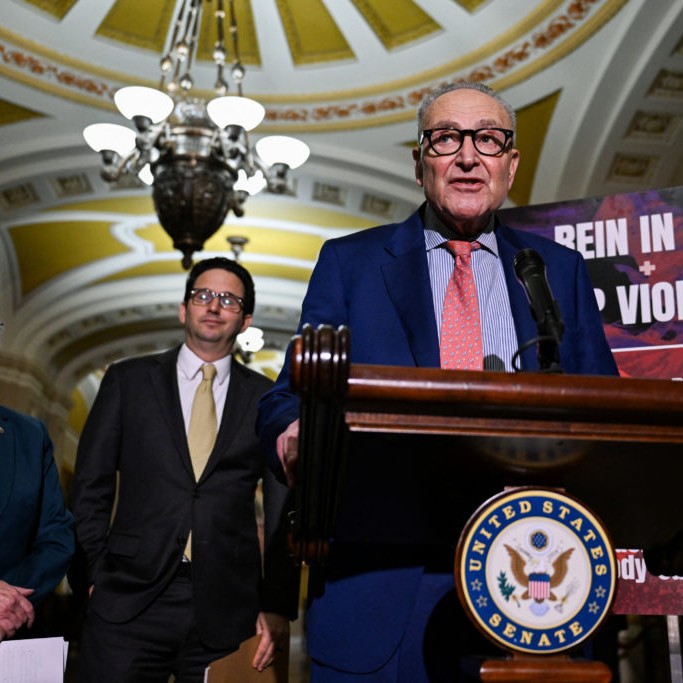
On Capitol Hill, Democrats are selling their demands as baseline governance, not ideological wish lists. Schumer put Republicans on notice on the Senate floor. “Republicans, the clock is ticking,” he said, according to the AP report. “We have sent you our proposals, and they are exceedingly reasonable.”
Jeffries used even cleaner language, and he used it as a line in the sand. “Dramatic changes are needed at the Department of Homeland Security before a DHS funding bill moves forward,” he said, according to the same report. “Period. Full stop.”
The phrase is blunt, but the strategy is sharper. Democrats are not just trying to win a policy fight. They are trying to rewrite the terms of what counts as “must-pass” in the first place. If the deal is “fund DHS or shut it down,” Democrats want to make ICE restrictions part of the definition of funding DHS.
The White House Signals a Split, Some Items up for Debate, Others Dead on Arrival
Trump agreed to separate DHS funding from a larger spending measure, according to the AP report. That created a short runway, and Democrats moved fast to load it with conditions.
However, the White House message, at least publicly, is that Democrats are not getting a blank check to set enforcement rules. The AP report quoted Leavitt describing the administration’s posture as willing to discuss some items, but rejecting others. “Others don’t seem like they are grounded in any common sense, and they are nonstarters for this administration,” she said.
That is the contradiction animating the whole standoff. Democrats are calling their proposals “exceedingly reasonable.” The White House is calling parts of that same list “nonstarters.” And the public still does not have the actual text.
Republicans Push Back, and Add Their Own Demands
Republicans are not just saying no. They are trying to widen the negotiating field, and that matters because the wider the field gets, the easier it is for talks to collapse under their own weight.
According to the AP report, some Republicans want to add legislation requiring proof of citizenship before Americans register to vote, as well as restrictions on cities they argue are not cooperating enough with immigration enforcement. Those are not small side quests. They are politically loaded demands that would turn a DHS funding bill into a broader culture and election-law fight.
House Speaker Mike Johnson argued that a Democratic demand to remove masks from ICE officers could put agents and their families at risk. “Taking the masks off ICE officers and agents, the reason we can’t do that is that it would subject them to great harm, their families at great risk because people are doxing them and targeting them,” Johnson said, according to the AP report. “We’ve got to talk about things that are reasonable and achievable.”
Sen. Bill Hagerty, appearing on “Fox News Sunday,” went even further, casting Democrats’ posture as performance politics. Democrats, he said, are “trying to motivate a radical left base.” He added, “The left has gone completely overboard, and they’re threatening the safety and security of our agents so they cannot do their job,” according to the AP report.
In other words, Democrats are framing this as accountability and restraint, while Republicans are framing it as officer safety and deterrence. Both sides are speaking in absolutes, and the only thing in the middle is a funding deadline.
Shutdown Stakes Go Past the Border
When lawmakers argue about ICE, it is easy to forget what else is inside DHS, until the practical consequences show up at an airport checkpoint or in an emergency response budget.
The AP report noted that DHS includes FEMA and the TSA, along with immigration enforcement agencies. Thune warned that if DHS shuts down, there is “a very good chance we could see more travel problems” similar to a previous government closure, according to the report.
That is why there is quiet interest in a workaround. The AP report said lawmakers in both parties have suggested separating out funding for ICE and Border Patrol while passing the rest of DHS. Thune, according to the report, was cool to that idea and floated another short-term extension for all of DHS while negotiations continue.
Extensions are where the pressure gets personal. Many Democrats, the AP report said, are unlikely to vote for another extension, especially those who want enforcement “radically scaled back.” Republicans, meanwhile, may need Democratic votes to move anything through both chambers without internal defections, particularly if the final deal looks like a concession on enforcement.
Jeffries tried to pin the responsibility for the next steps on Republicans. “The ball is in the Republicans’ court,” he said, according to the AP report.
What To Watch Next: The Paper, the Public, and the Pressure
The negotiations are being described as active, but the public details are thin. That is not just a transparency issue. It is part of the power play.
If Democrats release their full list, they risk boxing themselves in, and they risk handing Republicans a menu to attack line by line. If the White House releases its counterproposal, it risks angering either immigration hardliners who want maximum enforcement flexibility or moderates worried about use-of-force rules and public trust.
Meanwhile, the shutdown date stays fixed. If the deadline slips via a short-term extension, that is a victory for the side that benefits from more time, and an admission that the other side could not convert outrage into votes fast enough.
For now, the public is left with a fight built on three visible facts: DHS funding is running out, Democrats are trying to attach enforcement restrictions to the money, and the White House and GOP leaders are signaling resistance without showing their full hand.
References
- PBS News: Watch: Senate Convenes as Democrats and White House Trade Offers Over DHS Funding
- PBS News: Poll: Nearly Two-Thirds of Americans Say ICE Has Gone Too Far in Immigration Crackdown
- PBS News: Democrats Demand “Dramatic Changes” for ICE on Masks, Cameras, and Judicial Warrants
- PBS News: How Public Opinion Shifting Against ICE May Affect the DHS Funding Showdown in Congress