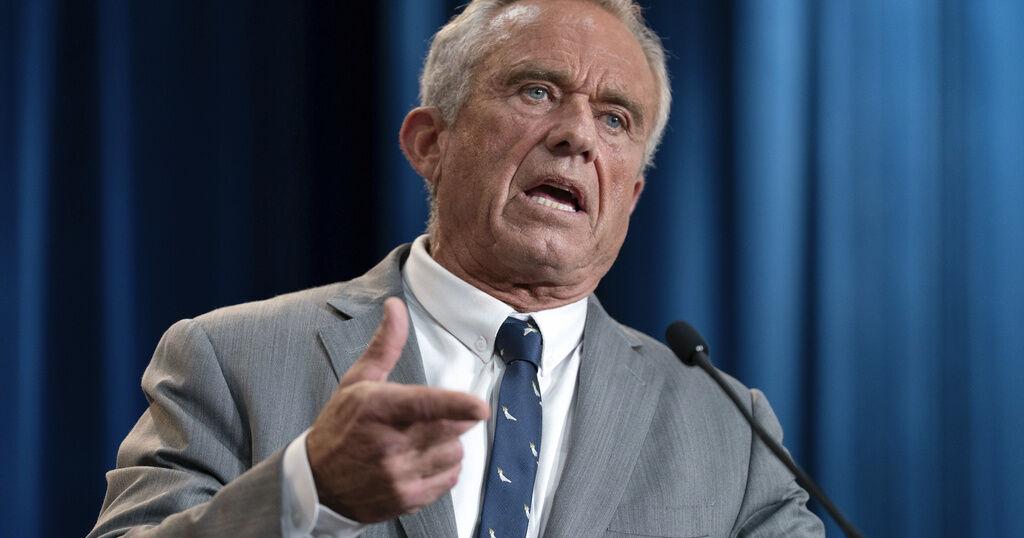
Robert F. Kennedy Jr. did not show up to nibble around the edges of Americas diet debate. He showed up with a word that lands like a gavel, and a target that sits deep inside the federal rulebook.
What You Should Know
A CBS News “60 Minutes” segment featured HHS Secretary Robert F. Kennedy Jr. blaming ultraprocessed foods for obesity and calling them “poison.” The debate is now colliding with federal food-ingredient oversight, including the FDA’s GRAS process for deeming substances safe.
Kennedy, the Health and Human Services secretary, is arguing that the country has built a food system that can pack on weight while stripping out nutrition. In his telling, this is not just a personal-choice story. It is a policy story, a corporate story, and a regulatory story.
The Line That Made the Fight Plain
On CBS News’ “60 Minutes,” Kennedy delivered a diagnosis in a single, combustible sentence: “There are Americans who are obscenely obese and at the same time malnourished.” He pinned much of that outcome on ultraprocessed food, and he used another word that food-industry veterans tend to treat as an accusation, not a descriptor: “poison.”
The segment, framed around the role of ultraprocessed foods in obesity and public health, put Kennedy in a familiar political position. He is the government official saying the system is broken while inheriting the very machinery that decides what gets sold, labeled, subsidized, and served.
That tension matters because HHS sits atop agencies that shape the American diet in real ways, from the FDA’s food-ingredient oversight to public health guidance, research priorities, and the broader public messaging power that comes with the cabinet title.
Ultraprocessed Food Is a Category, and a Political Weapon
Ultraprocessed food is not a legal definition on most U.S. packaging. It is a classification used heavily by researchers, often associated with the NOVA system, that groups industrial formulations made with additives, flavorings, colorings, emulsifiers, and other ingredients designed for shelf stability and hyper-palatable taste.
The scientific argument Kennedy is leaning on is not subtle. Research has repeatedly linked higher intake of ultraprocessed foods with worse health outcomes. The most compelling evidence, politically, is the kind that looks less like correlation and more like cause.
In a widely cited NIH-controlled inpatient study, participants eating an ultraprocessed diet consumed more calories per day and gained weight compared with those eating a minimally processed diet, despite meals being matched for calories, sugar, fat, fiber, and macronutrients. According to the National Institutes of Health, the ultraprocessed group ate about 500 more calories per day on average.
That kind of finding is gasoline in Washington because it suggests environment beats willpower. If the product design is driving intake, then the question becomes who is supposed to step in, and how hard.
GRAS: The Quiet Gatekeeper in Plain Sight
Kennedys harsh language also points to a regulatory choke point that most consumers never hear about unless something goes wrong. It is called GRAS, short for Generally Recognized as Safe.
GRAS exists inside the FDA’s food-ingredient framework. In broad terms, a substance can be considered GRAS for its intended use based on scientific procedures, or, for certain ingredients, on common use in food before 1958. The FDA explains that companies may reach their own GRAS conclusions, and they can choose to submit a GRAS notice to the agency, but the process is not the same as a formal premarket approval for a food additive.
That is where the power dynamics get interesting. GRAS can operate like a fast lane for ingredients. Critics have long argued that it gives industry too much room to self-police, while defenders argue it reflects scientific reality and keeps innovation and production moving.
If Kennedy wants to move beyond rhetoric, this is one of the biggest levers with real downstream consequences, from reformulation costs to supply-chain disruptions to legal exposure if companies are pushed to re-justify ingredients that have been treated as routine.
Why This Becomes a Washington Knife Fight
Food is not just culture. It is revenue, and in many communities, it is jobs. The processed-food economy is massive, and the regulatory pathway that governs ingredients and labeling is where business risk gets priced in.
A crackdown, or even the credible threat of one, can create winners and losers quickly. Large manufacturers may be able to reformulate, relabel, and litigate. Smaller brands can get squeezed. Retailers and restaurants can get caught in the middle. Investors tend to punish uncertainty.
Meanwhile, public health agencies have their own reputational stakes. If ultraprocessed foods are widely framed as structurally harmful, it invites a question that is hard to dodge: If the problem has been visible for years, why does it still dominate the American menu?
The politics get sharper because Kennedy is not just another nutrition scold. He is a cabinet official with a history of mistrust battles, now pointing his credibility cannon at a system that, for decades, has balanced industry flexibility with consumer protection.
Obesity Numbers Make the Messaging Easier
Public arguments tend to follow visible pain. Obesity is visible pain, economically and medically, even before you get to the human side of complications that can include diabetes, cardiovascular disease, and other chronic conditions.
The CDC has tracked high adult obesity prevalence in the United States for years, and those figures have become a political talking point because they are simple to communicate and hard to spin as a short-term blip. When an administration wants to justify a tougher approach, the prevalence charts are already drawn.
Kennedys framing, however, is more specific than the usual advice to eat less and move more. He is focusing on the structure of the food supply, which implies structural interventions. That is where resistance hardens.
The Pushback Playbook Is Already Written
Industry defenders typically argue that no single category of food explains obesity, that overall diet patterns and lifestyle matter, and that demonizing processing can confuse consumers and unfairly stigmatize affordable, convenient products.
They also point out that many processed foods are fortified, shelf-stable, and central to food access, especially for lower-income households and areas with limited fresh options. If policymakers pressure companies to remove certain additives or remake products quickly, costs can rise, and price hikes tend to hit the same households hardest.
That does not automatically defeat Kennedys argument. It just raises the stakes. If he pushes for big regulatory changes, he will have to defend them not only as health policy, but also as economic policy.
What to Watch Next
The fastest signal will not be another on-camera line. It will be paper.
Watch for HHS and FDA actions that indicate the administration is moving from public condemnation to administrative change, including updated guidance, enforcement priorities, or a tougher posture on ingredient safety reviews and disclosures. Watch for congressional interest, too, because GRAS reform has a history of drawing bipartisan curiosity when framed as transparency and consumer protection.
Also watch how carefully Kennedy calibrates his language. Calling food “poison” is attention-getting. Turning that into enforceable policy without collapsing into lawsuits and backlash is the part that separates a media moment from a governing strategy.
References
- CBS News: RFK Jr. Pins America’s Obesity on Ultraprocessed Food, Calls it “Poison”
- National Institutes of Health: Ultra-Processed Diets Cause Excess Calorie Intake and Weight Gain
- U.S. Food and Drug Administration: Generally Recognized as Safe (GRAS)
- Centers for Disease Control and Prevention: Adult Obesity Facts