

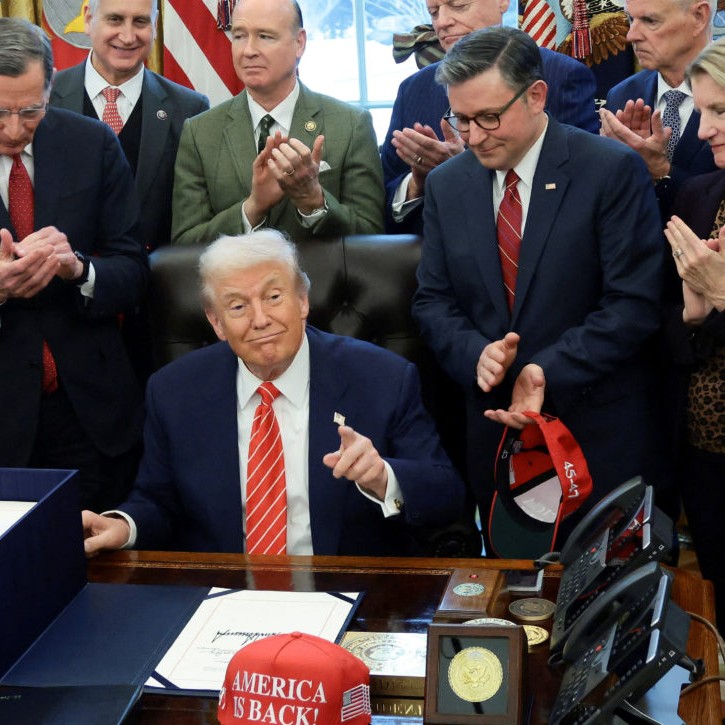
The shutdown ended with a signature, but Washington did not get a clean win. President Donald Trump signed a roughly $1.2 trillion government funding bill that reopened big chunks of the federal government, and then, almost immediately, Congress pivoted to the next pressure point: the Department of Homeland Security on a two-week timer.
If the first fight was about keeping the lights on, the second is about who controls the rules inside the agencies that police the border. The fuse is short. The deadline is February 13. The politics are loud.
According to an Associated Press report published by PBS NewsHour, Trump moved quickly after the House passed the bill, 217-214, to end the partial shutdown that began over the weekend.
“This bill is a great victory for the American people,” Trump said.
The line was meant to close the chapter. The bill itself kept it open.
A Funding Deal With a Catch: DHS Gets 2 Weeks
The measure wrapped up congressional work on 11 annual appropriations bills that fund agencies and programs through September 30, according to the AP account. That is the kind of sentence that normally signals the end of a story.
Not this time.
The package funds the Department of Homeland Security for only two weeks, through February 13, in what the AP described as a Democratic demand tied to calls for tougher restrictions on immigration enforcement after two fatal shootings in Minneapolis involving federal officers.
That is the new leverage point. DHS houses U.S. Immigration and Customs Enforcement, and it is where the next shutdown-style standoff can be aimed, narrowly, and with maximal political messaging.
Even the structure of the compromise tells you what is coming: most of the government is funded through September, but the immigration apparatus is set up as the next hostage, and both sides know it.
Jeffries Draws a Line on ICE
House Democratic Leader Hakeem Jeffries put Democrats on notice that the two-week extension is not a routine bridge to a final number. It is a test of whether Republicans will accept changes to how DHS, including ICE, operates.
“We need dramatic change in order to make sure that ICE and other agencies within the Department of Homeland Security are conducting themselves like every other law enforcement organization in the country,” Jeffries said.
That statement does two things at once. It frames DHS as an accountability problem, and it makes future funding contingent on policy concessions, not just topline dollars.
Republicans hear a different message: Democrats are threatening to withhold votes unless immigration enforcement is reshaped under a Democratic checklist.
Either way, the leverage is real. A department-level shutdown, even if narrower than a full-government shutdown, would hit agencies that are politically radioactive, operationally sensitive, and constantly in the headlines.
Johnson Wants a Deal, but He Is Counting Votes
Speaker Mike Johnson, a Louisiana Republican, tried to project calm and urgency at the same time. According to the AP report, he said he expects the two sides to reach an agreement by the deadline.
“This is no time to play games with that funding. We hope that they will operate in good faith over the next 10 days as we negotiate this,” Johnson said. The president, again, has reached out.
Johnson is selling competence, but the math is what matters. The House vote to pass the broader funding bill was a nail-biter, and it was not just because Democrats were divided.
The AP reported that Johnson needed near-unanimous support from his Republican conference to get to the final vote, and that a roll call was held open for nearly an hour as leaders worked with holdouts who were trying to advance other priorities unrelated to the funding measure.
That is the part rarely captured by the celebratory signing photo. When the margin is four votes, any small faction with a demand and a deadline can turn the Speaker into a negotiator, a whip, and a hostage, all at once.
Thune Drops the Optimism and Keeps the Deadline
Across the Capitol, Senate Majority Leader John Thune, a South Dakota Republican, offered the kind of realism that reads like a warning label.
“There’s always miracles, right?” Thune told reporters, according to the AP account.
In other words, there is a deal to be made, but there is no guarantee the parties will choose one.
That matters because DHS funding is not just another line item. It is the center of a national argument about immigration enforcement, executive power, and what happens when Congress tries to steer operational agencies through appropriations language.
Trump’s Message: Unity, No Edits
Trump’s posture, at least publicly, was simple: stop wobbling.
According to the AP report, Trump weighed in the day before the House vote with a social media post urging Republicans to stay united and telling holdouts, There can be NO CHANGES at this time.
That message is aimed at his own side, but it also sets up an awkward dynamic for the next round. DHS is funded for only two weeks. Changes are the entire argument. If one party’s position is no edits and the other party’s position is edits or no votes, the deadline becomes the story.
And deadlines, in Washington, have a habit of turning into blame contests.
The Real Stakes: Who Gets to Define ‘Normal’ at DHS
Democrats are talking about oversight, standards, and conduct. Republicans are talking about enforcement, security, and keeping the department functioning. Both are also talking about the 2026 political map, even when they pretend they are not.
For Democrats, DHS funding becomes a way to force a national debate on immigration enforcement without waiting for stand-alone legislation that is unlikely to pass. For Republicans, refusing those demands is a way to show they will not let immigration agencies be reshaped through a short-term funding squeeze.
Johnson, in particular, is managing two cliffs. He has to negotiate with Democrats to avoid a DHS funding lapse, and he has to keep enough Republicans on board to pass whatever emerges.
The AP described a House vote where 21 Republicans voted against the bill, and 21 Democrats voted for it, in a reminder that even when the government gets funded, party lines can blur in ways that make leadership math uglier.
That kind of split is not a sign of stability. It is a sign that any future vote, especially one tied to immigration enforcement, could fracture in unpredictable ways.
What to Watch Before February 13
The next moves are not subtle.
- Whether Democrats put specific, written conditions on DHS and ICE operations, and whether those conditions are tied to funding duration, reporting requirements, or enforcement limits.
- Whether Johnson can produce a bill that keeps DHS open without losing a bloc of Republicans who treat concessions on immigration enforcement as unacceptable.
- Whether Senate leaders signal a realistic path forward, or whether Thune’s miracles line becomes the quiet consensus.
- Whether Trump applies public pressure again, and if so, whether it is aimed at Democrats, Republican holdouts, or both.
The partial shutdown is over. The shutdown politics are not. Congress funded most of the government through September 30, but it left DHS on a two-week leash. That was not an accident. It was a preview.