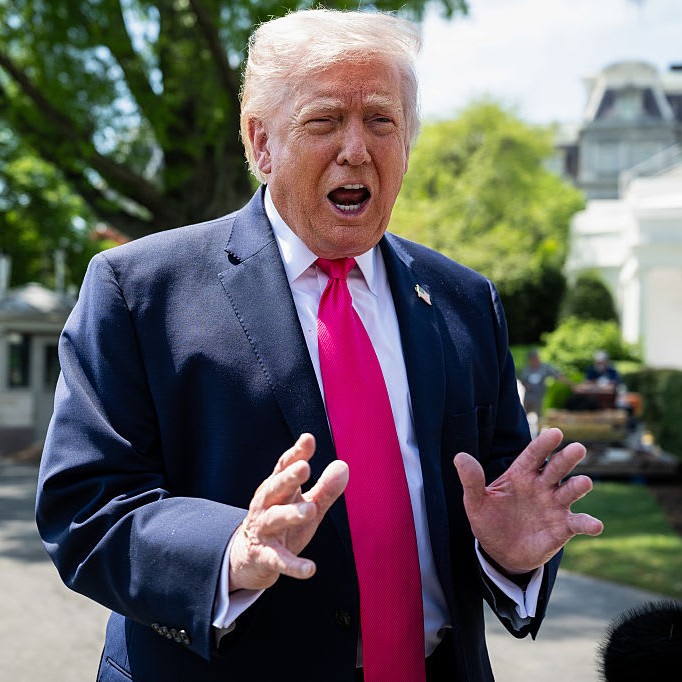


It was billed as a one-year scoreboard, a presidential victory lap with cameras rolling. But once President Donald Trump’s 104-minute press-room marathon ended, the loudest questions were not about his pace. They were about his math.
At the one-year mark of Trump’s second term, PBS NewsHour published a PolitiFact-backed breakdown of claims made during the extended White House press briefing. The result reads less like a recap and more like a list of asterisks, with several headline assertions disputed by public data, missing government reporting, or earlier fact checks.
A Press-Room Opening That Set the Tone
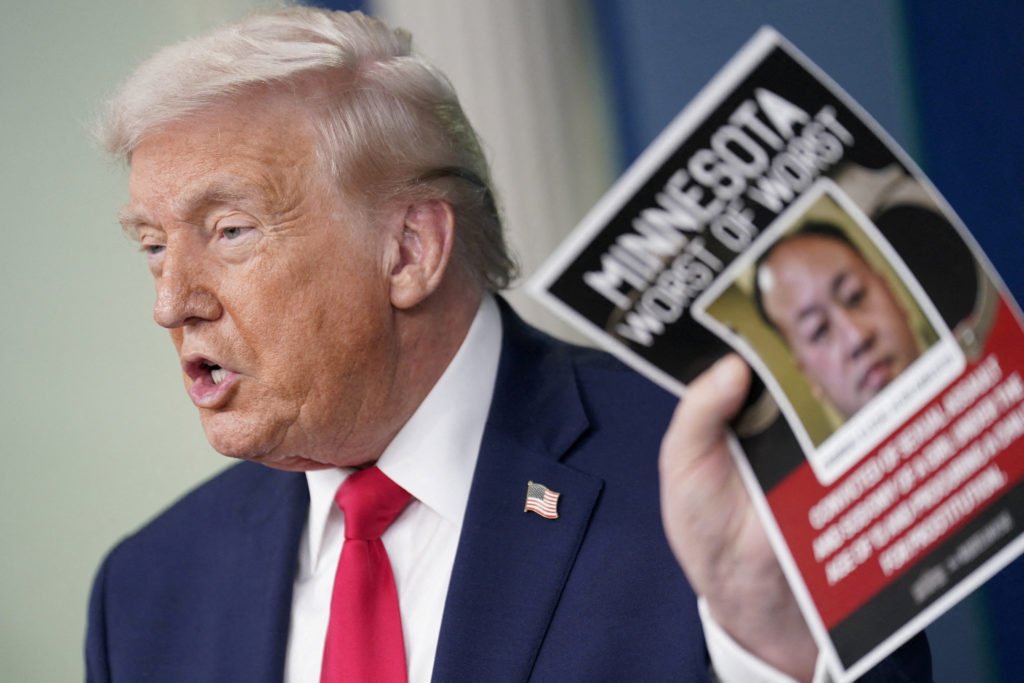
Trump began the event by displaying photos of people arrested by Immigration and Customs Enforcement in Minneapolis, according to the PBS report. The backdrop was already volatile: the city had seen large-scale raids, counter-protests, and, as PBS reported, the fatal shooting of an American citizen by an ICE agent.
From there, Trump moved through prepared accomplishments and frequent digressions, then took questions. Foreign policy, PBS reported, dominated much of the Q&A, including Greenland, a “Board of Peace for Gaza reconstruction,” and Venezuela after Nicolas Maduro’s leadership. Trump was also scheduled to attend the World Economic Forum in Davos, Switzerland.
The Economy: Tariffs, Inflation, and What the Price Tags Say
Trump claimed tariffs have not caused inflation and that inflation is “very low,” according to PBS. PolitiFact’s approach was straightforward: look at the price data over the prior year.
The conclusion was not a clean win for either side of the political food fight. PBS summarized the data this way: overall prices were still rising, but some high-attention items such as eggs and gasoline had declined.
That matters because tariffs and inflation arguments often hinge on lived experience. Consumers do not shop based on “overall prices.” They shop in grocery aisles and at the pump. But fact-checking is allergic to selective baskets, and the piece emphasizes that broad inflation measures are still up even when a few items fall.
Gas Prices: Down, But Not as Low as Described
Trump also said gasoline is cheap in many states. The PolitiFact numbers PBS cited were specific: in early January 2026, the national average was about $2.78 per gallon, down from about $3.11 in January 2025. But PBS added one key qualifier: “No state has seen its average price fall below $2.”
The political takeaway is less about whether $2.78 feels “cheap” and more about how carefully these claims are constructed. The direction of travel helps Trump. The floor does not.
Deportations and the Data Gap: A Claim That Outruns the Paperwork
On immigration, PBS reported that Trump said his administration prioritized deporting criminals and claimed “hundreds of thousands” of deportations in his first year.
Here is the problem PolitiFact highlighted: the administration had not published detailed deportation data, making it unclear how many deportees had a criminal history.
Meanwhile, PBS cited a separate data point with major narrative implications: about 74% of roughly 70,000 immigrants in detention had no criminal convictions.
That does not prove the deportation claim false on its face. It shows the administration’s preferred framing is hard to verify without the underlying numbers, and that detention demographics do not neatly match the “criminals first” messaging.
The $18 Trillion Promise and the White House’s Own Lower Total
Trump repeated a familiar brag with a specific figure. PBS reported he said the U.S. secured a record-high “$18 trillion” in commitments for new investments.
PolitiFact pointed to the White House’s own website, which showed about $9.6 trillion. That is not a rounding error. It is the difference between a number that dwarfs the annual output of most nations and a number that is still enormous but at least closer to Earth.
Even the smaller figure comes with caveats. Experts, PBS reported, warned that some pledges may not materialize, and others may be unrealistically large compared with the GDP of the countries involved. In other words, there is a second asterisk after the first: even if a pledge is announced, it can be revised, delayed, downsized, or never built.
Jobs Under Biden: A Big Claim Meets a Smaller Percentage
Trump also took a swipe at the Biden-era economy, claiming that under Biden, one out of four jobs added was a government job.
PBS summarized PolitiFact’s conclusion: the claim is exaggerated. Over four years, the economy added more than 16 million jobs, with about 1.8 million in federal, state, or local government positions. That is about 11% of the total, not 25%.
The dispute is not academic. “One out of four” is a rhetorical weapon, built to imply the private sector was weak and public payrolls were padding the stats. Eleven percent tells a different story, even if critics still argue that government hiring was too high or too low.
Fentanyl and Overdose Deaths: A Number That Does Not Match Federal Data
On fentanyl, PBS reported Trump said 300,000 people died last year due to fentanyl overdoses.
Federal data cited in the fact check did not support that. PBS reported that in the 12 months before August 2025, about 69,000 people died from all types of drug overdoses.
The gap between those numbers is so wide that it changes the conversation. A fentanyl-only figure of 300,000 suggests a catastrophe at a scale that would swamp the entire overdose category reported in federal totals. PolitiFact treated it as a factual mismatch, not a semantic debate.
‘Eight Unendable Wars’ and the Line PolitiFact Called ‘Pants on Fire’
Foreign policy claims also got the microscope. PBS reported Trump said he ended “eight unendable wars in 10 months,” a claim PolitiFact rated Mostly False.
Then came a line that PolitiFact has already tagged with its harshest label. Trump said, “No president has probably ever settled one war,” which PolitiFact rated Pants on Fire, PBS reported.
That rating matters less as an insult than as a signal. It is PolitiFact’s way of saying the claim is not just wrong, it collapses under basic historical reality.
Why This Fact-Check Lands With Extra Force
Trump’s format was part policy pitch and part performance. But the fact check underscores a recurring dynamic: the biggest applause lines often live in the least documented space.
Investment “commitments” depend on which announcements count, whether they are duplicates, and whether they ever become shovels in the ground. Deportation claims depend on detailed releases that the government controls. Price talk depends on whether you cite a national average, cherry-picked local snapshots, or the broader inflation picture.
And because this press briefing was explicitly framed as a one-year report card, the numbers were the message. That invites the kind of scorekeeping PolitiFact delivered.
What To Watch Next
Two things are likely to matter more than the sound bites. First, whether the administration releases detailed deportation data that allows independent verification of who is being removed and why. Second, whether the investment pledge totals get reconciled in a consistent public ledger that separates signed deals from aspirational announcements.
For now, Trump has a 104-minute tape of accomplishments. PBS and PolitiFact have a competing record of what the data can, and cannot, support. And hanging over it is Trump’s own sweeping line, offered as certainty: “$18 trillion.”