

Washington wants a calendar, Kyiv wants a ceasefire that sticks, and Moscow is still sending drones toward substations. In Zelenskyy’s telling, the peace push now comes with a June deadline, and it is landing in Ukraine right as the lights flicker.
What You Should Know
President Volodymyr Zelenskyy said the US has proposed a June deadline for Ukraine and Russia to reach an agreement to end the war. Ukraine’s grid operator said a major Russian strike hit energy infrastructure and forced nuclear plants to reduce output.
The key tension is simple: the Trump administration, per Zelenskyy, is pushing a summer timetable and offering the US as a venue for the next talks, while Ukraine says Russia’s campaign against power infrastructure is widening the humanitarian and economic pressure on Kyiv.
The Deadline That Changes Who Gets Squeezed
Zelenskyy told reporters that the US has given Ukraine and Russia a June deadline to reach a deal to end the nearly four-year war. If that deadline slips, he said, Washington is likely to lean on both sides to get back on schedule.
That framing matters because it shifts the negotiating optics. A deadline is not just a date. It is leverage. It signals who is expected to move, who might be blamed for the delay, and what kind of pressure campaign could follow if talks stall.
In Zelenskyy’s account, the US plan is built around momentum and choreography, with a sequence of meetings that can be marketed as progress even if the core disputes remain frozen.
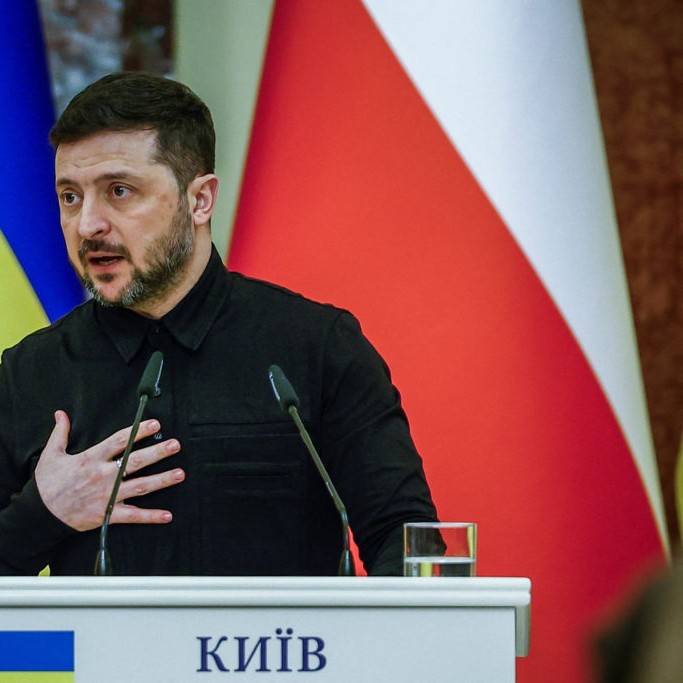
“The Americans are proposing the parties end the war by the beginning of this summer and will probably put pressure on the parties precisely according to this schedule,” Zelenskyy said.
He also described a push to hold the next round of trilateral talks in the US, for the first time, with Miami floated as a likely site. Zelenskyy said Ukraine accepted the invite: “We confirmed our participation,” he said.
Diplomacy on One Track, Drones on Another
While the scheduled talk is happening in conference rooms, Ukraine says Russia is still hunting for chokepoints in the energy system.
Zelenskyy said Russia launched more than 400 drones and about 40 missiles overnight into Saturday, targeting the energy grid, generation facilities, and distribution networks. Ukrenergo, Ukraine’s state energy transmission operator, said it was the second mass strike on energy infrastructure since the start of the year.
Ukrenergo said eight facilities in eight regions were hit, and the impact went beyond local outages. The operator said the strikes forced nuclear power plants in areas under Ukrainian control to reduce output.
“As a result of missile strikes on key high-voltage substations that ensured the output of nuclear power units, all nuclear power plants in the territories under control were forced to reduce their load,” the statement said.
Ukrenergo also said the power deficit increased “significantly,” leading to longer hourly power outages across Ukraine.
For Kyiv, the stakes are brutally practical. Negotiators can debate terms, but families are watching whether heating, water, and basic services hold, particularly during winter cold. And every time energy infrastructure is hit, Ukraine’s leaders are forced into a second negotiation with physics and capacity limits.
The US Wants a Ceasefire on Energy, Ukraine Wants Proof It Can Last
Zelenskyy said the US has again proposed a ceasefire that bans strikes on energy infrastructure. He said Ukraine is ready to comply if Russia does.
However, he pointed to what he described as a recent test case, a one-week pause suggested by the US that, he said, Russia violated after four days. The implication is not subtle: Ukraine is being asked to treat a promise as a mechanism, even after saying the mechanism failed on contact.
That sets up a familiar contradiction at the heart of the talks. A partial ceasefire is supposed to build trust. Ukraine is arguing that, so far, it has been an invitation for Russia to reposition while the clock keeps running.
The ‘$12 Trillion’ Pitch and the Quiet Fight Over Who Gets Paid
Then there is the money, and the messaging around money.
Zelenskyy said Russia presented the US with a $12 trillion economic proposal, which he dubbed the “Dmitriev package” after Russian envoy Kirill Dmitriev. He cast bilateral economic deals with the US as part of the broader negotiating process, a reminder that peace talks often come with a second, less public ledger: investment access, sanctions relief, reconstruction contracts, and who gets to declare a win.
Even without the details of the proposal, the power dynamic is clear. A giant number works like a spotlight. It aims attention to the upside of engagement, and it tests whether Washington is more motivated by a geopolitical outcome or by a business-case narrative that can be sold domestically.
Ukraine’s problem is timing. Kyiv is trying to keep military support and political backing aligned. Moscow, by Zelenskyy’s telling, is offering economic gravity, a way to make the war feel like a deal waiting to happen.
Abu Dhabi Showed the Limits, Donbas Shows the Red Lines
Zelenskyy tied the June talk to earlier US-brokered trilateral talks in Abu Dhabi that produced no breakthrough, with both sides holding to demands that do not fit together.
Russia, he said, is pressing Ukraine to withdraw from the Donbas, where fighting remains intense. Kyiv says it will not accept that. Zelenskyy summed up Ukraine’s posture with a line that reads like a negotiating memo and a political slogan at the same time.
“Difficult issues remained difficult. Ukraine once again confirmed its positions on the Donbas issue. We stand where we stand is the fairest and most reliable model for a ceasefire today, in our opinion,” Zelenskyy said.
He added that the hardest topics would be pushed to a leaders’ meeting, a classic pressure valve in diplomacy. It keeps the process moving while delaying the moment when someone has to sign their name under a concession.
Zaporizhzhia, Free Zones, and the Parts That Do Not Fit on a Timeline
Zelenskyy also said there was no common ground on managing the Russian-held Zaporizhzhia nuclear power plant, one of the most dangerous variables in the conflict. He expressed skepticism about a US proposal to turn the Donbas region into a free economic zone as a way to pause hostilities.
“I do not know whether this can be implemented, because when we talked about a free economic zone, we had different views on it,” he said.
That line is doing a lot of work. A free economic zone sounds technocratic, like a spreadsheet solution. The problem is that the Donbas is not a spreadsheet. It is territory, identity, control, and legitimacy, and any pause that leaves the underlying claim unresolved can look, to one side, like a trap and, to the other, like a foothold.
What to Watch Next
Three tracks are now moving at once.
- A June timetable, which could become a diplomatic cudgel if talks stall and someone needs a culprit.
- A proposed US-hosted meeting, possibly in Miami, which would be a major stage shift and a signal about Washington’s ownership of the process.
- Ukraine’s energy vulnerability, where each strike creates immediate civilian consequences and complicates any promise of calm.
If the US really intends to “do everything by June,” as Zelenskyy quoted, the pressure campaign will have to answer a basic question. Is the priority speed, or enforceability?
Ukraine is telegraphing its bet: a fast deal that cannot stop drones from hitting substations is not a deal. It is a pause with a countdown.