A document can be “100% ready” and still be one bad meeting away from becoming a political paperweight. That is the tightrope President Volodymyr Zelenskyy is walking after he said a U.S. security guarantees agreement for Ukraine is finished, yet still waiting for the one thing that turns text into power: a signing date, then votes.
The twist is where this “ready” deal is being shaped. Zelenskyy described two days of talks involving Ukraine, the United States, and Russia, a rare trilateral format that, in his telling, included military representatives as well as diplomats. The ambition sounds big. The unresolved issues sound bigger.
A “100% ready” document, and a clock that starts after signatures
In remarks to journalists in Vilnius during a trip to Lithuania, Zelenskyy said the U.S. security guarantees document is “100% ready” following talks held in Abu Dhabi, according to PBS NewsHour’s report of the Associated Press story.
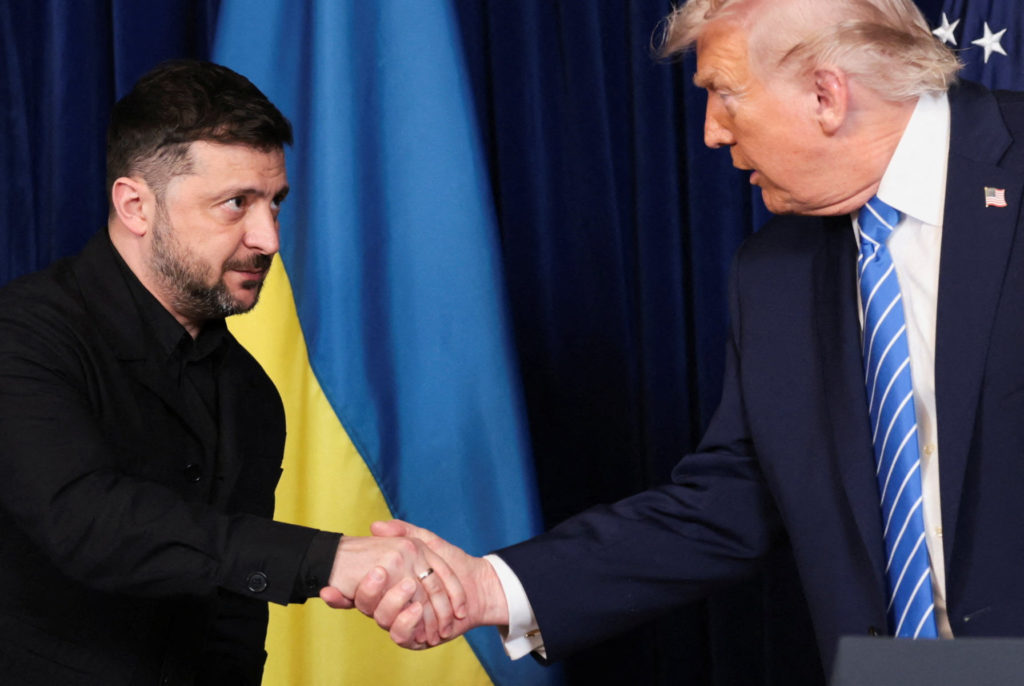
But Zelenskyy also made clear Ukraine is waiting for partners to set the signing date. After that, the text would head to the U.S. Congress and Ukraine’s parliament for ratification, per the same PBS NewsHour report.
🇺🇸🇺🇦 Security guarantees deal with the US is ready! Zelenskyy confirms the agreement will be signed soon and sent for ratification to Congress and Parliament. A major step toward strengthening Ukraine’s security framework. Details coming soon. pic.twitter.com/kp7A3uv40z
— Лев Шульман (@shulman_live) January 25, 2026
That sequence matters. Security guarantees do not really begin with the handshake photo. They begin when lawmakers lock in funding, oversight, and the political cost of backing away later. A signature can be dramatic. Ratification is where the leverage lives.
Why the room matters: Ukraine, US, and Russia at the same table
Zelenskyy framed the Abu Dhabi sessions as unusual because of the trilateral format and the presence of military representatives, not just diplomats, according to PBS NewsHour. If that description is accurate, it signals talks drifting from symbolism into operational questions: lines, monitoring, and enforcement.
The talks were presented as part of ongoing efforts to end Russia’s full-scale invasion, now nearing the four-year mark. That is the backdrop for the contradictions. Negotiators can draft a security text while simultaneously fighting about whether Ukraine should surrender land as a condition for peace.
The land problem that keeps swallowing every “framework”
Zelenskyy acknowledged fundamental differences between Ukrainian and Russian positions, with territorial issues still a core sticking point, according to PBS NewsHour.
That dispute is not just rhetoric. Russia has claimed to annex parts of eastern and southern Ukraine, a move rejected widely in international forums. The U.N. General Assembly adopted a resolution calling on states not to recognize any changes to Ukraine’s status based on Russia’s attempted annexation, in Resolution ES-11/4, “Territorial integrity of Ukraine”.
Against that legal backdrop, a U.S. security guarantees document raises the real-world question: guarantees of what, exactly, and for which territory, if a ceasefire line does not match Ukraine’s internationally recognized borders?
Trump’s envoys, Moscow’s demands, and Washington’s “compromise” talk
The report also placed the draft security document in the middle of a high-level U.S. diplomatic push. According to PBS NewsHour, Russian President Vladimir Putin discussed a Ukraine settlement with U.S. President Donald Trump’s envoys Steve Witkoff and Jared Kushner during lengthy talks.
In that account, the Kremlin’s stated position is blunt: for a peace deal, Kyiv would need to withdraw troops from areas in the east that Russia claims to have annexed, even though Russia has not fully captured them.
Zelenskyy, meanwhile, said the United States is trying to find a compromise. His line was spare but revealing: “all sides must be ready for compromise,” according to PBS NewsHour.
The tension is obvious on the page. “Compromise” is a flexible word in Washington. In Kyiv, it can sound like pressure. In Moscow, it can sound like a demand to accept faits accomplis.
The EU pledge Zelenskyy keeps pairing with security
Zelenskyy also pushed for European Union membership by 2027, calling it an “economic security guarantee,” per PBS NewsHour. This is a strategic pairing. Military security promises can wobble with elections. Economic integration, once locked in, is harder to unwind.
Ukraine has already been granted EU candidate status, a milestone the European Council announced in its conclusions on Ukraine. Candidate status is not membership, and the EU accession process is famously demanding. But Zelenskyy’s framing suggests he wants EU entry treated as part of the security architecture, not a separate lane.
The nuclear elephant in the room: Zaporizhzhia with no “final framework”
Then there is the issue that makes every ceasefire conversation feel fragile: control and operation of Ukraine’s Zaporizhzhia Nuclear Power Plant, occupied by Russia and described in the report as the largest in Europe. A U.S. official said there was not yet an agreement on a final framework for oversight and operation, according to PBS NewsHour.
The plant has been a persistent international concern. The International Atomic Energy Agency has repeatedly reported on safety and security risks at the site, including the realities of a nuclear facility in an active war zone. The agency’s ongoing public reporting on conditions is compiled through its IAEA and Ukraine updates, which have documented inspections, safety warnings, and the broader hazard of militarization around nuclear infrastructure.
This is where a “security guarantees” document gets tested. If there is no final framework for the biggest nuclear facility in Europe, skeptics will ask what kind of guarantees exist beyond words.
What happens next: a return trip to the UAE, and the votes after the photo
Negotiators are expected to return to the UAE for another round of talks on Feb. 1, according to a U.S. official cited by PBS NewsHour. The same official said the recent talks covered a broad range of military and economic matters and included the possibility of a ceasefire before a broader deal.
That sequencing can be politically convenient and strategically dangerous. A ceasefire can lower casualties and stabilize markets. It can also freeze battle lines and create a new normal that is hard to reverse, especially if the territorial question is deferred rather than resolved.
Zelenskyy’s “100% ready” claim puts pressure on the next steps. A signing date forces governments to reveal what is actually inside the agreement. Ratification forces lawmakers to own it. And if territorial concessions remain “fraught,” as PBS put it in a related explainer, the most important text may not be the draft agreement. It may be the fine print of what happens when one side claims the other broke it.
For now, the most concrete detail is also the simplest: a document is ready, and the signature is not. Zelenskyy’s three words are doing a lot of work. “All sides must” is either a bridge to an agreement, or an early warning that the bridge has missing planks.
References
- PBS NewsHour (AP): “Zelenskyy says U.S. security agreement for Ukraine is ‘100% ready’ to be signed”
- United Nations General Assembly: Resolution ES-11/4, “Territorial integrity of Ukraine”
- European: Council meeting (23 and 24 June 2022) – Conclusions
- International Atomic Energy Agency (IAEA): “Nuclear Safety, Security and Safeguards in Ukraine”