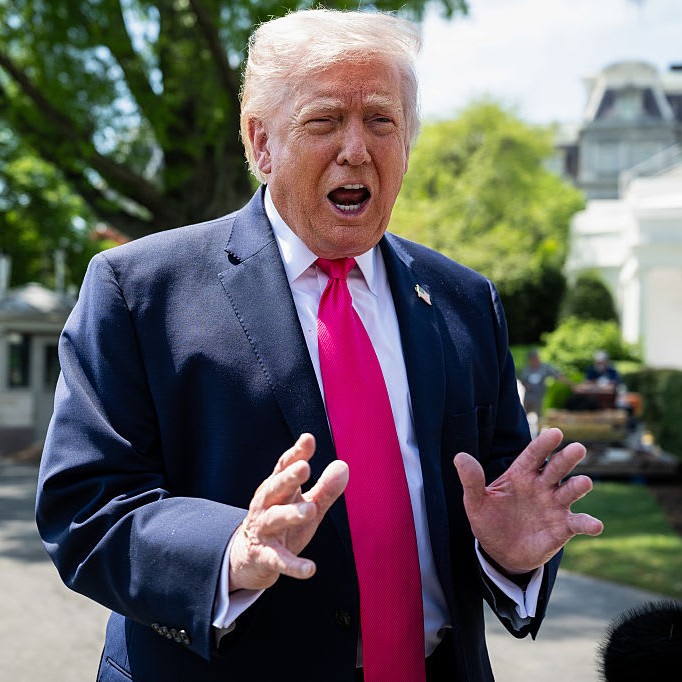


President Donald Trump used a word that sounds like a federal takeover, then the White House grabbed a bill number and tried to turn it into a policy explanation.
That is the gap at the center of this latest election fight. Trump told listeners Republicans should “take over” and “nationalize” elections. On Tuesday, White House press secretary Karoline Leavitt said he was referring to the SAVE Act, a Republican-backed push to tighten proof-of-citizenship requirements for voters.
Those two things are not the same, and that is where the stakes lie.
A Big Word, Then a Smaller Explanation
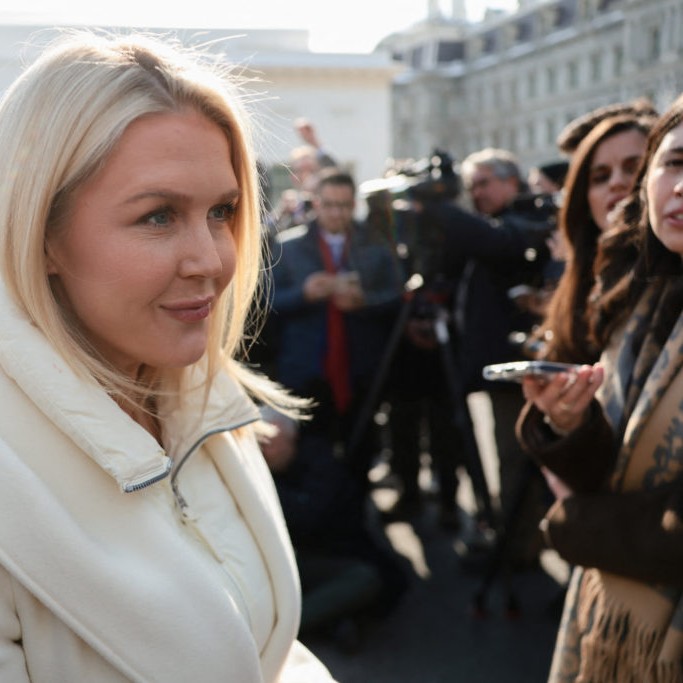
According to the Associated Press report published by PBS NewsHour, Leavitt told reporters that Trump’s “nationalize” line was a reference to voting legislation, specifically the SAVE Act. She offered the clarification after Trump’s podcast comments triggered a quick backlash and a wave of questions about what, exactly, he meant.
The sequence matters. Trump did not pitch a narrow tweak. He used the language of control. “Take over” and “nationalize” are verbs that imply a transfer of power away from states, counties, and local election offices.
Leavitt’s explanation, by contrast, pointed to Congress, where Republicans have been trying to move election policy through bills, not presidential decrees.
That pivot is a familiar Washington move. When the principal talks in slogans, the staff tries to translate them into process. In this case, the translation immediately ran into the system that Trump was talking about changing.
The Constitution Is Not Built for a One-Word Takeover
Running elections in the United States is a messy, decentralized business by design. States and local jurisdictions handle everything from polling places to ballot design to counting procedures, even when Congress passes laws that shape the rules.
The constitutional hook for federal involvement is real, but it is not unlimited. Article I, Section 4, sometimes called the Elections Clause, gives state legislatures the initial authority to set the “Times, Places and Manner” of congressional elections, while also giving Congress power to “make or alter” those regulations.
That is not a clean pathway to “nationalizing” all elections, especially presidential contests, which run through a separate structure tied to states appointing electors. It is also not a pathway to snapping your fingers and “taking over” operations that are managed by thousands of jurisdictions with their own equipment, staffing, budgets, and state statutes.
In other words, the White House can point to the SAVE Act all it wants. The word Trump used still suggests something much broader than what Congress is debating.
Why Leavitt Picked the SAVE Act
Leavitt said Trump’s comments were about the SAVE Act, which would tighten proof-of-citizenship requirements. The bill has been promoted by Republicans as an election-integrity measure, and criticized by voting-rights groups and many Democrats as a policy that could create new barriers for eligible voters who do not have easy access to specific documents.
That fight has a political logic. Proof-of-citizenship requirements have been a recurring Republican priority, and linking Trump’s rhetoric to legislation does two things at once.
- It converts a broad power claim into a concrete agenda item, which is easier to defend in a briefing room.
- It puts pressure on Congress by implying Trump is already calling the play, and lawmakers should follow.
The White House also pointed to additional House Republican legislation introduced to change election procedures nationwide, according to the PBS report. That is the administration’s preferred frame: not a takeover, but a national standard-setter.
The political problem is that Trump did not sell it that way. He sold it like a takeover.
Even Republicans Are Signaling Limits
The pushback is not confined to Democrats or election administrators. In a separate PBS NewsHour report, Senate Republican leader John Thune threw cold water on the idea of “nationalizing” elections, a notable note of restraint from a party that has spent years elevating election rules as a top issue.
That matters because it exposes a split inside the power structure that Trump needs to make anything real. The president can dominate headlines. He cannot pass a bill alone, and he cannot rewrite state election codes by podcast.
So the White House is left doing a delicate dance: keep the base energized by Trump’s maximal language, while telling swing voters, donors, and lawmakers that it is really just a bill about documentation and procedures.
That contradiction is the story, not the spin.
The Georgia Raid, the Old Claims, and the New Pitch
Trump’s comments also arrived in a combustible context. The PBS report noted they came after an FBI raid on a Georgia election office, a site that has been targeted by Trump’s often-debunked conspiracy theories about the 2020 election.
That backdrop raises the temperature on every word. When a president who has repeatedly challenged the legitimacy of the 2020 results talks about “taking over” elections, the question is not only legislative. It is about whether he is trying to relitigate an old grievance through new federal muscle.
Leavitt’s response, focusing on the SAVE Act, attempts to reroute that question into a safer lane. Instead of arguing about 2020, argue about proof of citizenship. Instead of debating whether Trump wants a federal takeover, debate whether Congress should tighten the rules.
But the trigger for the uproar was not a bill title. It was Trump’s choice of verb.
What Happens Next, and What to Watch
The immediate next step is legislative, not executive. Republicans can try to move the SAVE Act and related election bills through the House, then confront the Senate math and internal Republican caution.
The longer-term question is whether Trump keeps using “nationalize” and “take over” as a political promise, even if his staff keeps translating it into something narrower. If he repeats it, it becomes a loyalty test for Republicans and a messaging weapon for Democrats.
Watch three pressure points:
- Senate posture: whether Thune and other Senate Republicans treat Trump’s language as rhetorical noise, or as something they have to publicly reject.
- House strategy: whether Republican leaders package election bills as must-pass items or keep them as campaign messaging.
- Administration clarity: whether the White House issues a more formal definition of what “nationalize” means, beyond pointing to a bill.
For now, the White House has chosen its move: turn a headline-grabbing word into legislative jargon. The country gets to decide which version of the president’s message is the real one.
References
- PBS NewsHour: WATCH: White House says Trump was referring to SAVE Act when he advocated nationalizing elections
- PBS NewsHour: Thune throws cold water on Trump’s call to ‘nationalize’ U.S. elections
- Cornell Law School, Legal Information Institute: U.S. Constitution, Article I, Section 4
- National Archives: Constitution of the United States, Transcript