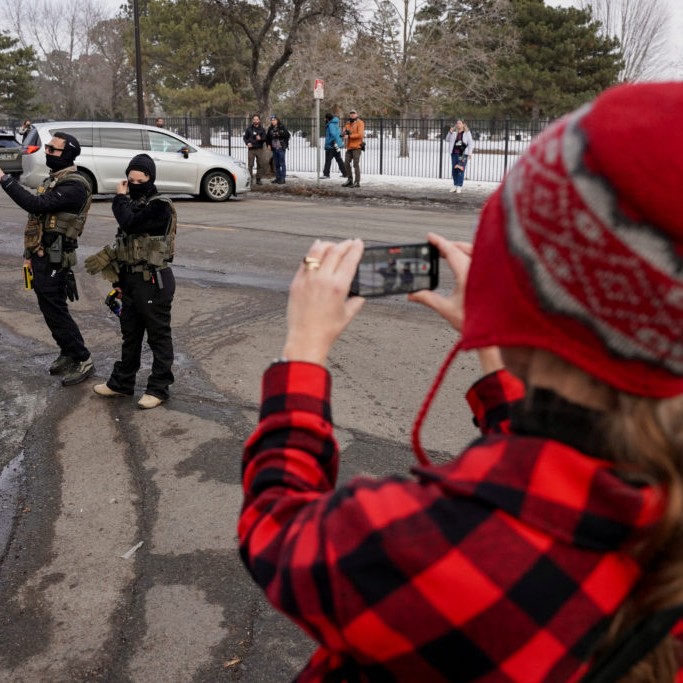
A phone gets grabbed in Minnesota. A woman in Maine gets told she is headed for a database and labeled a domestic terrorist. A dash cam catches masked agents swerving, stopping, and drawing guns. The videos keep coming, and so do the threats about what filming supposedly means.
What You Should Know
New disputes over filming immigration agents in public are colliding with First Amendment protections and law enforcement claims of obstruction. Legal experts say recording from an appropriate distance is generally protected, but arrests can still hinge on an officer’s judgment in the moment.
The fault line is not subtle. Minnesota Gov. Tim Walz has encouraged residents to record immigration agents to preserve evidence. Homeland Security Secretary Kristi Noem, overseeing the Trump administration’s enforcement push, has framed the same act as harmful, calling recording on-duty agents an act of violence, and DHS messaging has described it as doxing and a felony.
The New Power Play Is the Camera
The flashpoint is not an abstract debate about civil liberties. It is a series of real-world encounters where a phone lens becomes a trigger.
According to reporting published by PBS NewsHour and PolitiFact, a federal agent in Minnesota grabbed a woman’s phone as it recorded him approaching her on January 9th, 2026, two days after a federal agent shot a U.S. citizen. Weeks later in Maine, a woman kept her phone rolling while an agent filmed her license plate and told her she would be added to a database, with the agent allegedly saying she was now considered a domestic terrorist.
Then, on January 29th, 2026, a Minnesota driver captured masked immigration agents on a dash cam as they swerved in front of her car, got out, and pulled their guns. Three different scenes, one shared theme, which is the public trying to document what the government is doing in public spaces.
In one of the filmed confrontations described by PolitiFact, the person being recorded did not hide the disbelief: “For videotaping you? Are you crazy?”
That quote lands because it frames the core contradiction. Filming has long been part of American public life, but immigration enforcement is now testing whether the government can treat observation itself as a threat.
Walz Wants Receipts, Noem Wants Deterrence
Walz’s message is built for the evidence era: record it, preserve it, let the footage speak. In the reporting, he encouraged Minnesota residents to record agents so there is a clear record when encounters go sideways.
Noem’s message is built for deterrence: do not point a camera, because the camera is being recast as aggression. In statements cited by PolitiFact, Noem said recording on-duty immigration agents is an act of violence. A DHS spokesperson, per the same reporting, went further by characterizing videoing officers as doxing and labeling it a federal crime and a felony.
That framing is not just rhetorical. It changes the stakes for bystanders. If recording is treated as violence or doxing, then the person holding the phone is no longer a witness. They are a potential suspect.
It also raises a simpler question that the footage keeps forcing: if recording is inherently dangerous, why does the government record itself so aggressively?
PolitiFact noted that DHS social media accounts have posted videos and photos of immigration agents conducting enforcement operations. In other words, the department is comfortable with cameras when it controls the angle, the edit, and the captions.
When Video Collides With Official Narratives
This fight is not happening in a vacuum. It is happening after incidents where video did not merely supplement official accounts. It challenged them.
In one fatal shooting referenced in the PBS NewsHour and PolitiFact reporting, bystander video from multiple angles challenged Noem’s statements about what happened in the death of Alex Pretti, with the footage undercutting claims that Pretti brandished a gun at immigration agents before he was killed.
That is the underlying power dynamic. If a government narrative can be contradicted by a stranger’s phone, then the phone becomes a threat to authority, not because it obstructs, but because it competes.
And that is why the argument keeps sliding away from narrow legal language and toward big labels like violence, terrorism, and felony. Labels do not need to be proven in the moment. They just need to work long enough to make people stop filming.
The Legal Line Is Distance, Not Silence
So, what does the law actually say about filming immigration agents in public?
PolitiFact’s reporting leans on a familiar First Amendment principle: observing and recording government officials performing public duties in public spaces is generally protected. The catch is that recording can become risky if it is paired with physical interference, threats, or behavior that an officer says created a safety hazard.
Attorney and expert commentary cited by PolitiFact drew that line in plain language. “Holding up a camera at an appropriate distance and filming should not inhibit any law enforcement officials from doing their jobs unless they think they’re doing something wrong.”
A federal judge added a sharper edge to the debate in a January 16th, 2026, ruling referenced by PolitiFact: following federal agents “at an appropriate distance does not, by itself, create reasonable suspicion to justify a vehicle stop.”
However, the same reporting noted that an appeals court temporarily paused that order, a reminder that even when a judge draws a boundary, the boundary can move while litigation grinds on.
Jessica West, a professor at Mitchell Hamline School of Law, described the difference between documenting and interfering: “Following a police car or ICE vehicle on a public road is not obstructing.” She added that blocking a car to prevent it from moving could be treated differently.
The through line is that recording is not the problem on paper. The problem is what an officer says you were doing while recording.
Obstruction Is a Word That Can Stretch
If you want the quickest way to understand the risk, focus on one term: obstruction.
PolitiFact laid out the decision chain. First, an officer decides whether there is probable cause that someone physically obstructed law enforcement activity. Then the arrest can happen. After that, a judge or grand jury reviews evidence and decides whether charges proceed. If a case goes forward, a judge or jury decides guilt.
That structure explains why recording disputes feel like they have two separate realities.
Reality No. 1 is legal theory, where courts talk about constitutional protections and appropriate distance.
Reality No. 2 is roadside reality, where the officer with the badge decides, in real time, whether your proximity, your car, or your movement counts as interference.
PolitiFact also quoted a warning that sounds less like a civics lesson and more like a survival fact: “Courts have given a lot of deference to law enforcement officials, and so that is something that anyone who’s recording should be aware of.”
That deference matters because it can make the difference between a protected act and a night in jail, even if a case is later dismissed.
Doxing, or Just Documentation?
DHS officials have pushed the idea that recording immigration agents is doxing. In the way the term is commonly used, doxing means publishing identifying personal information, such as a home address, phone number, or private financial details, typically with the intent to harass.
Legal experts cited by PolitiFact argued that recording an agent in public is not doxing. The reason is straightforward: it is not the same thing to document what is happening in public as it is to publish someone’s private data.
The point was made with a line built for the masked-agent era: “It is not doxing to film something that is happening in public, even though somebody would rather not have that information public. Even if someone is masked to hide their identity.”
But the political utility of the doxing claim is obvious. It recasts the person with the phone as an aggressor, and it hands officers a justification to shut filming down before a clip can spread.
Why This Fight Keeps Escalating
On its face, this is a rights question. In practice, it is also a messaging war.
The government benefits when enforcement looks orderly, targeted, and controlled. Video is unpredictable. It can show confusion, fear, profanity, or force, and it can do it from the perspective of the person being questioned or detained.
That is why surveillance, public documentation, and narrative control are now colliding. PBS NewsHour has separately reported on immigration agents’ surveillance tools and tactics, which civil liberties advocates say can sweep in citizens and bystanders, not just targets.
Once the government is watching more, the public response is to watch back. Cameras are the cheapest oversight tool Americans have, and the crackdown rhetoric suggests officials understand that.
In Minnesota and beyond, the practical question is not whether the First Amendment exists. The question is whether recording will be treated as a protected observation or as a provocation that triggers a stop, a seizure of a phone, or an arrest framed as obstruction.
What to Watch Next
This story is moving on three tracks at once.
First, litigation. Rulings about following agents, filming from cars, and what counts as reasonable suspicion can shift quickly, especially when appellate courts pause lower court orders.
Second, policy. If DHS leadership continues to describe filming as violence or doxing, that language can shape training, field behavior, and the way incidents are written up in reports.
Third, the footage itself. Videos that contradict official accounts will keep raising the pressure, because every contradiction invites the same question: if recording is a crime, why does it keep producing evidence that officials end up having to explain?
The camera is not going away. The fight is over who gets to decide what it means when it is turned on.
References
- PBS NewsHour: Here’s What To Know About the Constitutional Right To Record Immigration Agents in Public
- PolitiFact: Recording ICE Agents in Public? Here’s What the Law Says
- PBS NewsHour: Immigration Agents’ Surveillance Tools and Tactics Raise Questions About Civil Liberties
- PBS NewsHour: ‘No Excuse’ for Immigration Agents’ Excess Use of Force, Says Former DHS Head Napolitano