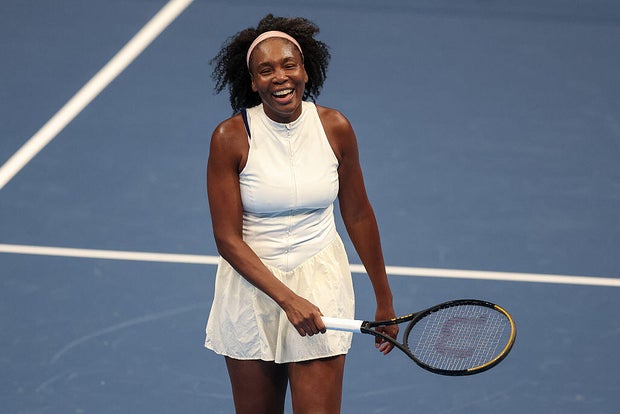
Venus Williams has never needed a comeback storyline to get attention. But this one comes with a number attached to it, and it is the kind tournament officials do not hand out lightly.
The Australian Open says Williams, now 45, will be back in Melbourne on a wild card for 2026. If she takes the court in the main draw, the event says she will become the oldest woman ever to do it.
A wild card that doubles as a record attempt
Australian Open tournament officials announced the wild-card entry for Williams for the 2026 tournament at Melbourne Park, marking her first appearance there since 2021, according to CBS News.
The tournament also framed it as a history moment: Williams would surpass the current age mark for oldest woman in an Australian Open main draw, a record held by Japan’s Kimiko Date, who was 44 when she played the event in 2015, per CBS News reporting.
This is not just about longevity optics. Williams is a seven-time Grand Slam singles champion with a deep resume in Melbourne, including two runner-up finishes in singles. She lost to her sister Serena Williams in the finals in 2003 and again in 2017, according to the report.
Venus Williams, 45, set to make Australian Open history after receiving wild-card entryhttps://t.co/4siCcjQgit pic.twitter.com/jmXvUOWxAT
— Amstel News (@amstelnews) January 2, 2026
Venus’ own words: why Melbourne still matters
Williams has talked about Australia like a place where her career has a long memory, not a short leash.
“I’m excited to be back in Australia and looking forward to competing during the Australian summer,” Williams said in a statement carried by CBS News. “I’ve had so many incredible memories there, and I’m grateful for the opportunity to return to a place that has meant so much to my career.”
The receipts: 28 years, 22 main draws, and a 54-21 record
The numbers make the wild card easier to understand, and harder to argue against.
Williams first appeared at the Australian Open in 1998, 28 years before the 2026 edition. She was 17 then. In one of the tournament’s early headline moments for the Williams family, she defeated Serena Williams in the second round before falling in the quarterfinals to American Lindsay Davenport, according to CBS News.
Her record at Melbourne Park sits at 54 wins and 21 losses, CBS News reported. The 2026 appearance would be her 22nd time in the Australian Open main draw.
Why this wild card is also a power move
Wild cards are not purely sentimental. They are an admission ticket controlled by the tournament, and the math is simple: one wild card for a legend is one fewer spot for someone else.
That is why these invitations routinely become a quiet argument about merit, marketing, and who a Grand Slam is for. The Australian Open does not need to explain itself when it hands a wild card to a player with Williams’ history, but the decision still signals priorities. Experience, name recognition, and narrative value matter.
For Williams, the invitation is also leverage. It is a direct path into the main draw without needing a ranking high enough to qualify the usual way. For the tournament, it is a ready-made global storyline: a record-age entry, a Hall of Fame resume, and a familiar face in a sport that is constantly introducing new ones.
The comeback proof point came in 2025
The wild card is not based only on past trophies, at least not according to the timeline described by CBS News.
In July 2025, Williams accepted a wild-card invitation to play singles at the Mubadala Citi DC Open and won a tour-level singles match, beating Peyton Stearns 6-3, 6-4. CBS News reported she became the second-oldest woman to win a tour-level singles match, and that it was her first singles victory in nearly two years.
Later in 2025, she also made a notable run at the U.S. Open in women’s doubles, partnering with Leylah Fernandez. They reached the quarterfinals before losing to Taylor Townsend and Katerina Siniakova, per CBS News.
Those results do not guarantee anything in Melbourne. They do, however, give tournament officials something concrete to point at when fans ask whether the wild card is competitive or ceremonial.
The lead-up: Auckland, then Hobart, then Melbourne
The plan, at least as described publicly, is not a one-off cameo.
In November, Williams announced she would play in Auckland, New Zealand, on another wild card, roughly two weeks before the Australian Open, CBS News reported. The Australian Open also said she was entered to play a tournament in Hobart, Australia, a week later, just before play begins at Melbourne Park.
That sequence matters. It suggests match preparation rather than a single appearance designed for the cameras and the applause.
Off court, a new chapter arrives with her old one
Williams’ return to Australia lands amid a personal milestone that also changes the way the public reads her schedule.
CBS News reported that in late December she married Danish-born model and actor Andrea Preti in Palm Beach, Florida.
In celebrity terms, it is a reminder that Williams’ life is not paused between tournaments. In tennis terms, it adds another layer to the question that will follow her into Melbourne: not whether she has anything left to prove, but whether she still wants the grind required to prove it on court.
What to watch once the main draw begins
The most obvious watch is the record itself. If Williams plays, the Australian Open says she will become the oldest woman ever in its main draw. The second watch is the draw placement and early matchups, because a wild card does not protect a player from a brutal first-round assignment.
And then there is the quieter watch: how the tournament and the sport talk about age when the player in the spotlight is one of the most famous women to ever hold a racket.
Williams has already told fans why she is doing it. Now the Australian Open has handed her the entrance. The only part no one can script starts when the chair umpire calls, “Time.”