

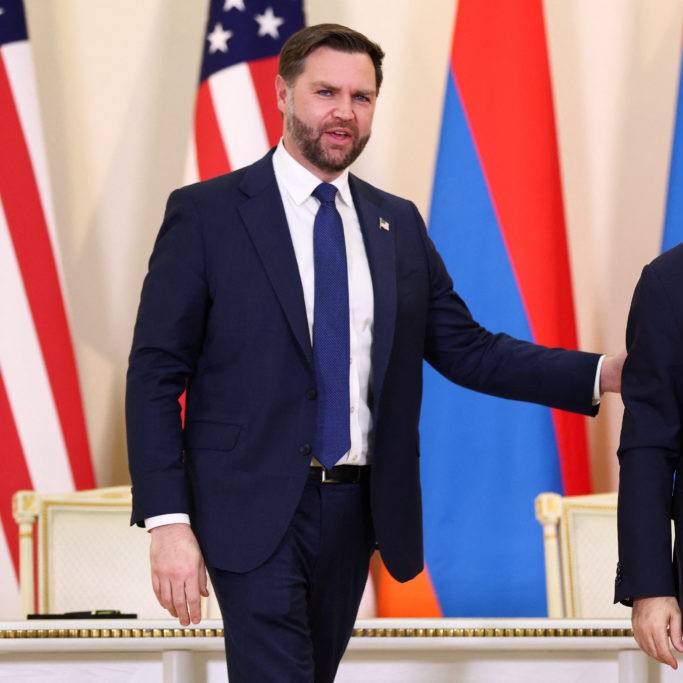
JD Vance touched down in Armenia with a promise menu that reads like geopolitics with a receipt: nuclear energy talks, high-end chips, surveillance drones, and a peace process whose biggest selling point might be its branding.
What You Should Know
Vice President JD Vance visited Armenia on February 9th, 2026, the first sitting U.S. vice president or president to do so. He and Prime Minister Nikol Pashinyan signed an agreement to advance negotiations on a civil nuclear energy deal.
The Trump administration is pitching Armenia on economics and security while trying to keep a U.S.-brokered Armenia-Azerbaijan peace track moving, including a proposed transit corridor through a thin strip of Armenian territory that has been a long-running flashpoint.
Vance is not just sightseeing in Yerevan. He is testing a theory of leverage: that a country wedged between Russia, Iran, Turkey, and the Caucasus conflict map can be pulled closer to Washington with concrete goods, high-status symbolism, and a peace deal that is close enough to be initialed, but far enough away to still be fragile.
According to reporting published by PBS NewsHour, which carried an Associated Press account of the trip, Vance and Pashinyan signed an agreement to push forward negotiations on a civil nuclear energy deal. The vice president also said the U.S. was ready to export advanced computer chips and surveillance drones to Armenia and invest in infrastructure.
The power dynamic is obvious: Armenia wants options and investment. The U.S. wants influence, a regional win it can point to, and a route that reorders trade and security in a neighborhood where Moscow has traditionally expected deference.
The First VP Visit Is a Signal, Not a Souvenir
Vance’s landing matters because of what had not happened before. The AP report carried by PBS said no sitting U.S. president or vice president had previously visited Armenia. That is a diplomatic gap, and gaps invite interpretations.
For Washington, a first visit is a low-cost way to suggest momentum. For Yerevan, it is a chance to say, on camera, that Armenia has not been forgotten, even after the region’s conflicts and alliances turned sharply in recent years.
Pashinyan leaned into the symbolism. He called the visit “of truly historic and symbolic importance” and said it “reflects the depth of the strong and strategic partnership forged between the Republic of Armenia and the United States of America,” according to the AP account.
That phrasing is doing a lot of work. Strategic partnership is a big label in a place where security guarantees have been debated, resented, and, at times, found wanting.
A Peace Deal That Exists on Paper, Not in Parliament
The trip is tethered to a deal that has been publicly celebrated, but not fully sealed. The AP report said Pashinyan signed a deal at the White House in August with Azerbaijani President Ilham Aliyev, reaffirming a commitment to signing a peace treaty. The text was initialed by the countries’ foreign ministers, which signals preliminary approval.
But the paper trail stops short of the finish line. The leaders have yet to sign the treaty, and parliaments have yet to ratify it, the report said. That is the tension point: the administration is selling the future, while the formal legal steps are still pending.
Vance tried to frame the gap as a choice between bitterness and momentum. “Peace is not made by cautious people,” he said. “Peace is not made by people who are too focused on the past. Peace is made by people who are focused on the future.”
It is a clean sound bite, and it also sets up a classic negotiation problem. The parties are being asked to act like the hardest questions are behind them, even though the corridor question and the conflict’s human costs are still live, politically combustible issues.
The ‘Trump Route’ and the 20-Mile Pressure Point
The most tabloid-ready detail in the AP reporting is also the one with the most serious consequences. The August deal, the report said, calls for a major transit corridor dubbed the Trump Route for International Peace and Prosperity.
It is expected to connect Azerbaijan to its autonomous Nakhchivan exclave. The catch is geography, and it is narrow enough to be weaponized by any future dispute: the corridor would cross a 32-kilometer-wide, or 20-mile-wide, patch of Armenian territory.
This is not a minor infrastructure squabble. A land bridge can change customs revenue, military logistics, and local sovereignty debates in one stroke. Armenia can see a corridor as an economic opportunity or as a concession that becomes permanent. Azerbaijan can see it as connectivity or as unfinished business. The U.S. can see it as a visible deliverable, and, if it works, a regional storyline that credits Washington’s brokerage.
Even the name is a power move. Branding a route after an American president is not just marketing. It is a flag on the project, and it dares future officials to keep it alive or explain why it died.
Why Armenia Is Being Offered Chips, Drones, and Nuclear Talks
Vance’s pitch, as relayed by the AP account, mixed energy, technology, and security. Civil nuclear energy talks can signal a long-term partnership, but they also raise the stakes on trust and regulatory alignment. Advanced chips and surveillance drones are not neutral exports in a neighborhood full of contested borders and surveillance anxieties.
Armenia, for its part, has reason to shop for new relationships. The AP report summarized a conflict history that has left deep scars: decades of fighting over the Karabakh region, known internationally as Nagorno-Karabakh, including a six-week war in 2020 and a September 2023 offensive that forced separatist authorities to capitulate. After Azerbaijan regained full control of Karabakh, most of its 120,000 Armenian residents fled to Armenia, according to the AP report.
That refugee flow is not just a humanitarian statistic. It is a political constituency, an economic burden, and a reminder that security arrangements can collapse quickly. In that context, a U.S. offer of investment and high-end technology is not simply about commerce. It is about reassurance, and about who gets to shape Armenia’s next chapter.
Still, this is where contradictions tend to form. Surveillance drones can be sold as border monitoring, deterrence, or modernization. They can also be criticized as escalation tools, depending on who is describing them and what incident comes next.
The Optics Package, Red Carpets, Protests, and Endorsements
The visit was stage-managed for prestige. The AP report said Vance and his wife, Usha Vance, arrived in Yerevan after four days in Milan at the Winter Olympics with their family. In Armenia, they were greeted with a red carpet, an honor guard, and a delegation of officials.
But the street view was not all flags and smiles. The AP account noted demonstrators along the route, including one holding a sign that read, “Does Trump support Devils?” It is a small detail, but it hints at the suspicion that inevitably shadows big-power courtship: who is gaining what, and who is being asked to swallow the costs.
Then came another loaded element: politics inside Armenia. The AP report said Vance told Armenians that Pashinyan had his endorsement in the upcoming elections. A U.S. vice president blessing a foreign leader is not unheard of, but it is always a choice, and it always creates receipts for opponents who want to argue that a leader is too aligned with an outside patron.
Vance also emphasized Armenia’s Christian identity, saying it was among the oldest to have identified as Christian, the AP report said. That, too, is a signal, especially to audiences that treat civilizational language as part of foreign policy. It can build affinity. It can also narrow the frame and invite criticism that complex conflicts are being turned into identity slogans.
The Other Track, Azerbaijan
Vance planned to travel to Azerbaijan on Tuesday, the AP report said. That next stop is where the corridor plan, treaty text, and security assurances face their toughest questions.
Azerbaijan holds leverage of its own, including geography, energy relationships, and the post-2023 reality on the ground. Armenia holds the terrain the corridor would cut across, and it holds domestic politics that can punish leaders seen as conceding too much. Washington is trying to keep both moving while advertising a success. The danger is that a deal that is initialed but not signed can look like progress until the moment it becomes a public failure.
What to Watch Next
Three pressure points are likely to decide whether this visit becomes a footnote or a hinge moment.
- Whether Armenia and Azerbaijan move from the initialed treaty text to signatures and ratification, which would turn a diplomatic statement into binding law.
- How the Trump Route corridor is defined, secured, and governed, including customs control, transit guarantees, and enforcement mechanisms if disputes flare.
- Whether the promised economic and technology cooperation becomes contracts and timelines, or stays in the realm of diplomatic talking points.
For now, Vance has done the easy part. He showed up, claimed a first, and put tangible items on the table. The hard part is whether the corridor, the treaty, and the tech promises survive contact with the region’s politics.