

The sales pitch was polished. The smoke on the ground was plastic.
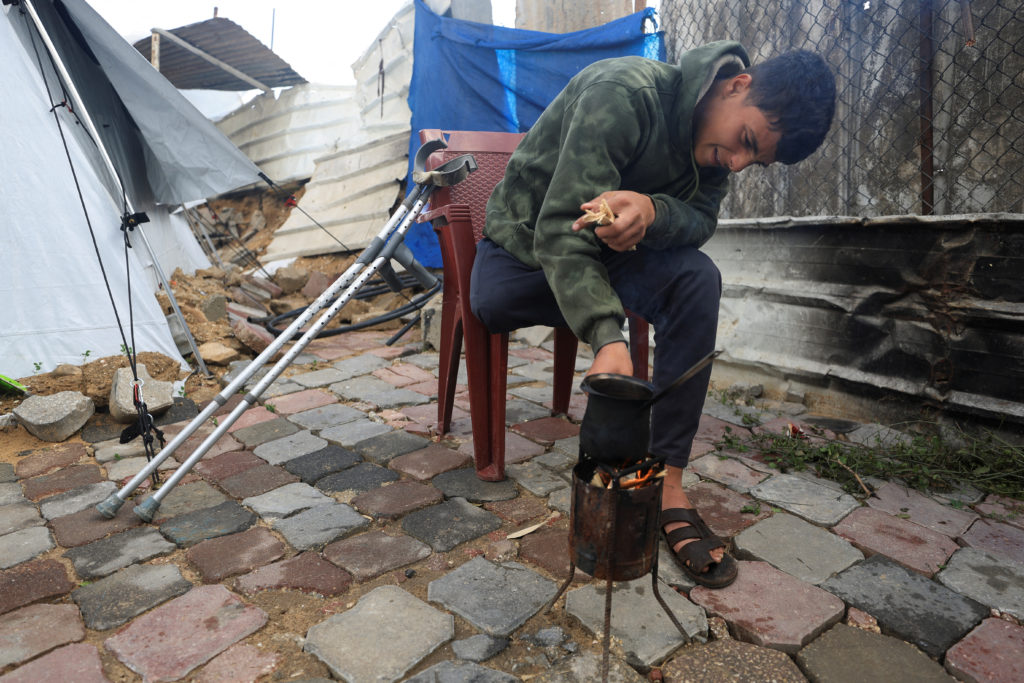
As U.S. President Donald Trump and allies promoted a new Gaza “Board of Peace” and a redevelopment vision at Davos, families in Gaza were digging through garbage for scraps of burnable material just to cook and keep children warm, according to an Associated Press report published by PBS NewsHour.
That contrast, between a future mapped out in conference rooms and a present measured in soot and cold, is now the story. It is not just a humanitarian snapshot. It is a political test of who gets to define “progress” in Gaza, and what counts as success while people are still living in tents.
Davos draws the blueprint, Khan Younis hunts for fuel
The AP report describes Palestinians at a garbage dump in the Muwasi area of Khan Younis searching with bare hands for plastic items to burn during winter damp and cold, after years of war and displacement. The same report says the scene stood in stark contrast to rhetoric at the World Economic Forum in Davos, where world leaders inaugurated Trump’s Board of Peace, a body presented as overseeing Gaza’s future.
At Davos, Trump claimed “record levels” of humanitarian aid had entered Gaza since an October U.S.-brokered ceasefire began, the report said. Jared Kushner and envoy Steve Witkoff, according to the same account, highlighted what they framed as development potential in the devastated territory.
Caretaker Government Defers Decision on Trump’s ‘Board of Peace’ Invitation
Thailand’s caretaker government has acknowledged an invitation from US President Donald Trump to join a proposed Board of Peace under Washington’s Comprehensive Plan to End the Gaza Conflict, but any… pic.twitter.com/Uq09I3ibr6
— Thai Enquirer (@ThaiEnquirer) January 23, 2026
On the ground, residents told a different version of the basics. The report says hundreds of thousands remained in displacement camps months into the truce, sheltering in tents and damaged buildings that do little against nighttime cold.
Gaza residents hear “Board of Peace” and ask: For whom?
The Board of Peace concept is being sold as a mechanism to oversee Gaza. But in the PBS-published AP report, skepticism is not subtle, and the questions are blunt.
One displaced man, Rami Ghalban, focused on the makeup of the committee. “This committee includes Israelis. I don’t understand, as citizens, how can we understand this situation?” he said, adding: “The Israelis that inflicted suffering upon us.”
Others sounded less ideological and more exhausted. “We are in a position where there are no alternatives,” Fathi Abu Sultan said. “Our situation is miserable.”
The political friction is obvious even without speeches. A board designed to project order and reconstruction meets a population still counting deaths, searching for fuel, and wondering if the new architecture is meant to change life or simply reframe it.
US President Donald Trump rescinded Canada’s invitation to join the #Gaza ‘Board of Peace’ after Prime Minister Mark Carney criticized economic coercion at Davos.https://t.co/GaiGwHtZqb pic.twitter.com/6lXTd9uRTJ
— The Palestine Chronicle (@PalestineChron) January 23, 2026
Ceasefire, but not silence
The AP report emphasizes that the ceasefire did not end violence. It cites recurring deadly strikes, including an incident in which Israeli tank shelling killed four Palestinians east of Gaza City, according to Mohamed Abu Selmiya, director of Shifa Hospital. The Israeli military did not immediately comment, the report said.
The same report says more than 470 people have been killed by Israeli fire in Gaza since the ceasefire began, according to Gaza’s health ministry, and at least 77 were killed by Israeli gunfire near a ceasefire line that splits the territory. The report notes the ministry is part of the Hamas-led government, but also says it maintains detailed casualty records that are seen as generally reliable by U.N. agencies and independent experts.
Those lines matter politically because they cut directly against the clean “post-war” framing. When the death count continues to rise during a truce, any glossy rebuilding narrative inherits an immediate credibility problem. People do not experience “recovery” if they still fear shells, bullets, and the night.
The survival math: burn plastic, risk the air
Even where aid has increased, the report says fuel and firewood remain scarce and expensive, and searching for wood can be dangerous. Hospital officials told AP that two 13-year-old boys were shot and killed by Israeli forces while trying to collect firewood.
For families, that is the ugly equation: pay prices they cannot afford, stay cold, or burn what is available even if it is toxic.
The report highlights Sanaa Salah, living in a tent with her husband and six children, describing fire-starting as a daily chore for warmth and cooking. She said the family cannot afford firewood or gas and knows the dangers of burning plastic, but sees no alternative. “Life is very hard,” she said. “We cannot even have a cup of tea.” She added: “This is our life. We do not sleep at night from the cold.”
Another resident, Aziz Akel, told AP his family has no income and cannot pay the 7 or 8 shekels (about $2.5) it would cost for firewood, the report said. “My house is gone and my kids were wounded,” he said. His daughter, Lina Akel, said he leaves early each morning to look for plastic in the garbage to burn, calling it “the basics of life.”
UN camp support: 970 sites, assistance at 40%
While political leaders talk about governance and redevelopment, the AP report points to the capacity limits of immediate relief. U.N. spokesperson Stephane Dujarric said U.N. partners managing displacement camps can support about 40% of the existing 970 sites across Gaza because of capacity and funding constraints, according to the report.
Dujarric said partners continue distributing tents, mattresses, sleeping bags, blankets, warm clothes, cooking utensils, and solar lights, the report added.
That statistic functions like a hard brake on the Davos storyline. Even generous visions depend on near-term logistics, funding, access, and security. If most sites are only partially supported, “rebuild” becomes something people hear about rather than something they live.
Three journalists killed, and fewer eyes on the war
The information battle is part of the power battle. The AP report says dozens of Palestinians mourned three Palestinian journalists killed when an Israeli strike hit their vehicle, according to Gaza health officials. It also notes one of the dead, Abdul Raouf Shaat, was a frequent contributor to Agence France-Presse, and that AFP demanded a full investigation.
The Israeli military said it struck after spotting suspects operating a drone that posed a threat to troops, according to the report.
The larger point is structural: the report says news organizations rely heavily on Palestinian journalists and residents to document what is happening because Israel has barred international journalists from entering Gaza, aside from rare guided tours.
That reality shapes what audiences worldwide see, what policymakers cite, and how competing narratives harden. When outside access is limited and local reporters are being killed, every claim becomes more contested, and every image carries more weight.
What to watch next: Rafah, money, and competing roadmaps
Beyond speeches, the AP report describes tangible next steps that could change daily life, if they happen.
Ali Shaath, described as head of a new future technocratic government in Gaza, said the Rafah border crossing would open in both directions the following week on the Gaza-Egypt border, the report said. Israel had said earlier it would open the Gaza side of the crossing but had not yet done so, according to the report. Reopening Rafah could make it easier for Palestinians to seek medical treatment or visit family in Egypt, the report added.
Then there is the money. The report says Russian President Vladimir Putin wanted to send $1 billion to the Board of Peace for humanitarian purposes if the U.S. unblocks the money, and that he met with Palestinian President Mahmoud Abbas in Moscow. “We believe that only forming and proper functioning of the Palestinian state can lead to a final settlement of the Middle East conflict,” Putin said.
Put that all together and the emerging picture is less a single plan than a collision of plans: Trump’s board and branding, Gaza’s immediate survival needs, Israel’s security posture, U.N. funding constraints, and international actors attaching conditions to cash.
Spain Opts Out of Trump’s Gaza-Linked “Board of Peace,” Citing Lack of Palestinian Role
Joining a wider EU holdout, Spain rejected the invitation, noting the board excludes the Palestinian Authority and conflicts with its commitment to UN-led conflict resolution. pic.twitter.com/vvWbxRsxS8— The Ground Narrative (@GroundNarrative) January 23, 2026
The Board of Peace may get its podium time. Gaza’s families, according to AP’s reporting, are still trying to find something that burns.