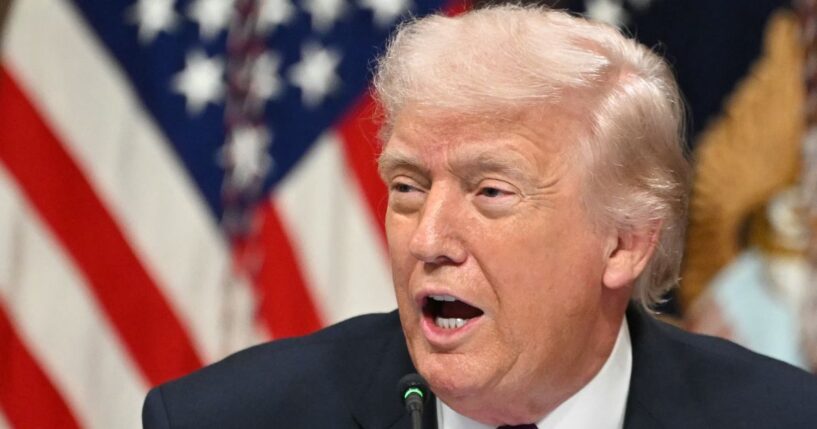
Trump is not just selling a voting bill. He is trying to turn the rest of Washington into collateral until it moves first.
What You Should Know
In comments aired March 11th, 2026, PBS reported President Trump said he would not sign other bills until the SAVE Act advances. The proposal would require proof of U.S. citizenship to register and require voter ID for in-person and mail voting.
The fight is less about the text of the bill than the leverage behind it. Trump is telling Congress that everything from routine legislation to must-pass compromises gets stuck behind a voting overhaul that critics say could block eligible voters and inflate federal control over elections.
Trump’s New Leverage Play
PBS NewsHour described Trump posting about the SAVE America Act after returning from Delaware, where he took part in an observance tied to the return of remains of six U.S. service members. The message was blunt, and it came with a governing threat: “must go to the front of the line. I as president will not sign other bills until this is passed.”
As outlined in the PBS segment, the bill would require Americans to prove citizenship when registering, and it would require voters to show an ID for in-person voting and voting by mail. Mail voters would need to include a photocopy of their ID, and states would be pushed to review voter rolls and share registration data with the federal government.
🚨 BREAKING: President Trump says he won’t sign ANYTHING until the “SAVE ACT” is passed!
“It supersedes everything else. MUST GO TO THE FRONT OF THE LINE. I, as President, will not sign other Bills until this is passed, AND NOT THE WATERED DOWN VERSION — GO FOR THE GOLD:#USA pic.twitter.com/RwfhQpYu8o
— Peter Brandt (@ptbrandtt) March 9, 2026
The Fraud Numbers vs. the Paperwork
The administration’s pitch rests on stopping noncitizens from voting, but the reporting also highlighted how small those cases appear to be. PBS cited a Department of Homeland Security study that reviewed 49.5 million voter registrations tied to the 2024 election and referred about 10,000 for additional investigation, roughly 0.02 percent.
PBS also pointed to a 2024 Georgia audit of its 8.2 million registered voters that found 20 noncitizens who had registered. Election law experts, including UCLA’s Rick Hasen, told PBS the legal risk is severe because falsely claiming citizenship on registration forms can be a felony with immigration consequences, all for a single ballot.
Public concern looks divided, not unanimous. PBS reported from a PBS News/NPR/Marist poll that 66 percent of Americans were confident their state or local government would run fair elections in November, down from 76 percent in October 2024, and that 33 percent named voter fraud as the biggest threat to safe and secure elections.
Who Gets Stuck Proving It
The political contradiction is that a bill framed as basic security could create new paperwork bottlenecks. PBS cited the Brennan Center for Justice’s estimate that more than 21 million Americans lack ready access to documents such as passports or birth certificates, and noted that about half of Americans do not have passports.
White House Press Secretary Karoline Leavitt defended the idea by comparing voting to everyday transactions that require identification, according to PBS. But the same report flagged a common real-world snag: name changes. A 2023 Pew survey cited by PBS found more than 80 percent of women and 5 percent of men change or hyphenate their names after marriage, which can force additional steps to align documents.
Then there is the extra-pressure talk around enforcement. PBS reported that Trump’s outside allies have urged him to declare a national emergency around elections, and that Trump denied considering it when asked. The segment also raised the question of the National Guard’s presence at polling places, the prohibition, and said the Senate was poised to take up the bill, noting a federal law was expected to fail.