


Donald Trump floated a big, glossy promise for Greenland: a U.S. hospital ship, en route, ready to treat people he said were “sick, and not being taken care of there.” Then a pesky detail surfaced: the Navy’s two hospital ships appear to be sitting in the same Alabama shipyard.
What You Should Know
Trump said the U.S. would send a hospital ship to Greenland, but Danish and Greenlandic leaders said they were not notified and that Greenland has free public health care. The Navy and the Pentagon referred questions about the ships to the White House.
The flashpoint landed in the middle of a touchy, months-long argument about who gets to call the shots in the Arctic, and what, exactly, Trump means when he talks about taking control of Greenland, a mineral-rich territory that is part of the Kingdom of Denmark.
The Claim Was Simple, the Logistics Were Not
In a Saturday night post on Truth Social, Trump wrote that the U.S. was going to “send a great hospital boat to Greenland” to take care of “the many people who are sick, and not being taken care of there,” adding, “It’s on the way!!!” He said the effort involved his special envoy for Greenland and Louisiana Gov. Jeff Landry.
Within hours, leaders in Greenland and Denmark were answering a different question: If this ship is really “on the way,” why does nobody in charge on the other end seem to know about it?
Danish Defense Minister Troels Lund Poulsen told Denmark’s public broadcaster DR that Danish authorities had not been informed the ship was headed to Greenland, according to reporting by the Associated Press carried by PBS.
Meanwhile, the Pentagon referred questions about the status of the Navy’s hospital ships, the USNS Mercy and the USNS Comfort, to the White House. The Navy also referred questions to the White House. The White House, according to the same report, did not immediately respond to repeated requests for details.
The contradiction was hard to miss. Trump suggested motion and urgency. Multiple official channels pointed away from the practical basics: which ship, which route, which timeline, and which approvals.
Greenland’s Prime Minister Said ‘No Thank You’ and Then Listed Receipts
Greenlandic Prime Minister Jens-Frederik Nielsen did not treat Trump’s post as a friendly offer. He treated it like a public allegation, one broadcast to Trump’s followers, that Greenland cannot take care of its own people.
“It’s a no thank you from here,” Nielsen said.
Then he went straight to the political nerve: the difference between Greenland’s system and America’s.
“We have a public health care system where treatment is free for citizens. That is a deliberate choice and a fundamental part of our society,” Nielsen said, adding that “that is not how it works in the USA, where it costs money to see a doctor.”
In other words, Nielsen was not just rejecting a ship. He was rejecting the premise, and he was doing it in a way that undercuts Trump’s populist framing.
Nielsen also delivered the kind of line that lands because it sounds like a leader running out of patience with performative diplomacy.
“Greenland is always open to dialogue and cooperation. But please talk to us instead of just making more or less random statements on social media,” he said.
The Submarine Evacuation That Lit the Fuse
Trump’s hospital ship post did not come out of nowhere. It followed a real medical incident near Greenland that was already public.
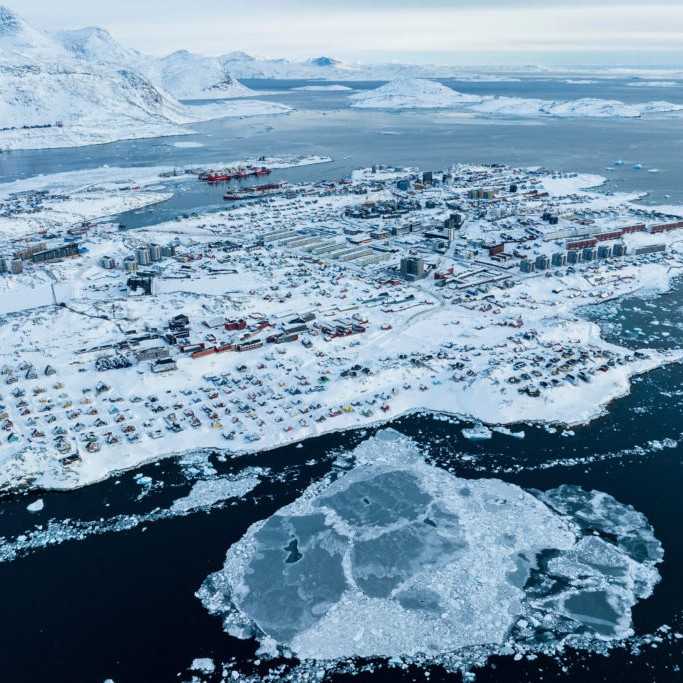
Denmark’s military said its Joint Arctic Command evacuated a crew member from a U.S. submarine off Greenland’s coast for urgent medical treatment. According to the Danish Joint Arctic Command, the evacuation happened about 7 nautical miles from Nuuk, Greenland’s capital, and the person was transferred to a hospital in the city after being retrieved by a Danish Seahawk helicopter deployed from an inspection ship.
That rescue, on its face, is the kind of allied cooperation governments usually celebrate. But in the current Denmark-Trump climate, it also becomes a story that can be repackaged into a very different message: Greenlanders are “not being taken care of,” and Washington has to ride in with a floating fix.
Denmark and Greenland, effectively, insisted the opposite. Their systems worked. Their forces executed the evacuation. The patient went to a hospital in Nuuk.
The Alabama Detail That Turned a Promise Into a Puzzle
Then came the Alabama wrinkle.
According to the PBS report, both USNS Mercy and USNS Comfort were shown in social media posts from a shipyard in Mobile, Alabama, with photos of the ships next to each other. The result was a fresh layer of questions that no official statement could quickly close.
If the ships are in maintenance, refit, or otherwise not mission-ready, that matters. If one is leaving, that matters even more. But the public trail, at least as reported, ran into a familiar wall: questions about the ships got bounced to the White House, and the White House did not provide specifics in response to repeated requests.
Even supporters who like the spectacle of a big promise tend to want the basics. Is there an order? A deployment? A schedule? Or is it just a post?
Denmark’s Stakes Are Not Just Pride, They Are NATO and Sovereignty
This is not a routine spat between capitals. Denmark is a NATO ally. Greenland is strategically located, and it sits at the center of modern Arctic competition, from military posture to shipping routes to access to critical minerals.
That is why Trump’s repeated talk about taking Greenland has landed less like a negotiating gambit and more like a stress test of the alliance itself.
The Associated Press report described the relationship as coming under severe strain in recent months as Trump “ratcheted up talk” of a possible U.S. takeover of the territory.
Danish Prime Minister Mette Frederiksen defended Denmark’s health care system in a Facebook post, saying she was happy to live in a country with free and equal access to health for all. She added that Greenland has the same approach.
In the power dynamic here, health care is not the whole argument. It is the stage. If Trump can paint Greenland as underserved, he can pitch U.S. involvement as benevolence instead of leverage. Denmark, for its part, responded like a government hearing the first notes of a familiar song: an offer that sounds optional, until it becomes a talking point, and then becomes a pressure campaign.
A Greenland Lawmaker Called the Ship ‘Poorly Maintained’ and ‘Rather Desperate’
Aaja Chemnitz, one of Greenland’s two representatives in the Danish parliament, escalated the critique with a different frame: not just “no thanks,” but what kind of help is this, exactly?
She wrote on Facebook that “Donald Trump wants to send a poorly maintained hospital ship to Greenland,” adding that it “seems rather desperate” and does not contribute to the long-term strengthening of the health care system she said Greenland needs.
Her point is political, but it is also tactical. A hospital ship is dramatic, and it is temporary. Permanent staffing, clinics, and medical infrastructure are not as cinematic, and they do not come with a photo that screams “rescue.”
Chemnitz added a postscript that captured how quickly Greenland’s leaders are learning to treat Trump-era communications as a genre of their own: “Another day. Another crazy news story.”
What Happens Next Is a Test of Who Controls the Narrative
There are two storylines competing for oxygen.
One is Trump’s: Greenland needs help, America is providing it, and the proof is a ship that is supposedly already moving.
The other is Denmark and Greenland’s: the health system exists, the allies already cooperate when emergencies happen, and Washington is freelancing in public without coordinating in private.
The next concrete detail will decide which storyline wins the next news cycle. If a ship actually deploys, Denmark will have to decide how loudly to object, and whether to treat it as an unwanted PR incursion or a sovereignty problem. If no ship deploys, Trump’s post becomes something else: a promise that functioned more like a pressure tactic than a plan.
Either way, the Arctic keeps getting dragged into a familiar Trump framework. Make a maximal claim. Let the bureaucracy scramble. Force allies to respond. Then measure who blinked first.