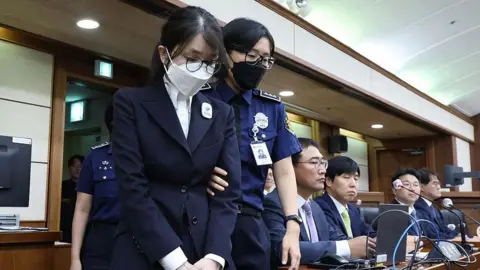
South Korea just wrote a new rule for political gravity: even the spouse can go down, and not as a footnote.
Kim Keon Hee, the former first lady and wife of disgraced ex-President Yoon Suk Yeol, was sentenced to 20 months in jail after a court found her guilty of accepting bribes from Unification Church officials. She was cleared on other major charges. Two more cases are still waiting in line.
It is a verdict built on luxury goods, influence, and the kind of proximity to power that usually comes with plausible deniability. This time, the court did not buy the clean-hands story.
A Historic First: Indicted While Detained
The headline fact is not just the sentence. It is the precedent.
According to the BBC, the case marks the first time in South Korea’s history that a presidential spouse has been indicted while detained. That is a seismic shift in a system where proximity to the Blue House has often meant insulation, or at least delay.
Kim, 52, denied the charges against her, including allegations of bribery, stock manipulation, and political interference. The court’s mixed verdict effectively split her public image into two competing stories. One is about corruption and access. The other is about accusations that could not be proven in court.
But the bribery conviction is the one with teeth, and it has now put an official number on her legal exposure: 20 months.
The Bribery Conviction, and the Charges That Fell Apart
Prosecutors accused Kim of accepting luxury bags, a diamond necklace, and other gifts worth up to 80 million won as bribes from Unification Church figures in exchange for business favors, the BBC reported.
The court convicted her on that bribery count.
At the same time, Kim was cleared of charges related to alleged stock price manipulation and violations of South Korea’s campaign financing laws, according to the BBC’s account of the ruling. That matters because those allegations carried a different kind of sting: not just a whiff of influence peddling, but a claim of active engineering of money and politics.
Prosecutors had alleged she made more than 800 million won by participating in a price-rigging scheme involving Deutsch Motors stock between October 2010 and December 2012, the BBC reported. The court did not convict her on that piece.
The result is a narrow but brutal landing. She is going to prison, but not for everything the prosecution threw at her.
The Chanel Bag Video, the Receipt, and a Line That Keeps Echoing
If Kim Keon Hee has a signature scandal, it is the handbag scandal. Not because the bag is the most significant alleged benefit, but because it is the most visually legible.
The BBC reported that spy camera footage surfaced in late 2023 showing Kim receiving a luxury handbag in September 2022. The pastor Choi Jae-young allegedly filmed it with a camera embedded in his watch. The footage appeared to show him buying a grayish-blue calfskin bag, with a receipt listing the price at 3 million won.
Then comes the kind of moment politicians dread because it sounds real. In the video, Kim is quoted as asking: “Why do you keep bringing me these things?”
South Korea’s anti-graft rules make it illegal for public officials and their spouses to receive gifts worth more than 1 million won at once, or more than 3 million won in total within a fiscal year, the BBC noted. In other words, the receipt figure sits right on the legal tripwire, which is precisely why it became political dynamite.
And the official response did not cool it down. The BBC reported that the Korea Herald said the presidential office confirmed receipt of the bag and said it was “being managed and stored as a property of the government”.
That line is the classic damage-control move, but it also implicitly concedes the core fact that mattered to the public: the bag arrived, and the system had to decide what to do with it.
Even so, Wednesday’s verdict did not center on that specific bag video. The court focused on alleged bribes from the Unification Church, alongside other allegations that did not result in convictions, the BBC reported.
Kim denied the charges, though she admitted to receiving Chanel bags and said she returned them unused, according to the BBC.
The Resume Apology, and the Promise That Didn’t Age Well
The Kim story is not a single scandal. It is a pattern of accusations that pile up, then mutate into a larger question: what was the first lady’s role in the machinery of power?
Before the presidential years, Kim was known as a businesswoman and art lover. She founded the exhibition company Covana Contents in 2009 and remained its CEO and president, the BBC reported.
She also carried personal controversies into national politics. The BBC reported that Sookmyung Women’s University annulled her degree in 2025 after its research ethics panel found her thesis was compromised, following repeated plagiarism allegations. The BBC said she has never commented publicly on those allegations.
Then came the pre-election credential scandal. As Yoon ran for president, Kim faced allegations that she submitted applications with false qualifications and awards. She responded with a public apology for what she called “exaggerations” on her resume, the BBC reported.
She also offered a pledge that reads differently in hindsight: if her husband became president, she would “focus solely on my role as his wife”.
That promise is now trapped in a collision with the allegations that followed, including claims of political interference and influence trading. Even with acquittals on some counts, the bribery conviction makes the promise look less like a boundary and more like a slogan.
Two Cases Still Pending, and a Country Watching the Next File
The legal story is not over. The BBC reported that there are still two cases against Kim that the court has yet to hear.
That is the part that matters for South Korea’s political class, including Yoon’s allies and his enemies. A conviction can be absorbed. A continuing cascade is more complex to contain because it invites new witnesses, new documents, and new political betrayals.
Prosecutors, the BBC reported, sought a 15-year prison term and a 2 billion won fine. They argued she had “stood above the law” and claimed she colluded with the Unification Church to undermine the “constitutionally mandated separation of religion and state”.
The court did not give prosecutors their maximum ask. But it gave them the one result that matters most in public life: a guilty verdict that can be stated in a single sentence.
Yoon’s Prison Sentence Turns a Personal Scandal Into a System Story
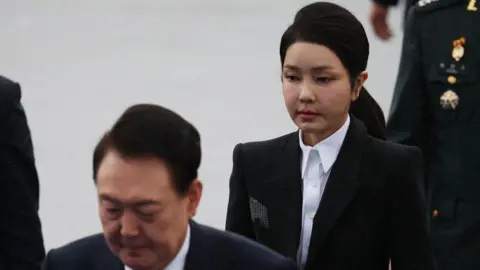
Kim’s verdict lands in a politically toxic window because her husband has already been sentenced.
Less than two weeks earlier, the BBC reported, Yoon was sentenced to jail for abusing power and obstructing justice in connection with his failed bid for martial law. The BBC said he was sentenced to five years in prison after being found guilty of abuse of power, falsifying documents, and obstructing justice tied to the 2024 episode.
The judge, the BBC reported, said Yoon’s actions “plunged the country into political crisis” and noted that he had “consistently shown no remorse”.
Put the two cases side by side, and the stakes shift. This is no longer just about whether a spouse accepted luxury goods or whether a politician overreached in a moment of panic. It becomes a broader test of whether institutions will punish an entire power circle, not just the one person who signed the decree or held the title.
What To Watch Next: The Evidence Trail, and Who Runs From It
Kim Keon Hee’s legal future now runs on two tracks at once. One is the sentence already imposed. The other is whatever comes out of the remaining cases still pending.
In political scandals, the most dangerous phase is rarely the first conviction. It is the moment when people around the accused begin to calculate whether loyalty is still worth the cost.
For South Korea, the question is not just whether a former first lady goes to prison. It is whether this era leaves behind a new expectation that the people closest to power can be investigated, charged, and sentenced without waiting for the political weather to change.