


Norway’s royal household has a message it keeps returning to, like a shield held out at arm’s length: Marius Borg Hiby is not part of the royal family. He is not a public figure.
Then a seven-week rape trial starts in Oslo, the world’s press packs the courthouse, and that neat boundary line gets stress-tested in real time.
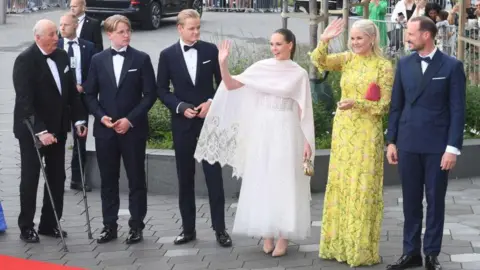
Because Hiby is not some distant acquaintance. He is the 29-year-old son of Crown Princess Mette-Marit, and the stepson of Crown Prince Haakon, the heir to the throne. The palace can call him private, but the country knows exactly where he fits in the family photo.
A Palace That Wants Distance, and a Case That Won’t Allow It
Hiby is due to appear in room 250 at Oslo District Court, in what the BBC described as Norway’s biggest trial in years. The court has banned pictures of him inside and outside the building, but the spectacle is still going global, fueled by the basic contradiction at the heart of the story.
On one side, the palace’s attempt to shrink him down to a private citizen. On the other, the reality that the accused has spent much of his life adjacent to the throne, known to the public since childhood, and treated like family by the most powerful names in Norway.
Even the royal calendar becomes part of the optics. According to the BBC, neither Crown Princess Mette-Marit nor Crown Prince Haakon is expected to attend the trial, and King Harald V and Queen Sonja also will not be there.
What Hiby Is Accused of, and What He Admits
The stakes are not abstract. The BBC reported Hiby faces 38 charges, including four rape allegations, plus assault and threats involving a girlfriend, property damage, drug charges, and driving offenses. If convicted, he could face more than 10 years in prison.
According to the BBC’s account of the indictment, the alleged rape charges span from 2018, at Skaugum, the official residence of the crown prince and crown princess, to November 2024, after Hiby’s initial arrest. The BBC reported the accusations include sexual activity while the women were incapacitated, which can meet Norway’s legal definition of rape.
Hiby has admitted to some lesser offenses, the BBC reported, including acknowledging physical abuse and destroying objects after his arrest. The indictment described alleged violence and degradation, including tearing down a chandelier, throwing a knife at a wall, and shattering a mirror, along with slurs aimed at the woman involved, according to the BBC.
His defense, however, disputes most of the case. In a statement cited by the BBC from defense counsel Petar Sekulic, the message is: take it seriously, deny the core accusations.
“Hiby is absolutely taking the accusations very seriously, but doesn’t acknowledge any wrongdoing in most of the cases , especially the cases regarding sexual abuse and violence.”
The legal fight, in other words, is set up to be total, not technical. The most explosive allegations are not being negotiated in public. They are being contested.
The 1 Woman Who Can Be Named, and the Price of Going Public
Trials like this have two sets of consequences: the verdict and the collateral. The BBC reported that multiple women are expected to give evidence, not only those involved in the rape allegations. But only one can be identified publicly.
Former girlfriend and social influencer Nora Haukland sought anonymity, the BBC reported, but the courts rejected her appeal. The BBC said allegations she previously made publicly are part of the indictment, including claims of physical violence and choking, and that she said he shouted a slur at her.
His defense denies those serious allegations, the BBC reported, and also disputes a charge added more recently involving transporting 3.5 kilograms of marijuana.
That detail matters for a different reason. It signals the case is not frozen in time. Charges can shift, expand, and harden, and every new allegation amplifies the pressure on the palace’s chosen posture of distance.
Haakon’s Tightrope: Family Loyalty vs. Public Responsibility
If the palace wants the public to see Hiby as separate, Crown Prince Haakon’s own words complicate the message. The BBC reported Haakon spoke to reporters ahead of the trial and addressed both family and alleged victims in one breath.
“We love him, of course, he’s an important part of our family.”
Then, the BBC reported, he pivoted directly to the women and their families.
“We care about them. We know many of you are going through a difficult time right now.”
It’s a rare public balancing act. The future king is signaling loyalty to someone he considers a son, while also trying to show the state, the court, and alleged victims that the institution is not closing ranks against them.
But the tightrope is visible, and visibility is the problem a monarchy cannot fully control.

Mette-Marit’s Illness, and a Second Crisis on the Same Timeline
The trial would be a brutal test for any family. Here, it runs alongside another vulnerability at the top of the monarchy.
The BBC reported Crown Princess Mette-Marit is seriously ill with pulmonary fibrosis, and her doctors are preparing her for a lung transplant. The BBC also reported she spoke personally in an NRK documentary about criticism of her parenting and the family’s handling of her son’s struggles.
“What I’m perhaps most upset about is being criticised for how we’ve handled it as parents. That we haven’t taken it seriously, I find that difficult. To be so harshly criticised in a situation where we’ve tried to do the best we can and sought professional help… so it feels a bit unfair.”
That quote does a lot of work. It frames the family as seeking professional help, and it frames the public as judging without full access to the private story.
But the legal system does not operate on family framing. It operates on testimony, evidence, and a charge sheet that, in this case, repeatedly drags the crown’s physical spaces and relationships into the record.
Norway’s Monarchy Vote Lands on the Same Day
Then there is the calendar coincidence that feels a little too neat to ignore. The BBC reported that every four years, Norway’s parliament, the Storting, holds a vote on replacing the monarchy, and that it comes up again on the same day the trial begins. The BBC said no one expects the vote to succeed.
Still, symbolism is the monarchy’s native language. A trial that centers on alleged violence and sexual assault, tied to a man raised in the royal orbit, beginning as lawmakers formally revisit whether the country should keep the institution at all, is the kind of overlap that turns a criminal case into a national test of confidence.
The BBC reported a Norstat survey late last year put support for the monarchy at 73%, suggesting many Norwegians separate the trial from their overall view of the royals. That is the best-case scenario for the palace: containment.
The risk is that containment starts to look like avoidance. The BBC reported the palace has been keeping well away from court, while global media attention increases.
What to Watch Next
For seven weeks, the courtroom will become the only stage that matters, even if cameras are barred. Watch for three things.
First, how the prosecution builds the timeline across multiple alleged victims, and whether the court record ties key events to royal properties and family proximity in a way the palace cannot talk around.
Second, how the defense positions the admissions on lesser offenses alongside denials of sexual abuse and violence. That split can shape how the public reads credibility without deciding guilt.
Third, what the palace does when it cannot do the one thing it prefers: say nothing. In a monarchy, silence is not neutral. It is interpreted.
Norway’s royals have long benefited from a national image of accessibility and restraint. The question now is whether that same openness makes it harder to keep a scandal at the edge of the crown, especially when the accused has never truly lived outside its shadow.