

The Grammys are supposed to be about the music. Then the cameras hit the carpet, and suddenly it’s about who controls the story before the first note is sung.
This year, the BBC’s red carpet roundup read less like a fashion scrapbook and more like a field report from a glossy battlefield. The looks were loud, but the messaging was louder: old-Hollywood power plays, luxury flexes, and at least one blunt little slogan pinned to a celebrity chest.
Because when Justin and Hailey Bieber walk in wearing matching badges that say “Ice out,” that’s not just styling. Thats positioning.
The Carpet Is the Pre-Show, and Everyone Knows It
The BBC documented a familiar Grammys rhythm in Los Angeles: stars arrive, photographers funnel them through the same tight lanes, and a night’s worth of headlines gets decided in a few minutes of poses.
On paper, it’s harmless: a gowns-and-suits slideshow before the main show. In practice, the red carpet is a high-stakes media negotiation. Artists and brands want dominance. Publicists want clean images. Fans want proof that their favorite is winning even before the trophies come out.
That tension is baked into the Grammys. The awards are a music institution, but the carpet is an attention economy. And attention has its own rules.
Sabrina Carpenter Went Full Marilyn, With Diamonds Doing the Talking
One of the clearest plays, per the BBC, was Sabrina Carpenter arriving in a crystal and diamond gown, reminiscent of Marilyn Monroe.
That reference is not subtle. Monroe is still an international shorthand for fame, spectacle, and a kind of blonde, camera-ready mythology that outlives the person. Borrowing that silhouette, or even flirting with it, is a way to say: I’m not just nominated, I’m an image.
The BBC also noted Carpenter’s Grammy-nominated album is titled “Man’s Best Friend,” which only sharpens the contrast. An album title that sounds playful, even domestic, paired with a look designed for maximum spotlight.
In other words, the outfit is not there to match the music. It’s there to outrun it.
The ‘Ice Out’ Badges: A Slogan in the Middle of the Frame
The Biebers’ badges were the kind of detail that might have been overlooked a decade ago. Now it’s the point.
“Ice out.”
Two words, on black outfits, on a carpet engineered for close-ups. Whether it’s a jewelry nod, an inside joke, a brand tease, or simply a flex, the move works because it’s legible. You don’t need a caption. You don’t need a deep read. The phrase carries its own meaning in pop culture: diamonds, shine, status, money.
That is the red carpet in 2026. Even the accessories are trying to go viral.
Bad Bunny, Lady Gaga, and the Luxury of Going Simple
Not every power move is maximalist. Sometimes it’s choosing not to play the same game as everyone else.
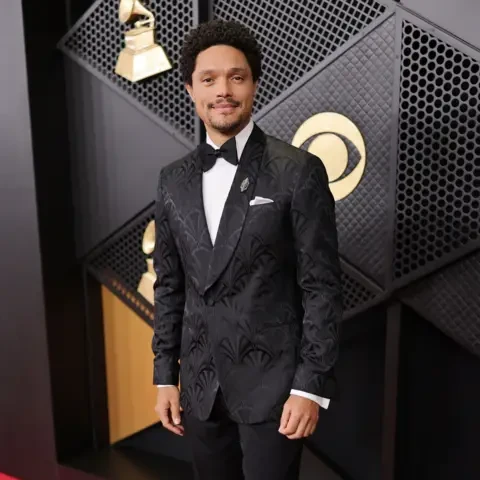
The BBC described Bad Bunny in a classic tux and bow tie. In a room full of engineered spectacle, classic menswear can read like confidence. It also keeps the focus where his team might want it: on nominations, performance moments, and whatever gets said on stage.
Lady Gaga, meanwhile, was described as returning to the feathered look she debuted at last years ceremony. Repetition can be its own strategy. When an artist is already a walking reference point, recycling a signature element is a reminder: the brand is stable, and the audience knows it.
Consistency is a form of leverage. Not everyone has it.
Addison Rae, Kesha, and the Stiletto Arms Race
If there was a theme in the BBC list, it was extremity disguised as elegance.
Addison Rae, a best new artist nominee, brought what the BBC called very, very high stilettos, paired with a fitted white Alaia-designed dress. A look like that does two jobs at once. It sells fashion credibility, and it dares photographers to miss the shot.
Kesha, per the BBC, arrived late and made an entrance in an all-white dress with bare shoulders. Timing matters on carpets. Showing up later can mean fewer competitors for attention, but also a higher risk if the cameras have moved on. The point is to arrive when the lens is hungry.
That’s the quiet math under the glitter: where do you stand, when do you show, and how do you force the room to notice?
Pharrells Pink Suit and the Perks of Being the Boss
The BBC also clocked Pharrell Williams in a pink velour suit, with a line that carried more than a little insider wink: as men’s creative director for Louis Vuitton, he probably got a discount.
Whether he did or didnt is almost beside the point. The line highlights the modern celebrity stack: musician, executive, designer, brand. People like Pharrell don’t just wear fashion. They help decide what fashion is, then profit from the decision.
On a night like the Grammys, that kind of role overlap matters. It blurs the old categories. Artist, influencer, executive, and luxury ambassador become the same job title.
Tribute Hugs, New Groups, and the Real Prize: Camera Time
The BBC noted Yungblud gave Sharon Osbourne a big hug ahead of a performance tribute to the late Black Sabbath star. On an awards carpet, a public hug can work like a press release. It signals affiliation and respect, and it frames a moment as bigger than self-promotion, even though it still lands in headlines.
Katseye also got a mention for catching the eye, with the BBC noting nominations for best new artist and best pop duo/group performance for their track “Gabriela.” For newer acts, the carpet can be make-or-break. A memorable look can be the difference between being one of many nominees and being the group people search for before the broadcast ends.
And Rose, per the BBC, was photographed shortly before kicking off the ceremony with a performance alongside Bruno Mars. Thats another reminder of how carefully the night is staged. Even the red carpet images are part of a larger sequence: photo, performance, clip, replay.
Olivia Dean and the Narrative Everyone Wants
The BBC framed Olivia Dean as a standout success on the night. That matters because awards shows run on narrative: breakout star, comeback, icon, underdog, new face, or unstoppable machine.
But the carpet can complicate those narratives, too. If you’re positioned as the fresh, real, music-first artist, and you show up dressed like a luxury campaign, that’s not necessarily hypocrisy. It is, however, a reminder that the modern music industry is not just about songs. Its about attention, brand safety, and leverage.
The Grammys are one of the few nights when all of that is visible at once.
What to Watch Next
The dresses and suits will keep circulating long after the winners’ list gets stale. Watch which images get reposted by brands, which outfits turn into memes, and which small details become talking points. The badges. The feathers. The stilettos. The Monroe echoes.
Because the red carpet is not a sideshow anymore. It’s where the power gets negotiated, in public, under bright lights, with everyone pretending it’s just fashion.