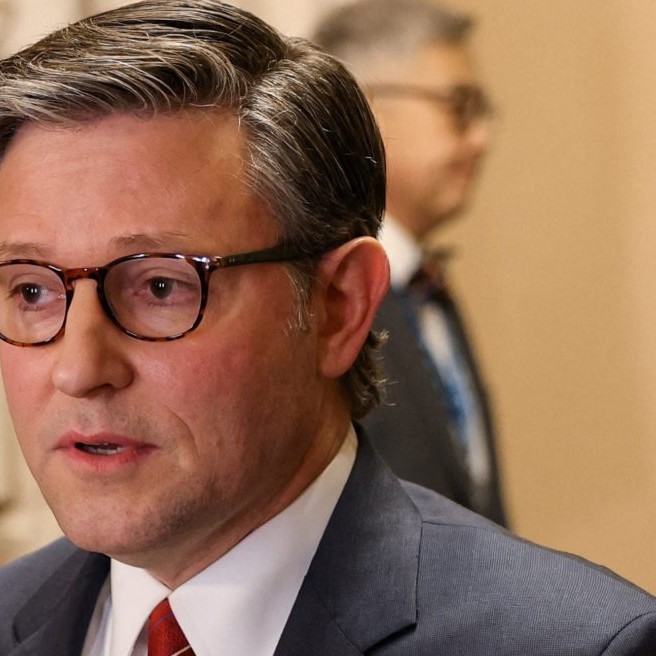
House Speaker Mike Johnson had a simple, high-stakes question put to him at the U.S. Capitol. If federal law enforcement is getting deployed into American cities as part of an immigration crackdown, do the rules need to change to protect civil liberties?
He did not answer it directly. He answered the politics around it.
On camera, Johnson, a Louisiana Republican and the most powerful elected official in the House, leaned on trust. Trust in the Department of Homeland Security. Trust in its leadership. Trust, he said, in Tom Homan, President Donald Trump’s so-called border czar.
That is not a small dodge. It is the entire governing argument in one move, because Congress was simultaneously wrestling with the only lever it always has: the money.
The Question Was Oversight, the Answer Was Deference
The exchange came after PBS News’ Lisa Desjardins asked Johnson whether federal law enforcement agencies deployed to American cities should make changes to protect civil liberties. It was the kind of question that forces a yes-or-no posture on accountability: oversight, limits, guardrails, and transparency.
Johnson’s response, as PBS framed it, was not a direct engagement with specific safeguards. Instead, he said he had “great faith and trust in the leadership” at the Department of Homeland Security, singling out Homan, whom he called the president’s “border czar.”
Then Johnson offered a broad principle, paired with a handoff to unnamed professionals.
“We all believe that immigration policy ought to be balanced and strategic and smart, and it obviously needs to comply with the law,” Johnson said. “I’m going to leave it to the experts to determine what that is.”
In Washington, that is not neutral language. “Leave it to the experts” is often what officials say when they want to keep an argument out of the public record, especially when the argument involves civil liberties, enforcement powers, and the optics of federal agents operating in city streets.
Money Was Moving While the Civil Liberties Debate Hung in the Air
Johnson’s comments landed the same day the House narrowly passed legislation aimed at ending a partial government shutdown. That package is headed to Trump, who could sign or veto it, according to PBS.
The spending deal, as PBS described it, finished work on 11 of the 12 appropriations bills and funded most of the government through September 30. But DHS, the department that sits above Immigration and Customs Enforcement, received its own short-term spending patch.
That is the pressure point. Democrats, PBS reported, pushed for reforms and restrictions tied to immigration enforcement. A short-term patch means the fight is not over. It means the next bill becomes a vehicle for conditions, and conditions become a proxy war over whether enforcement expands with few new constraints or expands with new rules attached.
So the question Johnson dodged is not just theoretical. It is the kind of question that shapes what lawmakers try to put into the next funding text, and what the administration resists.
Minneapolis, Cameras, and a Telltale Signal About Risk
The civil liberties question did not appear out of thin air. PBS has been tracking enforcement-related fallout in Minneapolis, including a DHS move to put body-worn cameras on Homeland Security officers there, a step that implicitly acknowledges public concern about how officers behave, what gets recorded, and what evidence exists after the fact.
Body cameras are a familiar political compromise. Agencies point to them as proof of professionalism and transparency. Critics argue that cameras do not matter if policies for activation, retention, public release, and discipline are loose or controlled by the same chain of command the public is being asked to trust.
Either way, cameras are not usually rushed out when everything is calm. They are installed when officials expect allegations, disputes, or litigation risk.
The Speaker’s Tightrope: Back the Crackdown, Avoid the Details
Johnson is trying to hold two competing positions together without letting them collide on live television.
Position one is political alignment with Trump’s immigration posture and with hardline messaging that plays well in Republican primaries. Position two is institutional insulation for Congress’s own role. If lawmakers fund an enforcement expansion, and something goes wrong, the public record matters. A crisp answer about civil liberties would create measurable promises, and measurable promises create measurable failures.
So Johnson chose a third path: deference. He affirmed that immigration policy should be “balanced” and legal, then shifted responsibility to “the experts.” In practical terms, that means DHS leadership and the Trump-aligned figures Johnson highlighted get the benefit of the doubt in public while Congress keeps negotiating the fine print in private.
That approach also minimizes daylight between House leadership and the administration on a day when the House needed votes to move funding. It is easier to herd a narrow majority when leaders are not publicly entertaining restraints on the crackdown that the base expects.
Why People Care: Enforcement Power Is Expanding, and So Is the Blowback
The stakes are not abstract. When federal immigration enforcement expands into cities, the collision points are predictable: arrests, detentions, mistaken identity claims, questions about probable cause, questions about who is targeted, and disputes over transparency when journalists, lawyers, or local officials start documenting encounters.
PBS also pointed to backlash tied to arrests of journalists as anti-ICE protests spread from Minneapolis. That is the kind of development that turns an enforcement debate into a civil liberties debate fast, because it drags in First Amendment issues, credentialing, and whether law enforcement is treating newsgathering as interference.
In that environment, a Speaker saying, effectively, trust DHS, trust Homan, becomes more than a talking point. It becomes a bet that the administration’s tactics will not produce images, lawsuits, or court rulings that force Republicans to choose between defending the crackdown and defending civil liberties principles they also claim to champion.
What to Watch Next: DHS Funding as the Real Battlefield
Johnson’s non-answer puts extra weight on the next funding negotiation, because that is where Congress can force clarity without getting it in a press conference.
Questions that were dodged at the microphone tend to come back as legislative language. If Democrats have the leverage, they can push for items like clearer use-of-force reporting, stricter body camera policies, limits on certain operations, or stronger protections for journalists and observers. If Republicans hold the line, DHS could get money with fewer new constraints, and enforcement will keep running on executive discretion.
Meanwhile, Johnson has staked out a public posture that is easy to repeat and hard to falsify in the moment: the law must be followed, and the experts will handle it. The trouble is that civil liberties controversies are rarely settled by trust. They are settled by records, policies, and court fights over what the government is allowed to do.
References
- PBS NewsHour: Watch: Johnson Dodges Question on ICE and Civil Liberties
- PBS NewsHour: Every Homeland Security Officer in Minneapolis Is Getting a Body-Worn Camera, Noem Says
- PBS NewsHour: Arrests of Journalists Fuel Backlash as Anti-ICE Protests Spread from Minneapolis
- PBS NewsHour: Watch Live: House Holds Key Procedural Vote on Government Funding to End Partial Shutdown