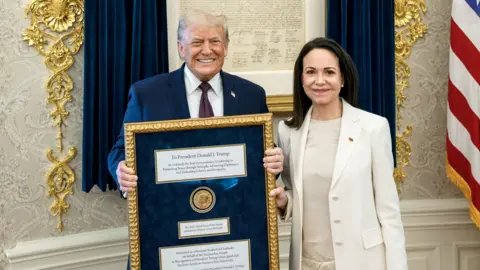
Maria Corina Machado walked into the White House carrying one of the most symbol-heavy objects on Earth, a Nobel Peace Prize medal. She walked out, saying Venezuela could count on President Donald Trump. The unanswered question was the one her supporters wanted settled in plain English. Was Trump ready to pick a side in Venezuela’s transition, or just take the photo?
That tension, the gift versus the endorsement, is now the storyline after Machado met Trump and literally placed her Nobel hardware in his hands. Trump called it “a wonderful gesture of mutual respect” on social media. The Nobel committee, meanwhile, pointed out a colder fact. The prize itself is not transferable.
A Medal on the Table, and a Leadership Question Still Hanging
According to BBC News, Machado, Venezuela’s opposition leader, gave Trump her Nobel Peace Prize medal during a White House meeting, framing it as recognition of his “commitment to her country’s freedom.” It was their first in-person meeting, coming weeks after an extraordinary US move in Caracas.
US forces seized Venezuelan President Nicolas Maduro in Caracas on 3 January, and the US charged him in a drug-trafficking case, according to the BBC. Maduro has not been convicted, and the case now sits at the center of a fast-moving political transition with major oil stakes.
Machado, whose movement claims it won Venezuela’s widely contested 2024 elections, has been viewed by many supporters as the face of the post-Maduro future. Trump has repeatedly praised her, even calling her a “freedom fighter” in the past. But the White House has stopped short of endorsing her as Venezuela’s new leader.
That gap is what makes the medal moment bigger than a feel-good gesture. Machado brought a world-class symbol of legitimacy. Trump, so far, is keeping his official relationships elsewhere.
Trump’s Other Channel: Delcy Rodriguez
While Machado’s coalition pushes for recognition, Trump has instead been dealing with Venezuela’s acting head of state, Delcy Rodriguez, Maduro’s former vice-president, according to the BBC report.
Trump did not slam Machado. He actually praised her after the meeting, calling it a “great honor” to meet her and describing her as “a wonderful woman who has been through so much.” The compliments were public. The endorsement was not.
It is a classic Washington split-screen. One meeting signals moral support. Another channel controls the paperwork, the oil, and the diplomatic reopening.
Outside the Gates, Machado Delivered Her Message
After leaving the White House, Machado addressed supporters gathered outside. The Associated Press quoted her telling the crowd in Spanish: “We can count on President Trump.”
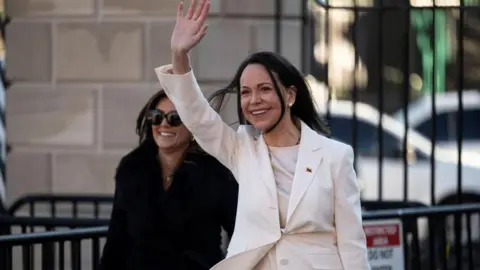
She repeated the core point to journalists in English, again per the BBC account: “I presented the president of the United States the medal of the Nobel Peace Prize,” calling it “a recognition for his unique commitment with our freedom.”
Then came the political soundtrack. Supporters chanted “Maria, presidente” as she visited Congress to meet US senators, drowning out parts of her remarks, the BBC reported.
In other words, Machado’s side is campaigning in public, at the gates, in the halls, and on camera. Trump’s side is governing through channels and leverage.
The White House Talks Bravery, but Keeps Options Open
White House Press Secretary Karoline Leavitt told reporters during the meeting that Machado is “a remarkable and brave voice for many of the people of Venezuela,” and said Trump was expecting “a frank and positive discussion” about the realities of life in Venezuela, according to the BBC.
Those lines validate Machado as a figure. They do not validate her as the figure. That distinction matters because Trump has given a practical reason for holding back. He has argued that Machado lacks sufficient domestic support for a leadership appointment, even while describing her in admiring terms, the BBC reported.
For Machado, the medal drop looks like a move to narrow that distance. For Trump, it reads like a way to accept the tribute while maintaining flexibility.
Opposition Allies Insist It Was Not a Quid Pro Quo Play
Freddy Guevara, co-founder of the Venezuelan opposition party Voluntad Popular and a former political prisoner of Maduro, now in exile, told the BBC he did not think Machado was “looking for endorsement” by giving Trump the prize, or using it as a tactic so Trump could appoint her.
Guevara said Machado believes it is “the right thing to do for the freedom of Venezuela,” and emphasized a democratic endgame: the opposition’s focus is securing elections so Venezuelans decide through votes who governs.
That claim is designed to defuse the obvious critique. A Nobel medal handed to a US president can look transactional to skeptics, especially when the Nobel committee itself says the prize is not transferable. Guevara’s framing is that the gift is symbolic support for the broader project, not personal coronation.
Follow the Money: $500m Oil Sale and Seized Tankers
Even as the political theater played out in Washington, the Trump administration was moving quickly on Venezuela’s oil sector, which had been under US sanctions. An American official said the US completed its first sale of Venezuelan oil valued at $500m (373m), according to the BBC report.
US forces have also seized oil tankers suspected of transporting sanctioned Venezuelan oil. The BBC reported that US forces said they had boarded a sixth tanker on Thursday.
Those are not side plots. They are leverage, and they are also a signal that the US intends to shape the post-Maduro reality with control over flows of crude, revenue, and maritime enforcement. Guevara acknowledged the oil gravity to the BBC, saying he did not think US actions were “just related to oil,” while adding, “we are not naive.”
Diplomacy Is Creeping Back In, With Rodriguez Sounding Confident
The New York Times reported a Venezuelan government envoy was expected to travel to Washington to meet US officials and take initial steps toward reopening the country’s embassy, according to the BBC summary. The emissary is reported to be a close ally and friend of Rodriguez, who the White House has described as “extremely cooperative.”
Rodriguez is also projecting her own posture publicly. In her annual Message to the Nation speech in Caracas, she said she was willing to attend meetings in Washington. The BBC quoted her as saying: “If I ever have to go to Washington as acting president, I will do so standing tall, walking, and not crawling,” and urged Venezuelans not to fear diplomacy with the US.
Then came the clincher detail for anyone tracking Trump’s personal readouts. Trump and Rodriguez spoke by phone, and Trump later described her as “a terrific person” on social media, according to the BBC. Rodriguez called the exchange “productive and courteous,” and marked by “mutual respect.”
What To Watch Next: The Endorsement Test Versus the Governance Reality
Machado’s medal moment is easy to clip, easy to share, and easy to misunderstand. One side sees gratitude. Another sees a hard sell. The Nobel committee’s non-transferability note adds an awkward footnote, but the politics were never about legal ownership of metal. They were about ownership of the transition narrative.
The measurable actions, for now, are elsewhere: oil sales, tanker boardings, embassy steps, and official communications with Rodriguez’s interim administration. Machado can fill the streets and the gates. Rodriguez can pick up the phone.
Trump now has two Venezuelan stories in his hands. One comes with a Nobel medal and chants of “presidente.” The other comes with deals, diplomacy, and $500m in oil. The next signal worth watching is not another photo. It is whether the White House ever turns private praise into a public pick.