

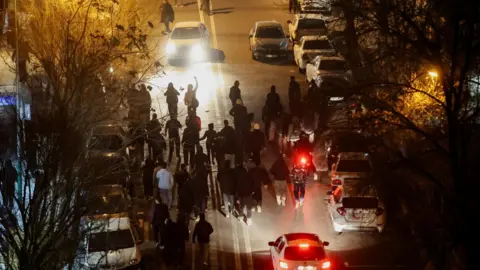
The streets are one story. The spreadsheets are another. And in Iran’s latest wave of unrest, the fight over what happened is not just about slogans and bullets. It is about numbers, names, and who controls a body after it falls.
Protesters speaking to the BBC described a crackdown that, in their telling, moved from familiar intimidation to something closer to mass terror. Meanwhile, human rights groups and Iranian authorities are publicly miles apart on the death toll. That gap is not an accounting error. It is a power struggle over reality itself.
When the Dead Stop Being Anonymous
One of the most revealing details in the BBC’s reporting is not a statistic. It is a social fact: people say they are losing someone they actually knew.
“My friends are all like me. We all know someone who was killed in the protests.”
That line, attributed by the BBC to Parisa, a 29-year-old from Tehran, lands like a quiet indictment of how violence changes a movement. When deaths are distant, fear is easier to compartmentalize. When the dead have birthdays and nicknames, the state is no longer threatening a crowd. It is threatening families.
Parisa told the BBC that the security force response earlier in January was unlike anything she had seen before, and she said she knew at least 13 people killed since protests erupted over worsening economic conditions on December 28, 2025.
The BBC described the protests as widening beyond economics into demands for political change. That shift matters because it changes what the government is defending. Price hikes are policy problems. Calls for political change are regime problems.
The Numbers Gap That Refuses to Close
Iran’s government and outside trackers are telling the world two sharply different stories about the scale of killing.
According to the BBC, the U.S.-based Human Rights Activists News Agency (HRANA) said it had confirmed at least 6,159 deaths since the unrest began. The BBC report said the figure includes 5,804 protesters, 92 children, and 214 government-affiliated individuals.
Iranian authorities, according to the BBC, said more than 3,100 people had been killed, while arguing that the majority were security personnel or bystanders attacked by rioters.
Those dueling claims are not just competing narratives. They set the stakes for what comes next. A death toll that starts with a 6 becomes a potential international flashpoint. A toll around 3,100, framed as the state protecting the public from chaos, is a different political story.
HRANA, as described in the BBC report, is trying to turn death toll claims into a database that can survive propaganda. The BBC quoted a representative emphasizing verification, not vibe.
“We are really committed to ensuring that every single piece of verified information that we report on sits next to a name and a location.”
That approach is designed for a grim purpose. If you can name the dead, you can challenge the state’s ability to erase them.
Another group, Iran Human Rights, warned that the final toll could exceed 25,000, the BBC reported. Iran’s government disputes the higher counts.
Live Ammunition, Verified Video, and a Locked-Out Press
Iran has long treated access as leverage, and the BBC noted that most international news organizations are barred from reporting inside the country. That makes verification harder and raises the value of any proof that can be authenticated externally.
The BBC reported that it verified videos showing security forces firing live ammunition at crowds. That matters because the government’s framing, at least as relayed by the BBC, leans on a narrative of violent rioters and casualties among security personnel and bystanders.
Verified video of live fire does not, on its own, settle who died or why. But it does narrow the debate over whether lethal force was used on a large scale. It also forces a question that authoritarian systems hate: if the state had nothing to hide, why work so hard to control the record?
The Internet Shutdown as a Second Front
When governments cannot fully control the streets, they often try to control the feed.
The BBC reported that young Iranians described the personal toll despite what it called a near-total internet shutdown. That detail is more than a technical footnote. It is an information blockade that can slow organizing, reduce documentation, and isolate people who are trying to figure out whether their loved ones are alive.
It also makes death toll accounting a structural problem. Every missing video, every blocked message, every delayed upload is not just an inconvenience. It is a chance for authorities to reshape the story before the evidence hardens.
What Mehdi Says He Saw Up Close
Another Tehran resident quoted by the BBC, Mehdi, 24, described what he called an unprecedented turnout and lethal violence. The BBC attributed to him a raw description of why people kept showing up even after deaths.
“Despite the killings on Thursday [8 January] and threats of more killings on Friday, people came out, because many of them could no longer endure it and had nothing left to lose.”
In the government’s telling, that persistence can be labeled unrest. In a protester’s telling, it becomes evidence of desperation.
Mehdi told the BBC he witnessed killings at close range. He described a shooting with live rounds, and he described an attack by motorcyclists using a shotgun.

“I saw a young man killed right in front of my eyes with two live rounds.”
The BBC’s reporting underscores a recurring theme in street crackdowns: ambiguity is a weapon. If deaths are chaotic, if bodies disappear, if the internet goes dark, the public is left arguing with itself about what is real.
The Body as a Bargaining Chip
One of the most consequential claims in the BBC report is not about bullets. It is about what happens afterward.
The BBC said protesters and activists described a pattern in which authorities refuse to hand bodies to families. Mehdi told the BBC that his friend’s cousin was killed, and that officials told the family to either pay a large sum of money to receive the body or agree to have him recorded as a member of the security forces.
If accurate, that is a strategy with multiple payoffs for the state. It punishes families financially, it pressures them into compliance, and it potentially shifts a death from the protester column into the security column. It is accounting as intimidation.
Human rights groups, the BBC reported, have warned that this practice can also obscure the actual death toll.
Why Tehran and the Tally Keep Colliding
Iran’s leadership has survived past protests partly by exhausting the public, splitting movements, and controlling information. But the BBC’s reporting suggests a new tension: the claims are now so large, and the personal losses so widespread, that denial becomes harder to sell at home, even if it is repeated abroad.
There is also a timing problem. The longer authorities delay bodies, names, and verifiable records, the more space opens for outside trackers like HRANA to become the default ledger. That is not just embarrassing. It is a shift in who holds the receipts.
And the receipts are the threat. A protest can be dispersed. A database of names and locations is more complex to disappear.
What to Watch Next
The next phase of this confrontation is likely to be fought on three tracks at once.
- The count: Whether human rights groups can continue naming victims and whether Iran’s government produces details supporting its own figures.
- The communications squeeze: Whether internet restrictions persist, and whether protesters find reliable ways to document events anyway.
- The families: Whether reports of withheld bodies and coerced classifications expand, and whether families speak publicly despite the risk.
In the end, the most destabilizing detail in the BBC report is also the simplest. It is not that people heard others were killed. It is that, increasingly, they say they know exactly who.