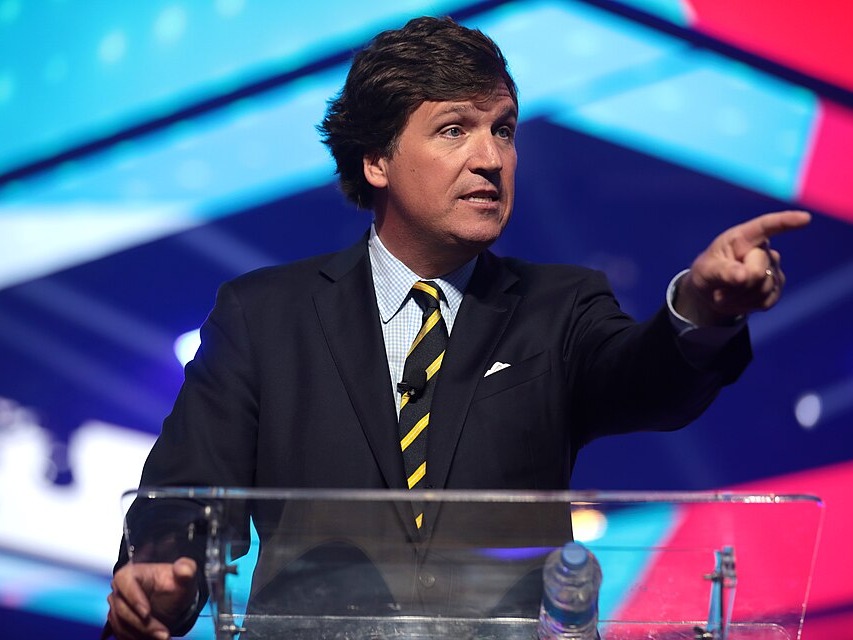
Tucker Carlson keeps insisting he is just asking questions, but the American right keeps treating him like a compass. A new BBC discussion tries to pin down why, and it accidentally reveals the deeper fight inside MAGA: who gets to define reality after the rallies stop?
What You Should Know
The BBC’s Americast released an episode, published February 20th, 2026, examining Tucker Carlson’s rise inside MAGA and what his influence suggests about conservatism’s direction. The episode features hosts Justin Webb and Anthony Zurcher and guest Jason Zengerle of The New Yorker.
The episode’s framing is simple: Carlson is not merely a talker in the background. He is presented as a movement actor, someone who can sense, and sometimes steer, what the base wants to hear, and what politicians feel pressured to repeat.
The Real Story Is Not Carlson, It Is Control
The BBC episode asks, “Who are the people shaping MAGA ideology in the US?” That question lands because it is a power question, not a personality quiz. In a party that sells itself as anti-establishment, the loudest megaphones can become the establishment’s gatekeepers.
Americast’s guest, Jason Zengerle, is the author of “Hated by All the Right People,” a book that traces Carlson’s long journey from preppy cable punditry to populist-brand insurgency. The hosts, Justin Webb and Anthony Zurcher, use Carlson as a lens on a conservative ecosystem that no longer needs a single network, a single donor class, or even a single party platform to coordinate its message.
That is the tension the episode keeps circling: Carlson’s influence grew inside traditional media, but his current leverage comes from something more durable than a time slot. It comes from attention that is portable, monetizable, and politically weaponized.
From Fox Exit to Free-Agent Kingmaker
Carlson’s break with Fox News in 2023 was one of those rare media moments that doubled as a political event. The separation became instant proof, to fans, that he was too dangerous to be contained, and instant proof, to critics, that his brand had become a liability.
Fox News framed the departure as a clean split. In a statement carried widely at the time, the network said, “FOX News Media and Tucker Carlson have agreed to part ways.” Carlson, meanwhile, signaled he was not retreating. His message was short and unmistakably forward-looking: “See you soon.”
Americast does not treat those lines as tabloid ephemera. It treats them as rival claims to authority. Fox wanted to look like the institution still in charge. Carlson wanted to look like the institution was optional.
The post-Fox phase also sharpened the contradiction at the heart of Carlson’s persona: he sells outsider skepticism while operating with insider access, elite media muscle memory, and a direct line into the movement’s most powerful incentives, fundraising, ratings, clout, and fear of being primaried.
The MAGA Media Algorithm Rewards Certainty, Not Governance
Zengerle and the Americast hosts keep returning to a sticky question: what exactly is MAGA when it is not an election campaign? The movement has policy preferences, but it also has a style of thinking about legitimacy. The style thrives on conflict with institutions, the press, the courts, academia, the national security bureaucracy, and corporate culture.
That style is perfect for a media star. It is harder for an elected official who has to sign bills, manage budgets, and own consequences.
This is where Carlson’s leverage becomes clearer. He can take positions with minimal institutional cost. He can shift frames quickly. He can punish disloyalty with mockery or suspicion. And he can do all of that while claiming he is simply providing information people are not allowed to hear.
The episode implicitly asks whether that is a preview of MAGA’s future: less party platform, more permanent content operation. Less coalition-building, more audience maintenance. Less governing, more narrative policing.
Why Politicians Keep Needing Carlson Anyway
The old model of conservative influence was linear. Donors funded candidates. Candidates courted networks. Networks amplified winners. The new model is messier and more personal. A single broadcaster can set a loyalty test, and a politician can fail it in one clip.
Americast points to Carlson as a prime example of how attention can become a veto. If a movement’s base is fragmented across platforms and distrustful of official spokespeople, the people who can unify it are the ones who can hold its attention. That is not the same thing as holding office, but it can shape who gets to keep office.
It is also a business model. The more the base believes it is being managed by hidden hands, the more it rewards figures who promise to expose the managers. That is a feedback loop that benefits the exposer.
In that sense, Carlson is less a single personality than a job description: the translator between raw voter anger and elite political ambition.
The Post-Trump Succession Fight Is Already Here
The BBC episode raises the question directly: where is the Make America Great Again movement going, and who leads it after Trump? The answer is not one name; it is a power structure.
Carlson is one potential node in that structure because he can do something many elected officials cannot. He can float future leaders, test them, elevate them, or freeze them out, all while staying technically outside the arena. He can also act as a bridge between hardline cultural grievance and a broader distrust of institutions, which is one of the movement’s most reliable binding agents.
At the same time, the episode hints at a ceiling. A movement built on distrust can turn on its own stars fast. Media influence is fickle, and the same audience that loves an icon for defying gatekeepers can decide the icon has become one more gatekeeper.
The succession stakes are also legal and financial. In the modern political economy, influence brings revenue, and controversy brings attention. But controversy also brings litigation risk, advertiser pressure, and platform moderation fights. That is not a moral point. It is a practical one. Any future MAGA leader will have to survive those pressures, and any media figure who wants to act like a leader will have to navigate them, too.
What to Watch Next
The value of the Americast episode is not that it breaks new facts about Carlson. It is that it forces the movement’s internal contradiction into the open. MAGA sells itself as an uprising against elites, yet it relies on a small cast of elites, political, media, and tech, to coordinate what the uprising thinks is true.
If Carlson remains central, the right’s center of gravity may keep drifting away from party institutions and toward personality-driven platforms that reward speed, certainty, and spectacle. If he fades, the larger pattern probably does not. Someone else will fill the role, because the incentive system is already built.
Either way, the future of MAGA may be decided less in campaign headquarters and more in studios, feeds, and podcasts, the places where trust is manufactured, and loyalty is enforced one audience at a time.