Washington is selling it as a safety fix. But buried inside Transportation Secretary Sean Duffy’s new English-only commercial driver’s license testing push is a more combustible question: Who has really been controlling the CDL pipeline, and who is about to lose it?
What You Should Know
Transportation Secretary Sean Duffy announced that commercial driver’s license tests will be administered in English as part of a broader federal safety and enforcement campaign. The Transportation Department also said hundreds of driving schools should close for failing basic standards.
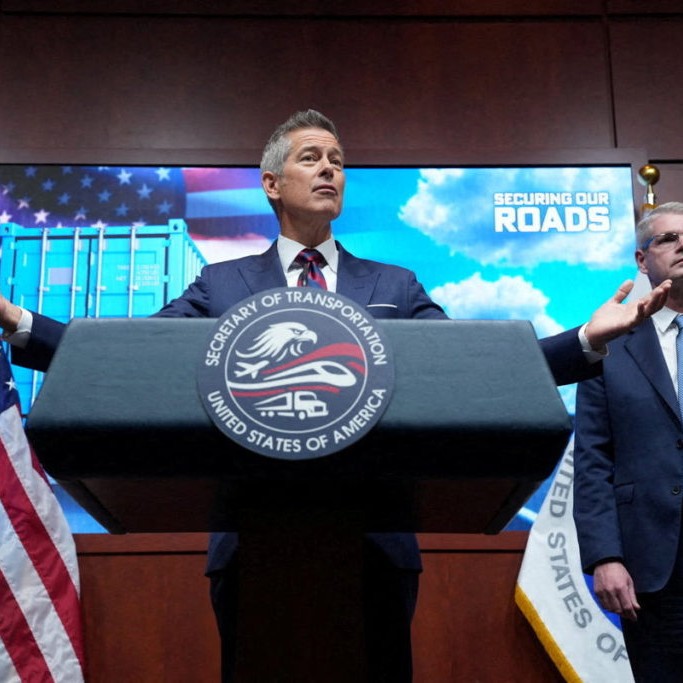
Duffy’s announcement, delivered at a news conference covered by PBS NewsHour on February 20th, 2026, is being framed as a simple, commonsense requirement: If you drive an 80,000-pound rig, you should be able to read signs and communicate with law enforcement. However, Duffy also aimed his fire at states, private testing contractors, and what regulators and industry veterans call chameleon carriers, companies that allegedly reappear under new names after violations.
A Policy That Sounds Simple Until You Follow the Money
On its face, the move is straightforward. Duffy said the goal is to ensure drivers understand English well enough to read road signs and communicate with law enforcement. Florida, he noted, has already started administering its tests in English.
The subtext is bigger. In Duffy’s telling, the federal government is not just battling bad drivers. It is battling a licensing ecosystem where the incentives can point the wrong way, especially when states outsource testing and oversight to third parties.
Duffy accused some third-party testers of enabling weak standards, tying them to schools he characterized as fraudulent. One line from the news conference captured the administration’s posture: “And the third-party tester is participating in the scam because they are not adequately testing the people who went through a sham school,” Duffy said.
That is the power shift to watch. If Washington tightens the rules or forces tougher compliance checks, it is not only immigrant drivers who feel it. State agencies, contracted examiners, and small training schools could see their business models rewritten.
English Proficiency Is Already in the Rulebook
Here is the twist that complicates the politics: English proficiency is not a new idea in federal trucking rules. The Electronic Code of Federal Regulations includes an English-language requirement among the general qualifications for drivers engaged in interstate commerce.
So why the headline-grabbing English-only testing announcement now?
Because there is a meaningful difference between a rule that exists on paper and a system that enforces it consistently across 50 states, multiple testing formats, and a mix of public and private gatekeepers. Duffy’s argument is that the enforcement gap has become a safety gap.
Critics, meanwhile, are likely to see a second agenda: using a safety rationale to squeeze an already vulnerable labor pool, and to press states into a more aggressive compliance posture that intersects with immigration politics. Duffy, for his part, presented it as overdue housekeeping in an industry he said had been neglected.
The Crackdown Is Not Just About Drivers, It Is About Infrastructure
The PBS NewsHour report tied the English-only testing move to a wider Transportation Department campaign. That includes enforcement against questionable schools, pressure on states to follow federal licensing rules, and action against carriers that, in Duffy’s telling, have been able to game registration requirements.
One flashpoint is training. The Transportation Department said 557 driving schools should close for failing to meet basic safety standards, according to a separate PBS NewsHour report. That number is not a rounding error. It is an assertion that a meaningful slice of the training market is not meeting federal expectations.
Then there is the business side of trucking oversight. According to the PBS NewsHour report, Duffy described a system where companies can register to operate by paying a few hundred dollars and showing proof of insurance, and they might not be audited until a year or more later. If you are trying to build a safety net, that is a long time to wait before looking closely.
Duffy said the administration wants to strengthen registration requirements, increase spot checks by Federal Motor Carrier Safety Administration inspectors, and pursue fraudulent operators.
The ‘Chameleon Carrier’ Problem Washington Keeps Pointing To
Duffy and federal officials have also highlighted chameleon carriers, a term used in the industry for companies that allegedly cycle through names and registration numbers to sidestep consequences after crashes or violations. In the PBS NewsHour account, Duffy said some of these companies can share addresses, including multiple registrations tied to the same apartment.
That matters for a reason that has nothing to do with language: it is a control problem. If regulators cannot reliably track the corporate entity behind a truck on the road, enforcement becomes a game of whack-a-mole.
It also raises a question that does not fit neatly into a sound bite. If the administration is serious about safety, why make English-only testing the banner headline, rather than corporate registration reform? One possible answer is that testing is visible, immediate, and politically legible. Corporate oversight is slower, more technical, and harder to communicate. But that does not make it less central.
Crashes Raise the Stakes, and Everyone Knows It
As Duffy described it, the crackdown gained urgency after fatal crashes that intensified scrutiny of licensing, qualifications, and enforcement. The PBS NewsHour report referenced a Florida crash that killed three people, and an Indiana crash in February 2026 that killed four, as part of a broader push.
The administration has also leaned on a basic reality that rarely breaks through political messaging: large-truck crashes kill thousands of people in the United States in a typical year, a point reflected in fatality statistics compiled by the Insurance Institute for Highway Safety.
That backdrop is why this fight is not going away. Road safety is a politically powerful justification, and it gives federal officials room to demand sweeping compliance changes from states and industry players.
What Changes Next, and Who Has to Prove it
Duffy’s announcement sets up a cascade of practical questions that states and carriers cannot dodge for long.
- States that offer CDL knowledge tests in multiple languages will face pressure to change their procedures, staffing, and contractor relationships.
- Third-party testers, already a target in Duffy’s remarks, could see tougher auditing and enforcement, or tighter state oversight to avoid federal scrutiny.
- Schools, especially those operating on thin margins, could be forced to upgrade programs quickly or close.
- Carriers with sloppy paperwork or questionable registration histories could face closer review, especially if regulators pursue chameleon-carrier patterns more aggressively.
The administration is betting it can tell a single story that covers all of it: safer roads, tighter standards, fewer bad actors. Opponents will argue the pieces do not belong under one banner, and that language will inevitably do political work that goes beyond road signs and traffic stops.
Duffy put the stakes in blunt terms at the news conference, warning that systemic neglect has consequences. “Once you start to pay attention, you see that all these bad things have been happening. And the consequence of that is that Americans get hurt,” he said.
The next receipts will not come from speeches. They will come from how many schools actually shut down, how many states change their testing practices, how aggressively FMCSA spot checks expand, and whether the government can make the chameleon-carrier problem harder to pull off in the real world.
References
- PBS NewsHour: Transportation Secretary Duffy Announces English-Only Commercial Driver’s License Tests
- PBS NewsHour: Transportation Department Says More Than 550 Driving Schools Must Close Over Safety Failures
- eCFR: 49 CFR Section 391.11 General Qualifications of Drivers
- Insurance Institute for Highway Safety: Large Trucks