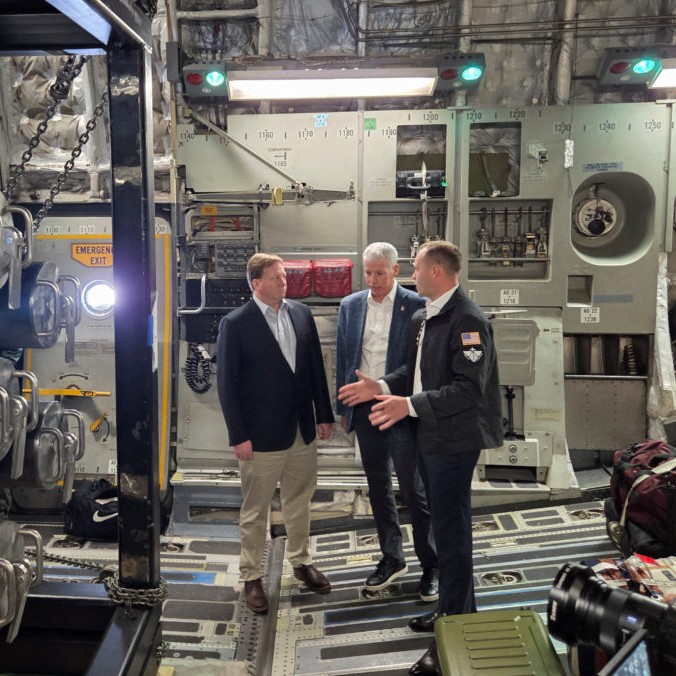
A minivan-sized reactor just took a military flight across the West, and the big question is not whether it can fly. It is whether Washington is trying to use a C-17 photo op to bulldoze the slow, unglamorous parts of nuclear oversight.
What You Should Know
The Pentagon and the Energy Department airlifted a 5-megawatt microreactor, without nuclear fuel, from California to Utah on February 15th, 2026. Officials cast the flight as a step toward rapid deployment for military bases and data-driven power demand.
Energy Secretary Chris Wright and Undersecretary of Defense Michael Duffey rode along with the privately built microreactor, framing the trip as a proof of concept for portable nuclear power. Skeptics, including a nuclear safety expert at the Union of Concerned Scientists, say the flight proves logistics, not safety or economics.
The Flight Was Real, and So Was the Message
According to reporting distributed by The Associated Press and published by PBS NewsHour, the Department of Defense and the Department of Energy moved a 5-megawatt microreactor roughly 700 miles, from March Air Reserve Base in California to Hill Air Force Base in Utah. The reactor carried no nuclear fuel, a detail that matters because it keeps the trip in the realm of heavy equipment transport, not high-consequence radiological security.
The administration did not treat it like a routine shipment. Wright and Duffey traveled with the reactor, and officials brought media coverage into the aircraft, turning an internal capability demo into a national storyline about speed.
Wright, speaking before the flight, put it in headline terms: “Today is history. A multi-megawatt, next-generation nuclear power plant is loaded in the C-17 behind us.”
That sentence is doing a lot of work. It sells inevitability. It also blurs categories, because a reactor module in transit is not the same thing as a power plant producing electrons under a full regulatory and security plan.
Trump’s Nuclear Push Is Also a Power Shift
The airlift sits inside a larger Trump administration pitch: nuclear power as the answer to a grid strained by artificial intelligence, data centers, and electrification, plus a way to harden military bases against outages and attacks. The subtext is institutional control.
In the AP account, Wright pointed to executive orders signed by President Donald Trump that, as described, allow the Energy Department to approve some advanced reactor designs and projects, reducing the traditional role of the Nuclear Regulatory Commission, the independent agency that has regulated commercial nuclear power for decades.
That is the real knife fight. Speed is popular, especially when everyone is promising national competitiveness and “energy dominance.” Independent regulators, by design, are not built for political deadlines like a campaign-style milestone.
Wright is not hiding the urgency. He said at least three microreactors will reach “criticality” by July 4th, a symbol-heavy target. That is a technical benchmark, but it is also a calendar flex, because federal licensing, environmental review, security planning, and waste strategy do not usually line up neatly with fireworks.
Why the Military Loves Portable Power
If you want to understand why the Pentagon is involved, follow the vulnerabilities. Large bases depend on civilian grids, and grids are exposed to storms, sabotage, cyber intrusions, and simple overload. A portable reactor is a potential solution that changes who has leverage in a crisis. It also changes who gets paid.
Duffey framed microreactors as mission tools, not science projects. In the AP story, he said mobile reactors could provide energy security on a military base without the civilian grid. He also described the flight as progress toward deploying nuclear power “when and where it is needed” to support warfighters.
That language is familiar in the defense world: resilient, deployable, expeditionary. Nuclear, however, adds complications that diesel generators and gas turbines do not.
There is also a market logic. If the Pentagon can be a first buyer, first tester, or first validator, that can pull private money into a technology that otherwise faces brutal skepticism from insurers, local governments, and regulators.
The Company Behind the Reactor Wants a Commercial Timeline
The reactor in the flight was built by Valar Atomics, a California startup. Its CEO, Isaiah Taylor, told the AP that the module can generate up to 5 megawatts, which he said is enough for about 5,000 homes. The company, per the same reporting, hopes to start selling power on a test basis next year and aims for full commercial operations in 2028.
This is where the rhetoric of “portable” meets the reality of customers. Data centers want stable pricing, predictable uptime, and clean audit trails on safety. Military buyers want hardened security, clear chain-of-custody rules, and plans for what happens when equipment becomes contaminated, damaged, or obsolete.
Microreactors promise to shrink the hardware. They do not automatically shrink the paperwork, politics, or risk.
The Skeptics Are Pointing at the Missing Pages
Edwin Lyman, director of nuclear power safety at the Union of Concerned Scientists, did not mince words. He called the transport flight, with cameras rolling, a “dog-and-pony show” in comments reported by the AP.
Lyman’s critique is simple: moving an unfueled reactor proves the military can move heavy gear. It does not prove the system is safe, economical, or secure once fuel enters the picture. He also argued, per the AP account, that the administration has not made a clear “safety case” for how microreactors could be shipped to places like military bases or data centers once the stakes become radiological.
Then there is waste. Nuclear power is often sold as carbon-free at the point of generation, which is true. But spent fuel is a political third rail. In the AP report, Wright said the Energy Department is talking with Utah and other states about sites that could reprocess fuel or handle permanent disposal. Talks are not a repository, and they are not a transportation plan.
The reactor flown to Utah is expected to go to the Utah San Rafael Energy Lab for testing and evaluation, and fuel is expected to come from the Nevada National Security site, according to the AP report. Each step adds a new set of questions that do not fit neatly into a celebration flight.
What Happens Next, and What to Watch
The administration has set up a high-pressure triangle: rising demand, national security urgency, and a promised timeline. That combination can produce results. It can also produce corner-cutting, or at least accusations of it, especially if the normal gatekeepers are perceived as sidelined.
Three issues will determine whether the C-17 moment becomes a lasting policy shift or a one-off stunt:
- Licensing clarity: Who signs off, under what authority, and with what transparency, if Energy Department approvals expand into territory the NRC usually owns?
- Security and transport rules: How will fueled microreactors be protected in transit, and what is the incident plan if something goes wrong?
- Waste and end-of-life: Where does spent fuel go, who pays, and how will host states be persuaded, or pressured, to accept it?
Wright, for his part, framed the broader strategy as deregulation plus abundance. In the AP reporting, he summed up the philosophy like this: “The answer to energy is always more.” He added a political contrast with the Biden years and then promised momentum: “Now we’re trying to set everything free. And nuclear will be flying soon.”
Nuclear is already flying, at least in hardware form. The fight now is over what else gets carried along with it: a tighter safety case, or a faster route around the people paid to say no.