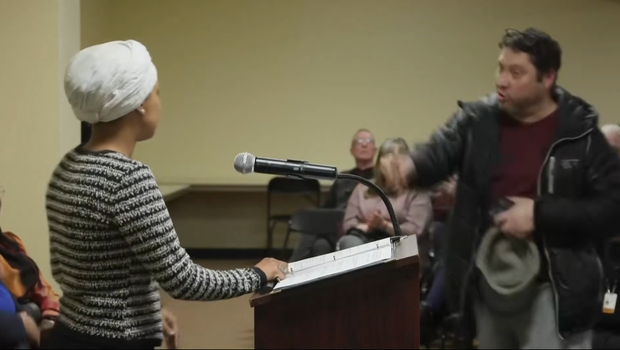
A man rushed the front row of Rep. Ilhan Omar’s Minneapolis town hall, sprayed her with an unknown liquid, and got tackled. The part people are still arguing about is what happened next: Omar did not leave.
In a political moment where immigration fights are turning into street-level conflict, Omar’s decision to keep talking turned a quick security incident into a bigger story about intimidation, control, and how public officials respond when politics stops being abstract.
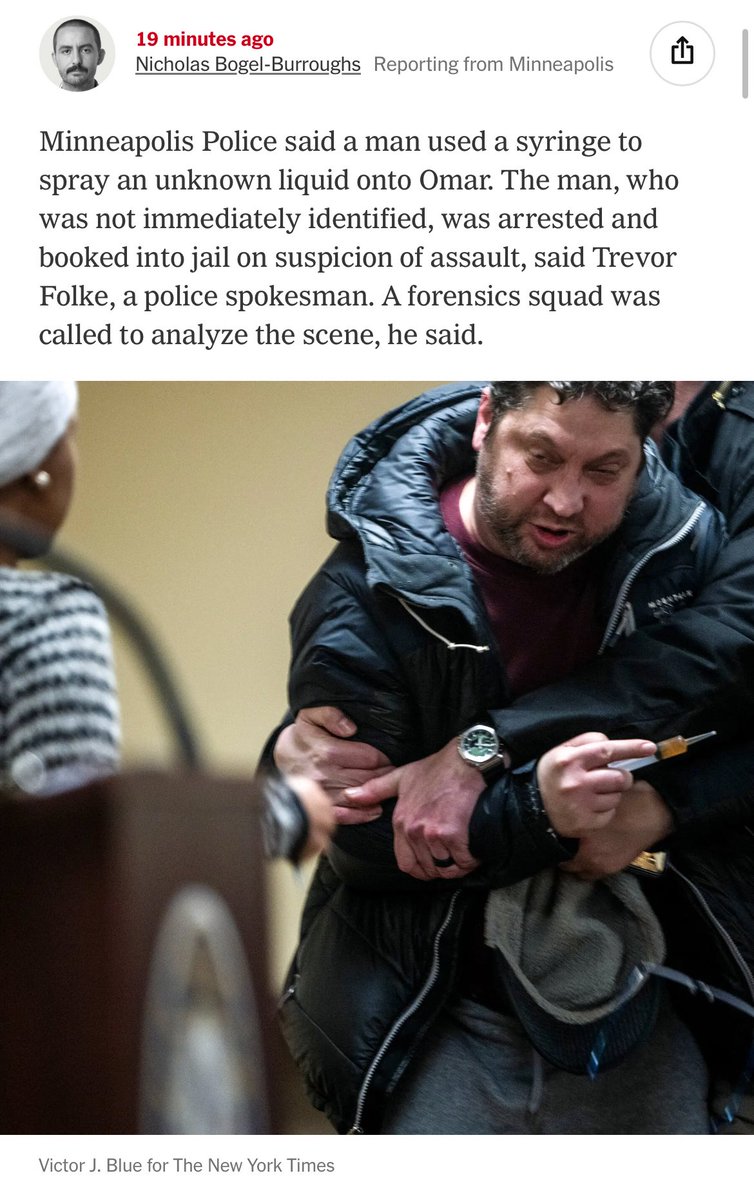
What police say happened: Minneapolis police told CBS News the suspect was immediately apprehended and booked into the Hennepin County Jail for third-degree assault. Police said Omar was not injured.
A Town Hall Turns Into a Security Scene
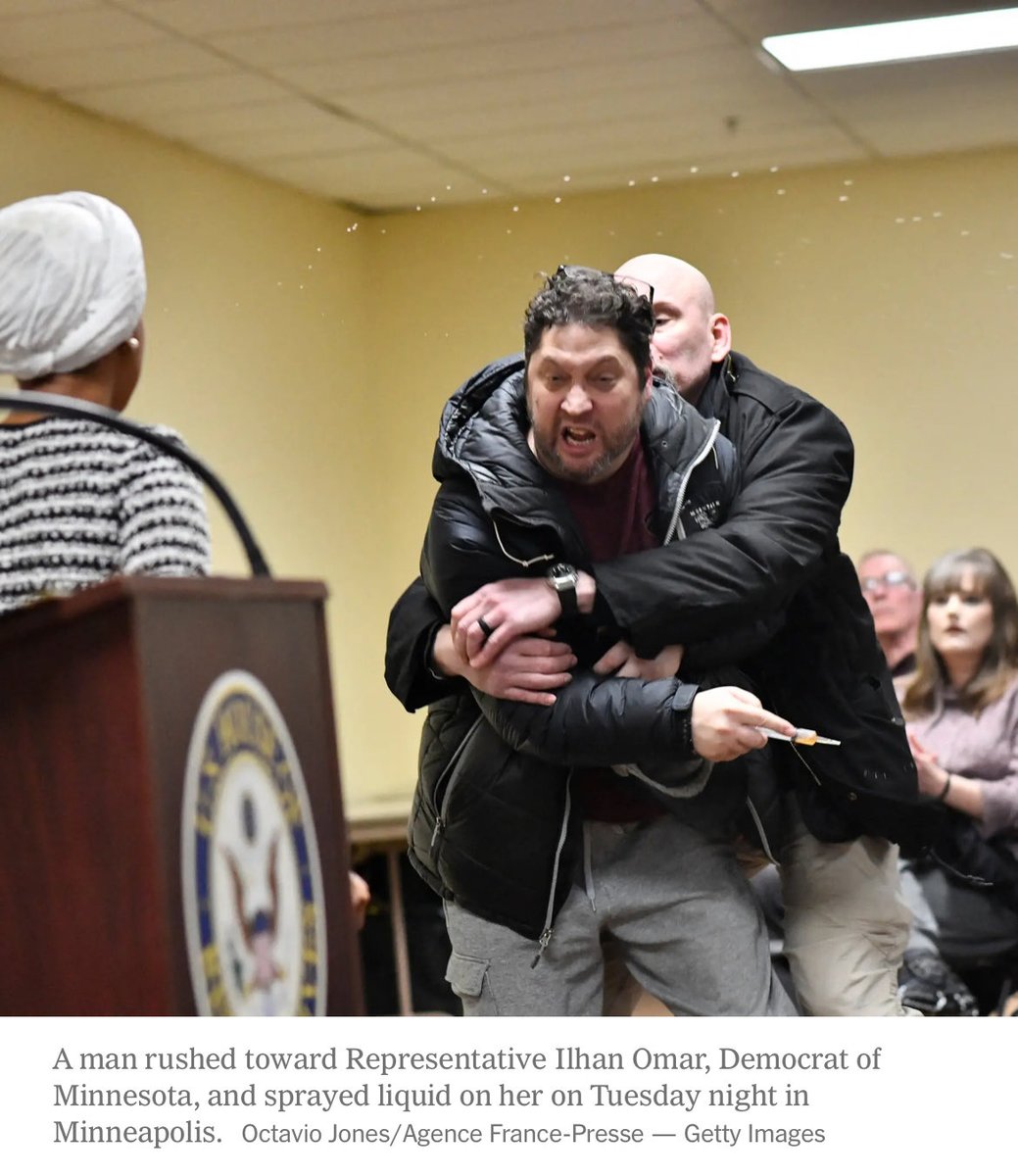
According to CBS News, the incident unfolded as Omar, a Democrat who represents Minnesota in the U.S. House, was speaking at a town hall in Minneapolis. A man sitting in the front row rushed toward her and sprayed her with a substance while yelling, and local police said a syringe was used.
Security personnel grabbed the man, led him out in handcuffs, and staff tried to get Omar to leave. Omar refused and continued the event, taking questions for nearly 30 minutes, according to CBS News.
The public facts, as reported, are straightforward. The subtext is not.
A town hall is supposed to be a controlled environment, the place where a member of Congress has the microphone, the agenda, and the home-court advantage. The attacker tried to flip that script in seconds.
Omar’s Answer: Keep the Microphone
Omar’s response was not subtle. She framed the confrontation as an attempt to intimidate her, then made a point of staying put.
“Here is the reality that people like this ugly man do not understand: we are Minnesota strong, and we will stay resilient in the face of whatever they might throw at us,” Omar said.
Breaking: A man with a syringe sprayed an unknown liquid on Rep. Ilhan Omar at a town hall in Minneapolis tonight. He was quickly arrested and Rep. Omar, who has faced many threats in the past, continued the event seemingly unharmed.
updates (no paywall): https://t.co/RBb608ISDK pic.twitter.com/XULqbh63KV
— Nicholas Bogel-Burroughs (@NickAtNews) January 28, 2026
At least one attendee urged her to get checked out, saying the sprayed substance “smells so bad,” according to CBS News. That detail matters because it underscores the fork in the road Omar faced in real time: treat it as a potential medical situation or as a political test.
She chose the test.
The Policy Fight Under the Splash
The confrontation did not happen in a vacuum. CBS News reported Omar was calling for the abolishment of ICE and for Homeland Security Secretary Kristi Noem to resign when the man rushed her.
Those are high-voltage demands aimed at the federal government’s immigration machinery and its leadership. They also land in a city already tense, with the federal presence growing and tempers shortening.
CBS News reported the incident occurred during a tense period in Minneapolis following the fatal shooting of 37-year-old Alex Pretti by two Customs and Border Protection agents, which prompted days of protests. CBS News also reported that thousands of federal immigration agents have been deployed to the Twin Cities area since last month as part of a Trump administration crackdown that has drawn criticism from Omar and other local politicians.
In that context, a town hall becomes more than a Q-and-A. It becomes a live referendum on who gets to feel safe, who gets to set terms, and whether political violence is creeping from online threats into physical spaces.
Arrested Fast, Questions Still Open
Police said Omar was not injured and that the suspect was booked on a third-degree assault allegation, according to CBS News. Beyond that, the unknown substance becomes the central unanswered question, both as a safety issue and as a prosecutorial detail.
CBS News reported it reached out to Omar’s office and to the U.S. Capitol Police for more information.
The legal path tends to move more slowly than the viral clip. A booking is not a conviction. Allegations can shift once evidence is tested and charges are reviewed. But the political consequences do not wait for lab results.
Not Just Omar: A Pattern of Confrontations
Omar is not the only House Democrat to report being physically confronted in recent days. CBS News reported that Rep. Maxwell Frost of Florida said he was assaulted during an event at the Sundance Film Festival, and that police in Park City, Utah, alleged a man unlawfully entered a private party and assaulted Frost and another person. The suspect was arrested on charges including simple assault and aggravated burglary, police said, according to CBS News.
These incidents are different, in different states, with different alleged facts. The connecting line is the venue. Public events used to be where politicians worried about hecklers. Now, they are the places where security decisions can make the headlines.
The Numbers Behind the Fear Economy
The threat picture for lawmakers has been rising for years, and the official numbers back that up. CBS News cited U.S. Capitol Police statistics saying it investigated 9,474 threats and concerning statements against lawmakers, their families, and their staff last year, up from 8,000 in 2023 and just below the 9,625 recorded in 2021.
Those numbers do not explain every incident, but they do explain why staffers tug a lawmaker off stage the moment something goes wrong. The risk calculus has changed. Every confrontation forces a split-second choice between physical caution and political posture.
Omar has long been a magnet for political fury, and she has publicly discussed death threats she has received, including ones containing racist or Islamophobic language, according to CBS News. That background adds another layer to Tuesday’s incident: it is not just an isolated disruption. It is a real-world collision with a threat climate she has been describing for years.
What to Watch Next
Three things will likely determine how this story hardens over time.
- The substance: If authorities identify what was sprayed and whether it posed a health risk, it could shape the criminal case and the public narrative.
- The charging path: A booking on a third-degree assault allegation is an early step. Prosecutors will decide what sticks, what escalates, and what evidence supports the final charges.
- The politics: Omar’s critics and supporters have competing incentives to frame what happened. Her refusal to leave gives both sides material; one side calls it defiance, the other, recklessness. The facts are the facts, but the incentives are obvious.
In the meantime, a Minneapolis town hall that was supposed to be about immigration policy, federal enforcement, and cabinet-level accountability just became a case study in how quickly power gets contested in public, and how hard it can be to take it back.