


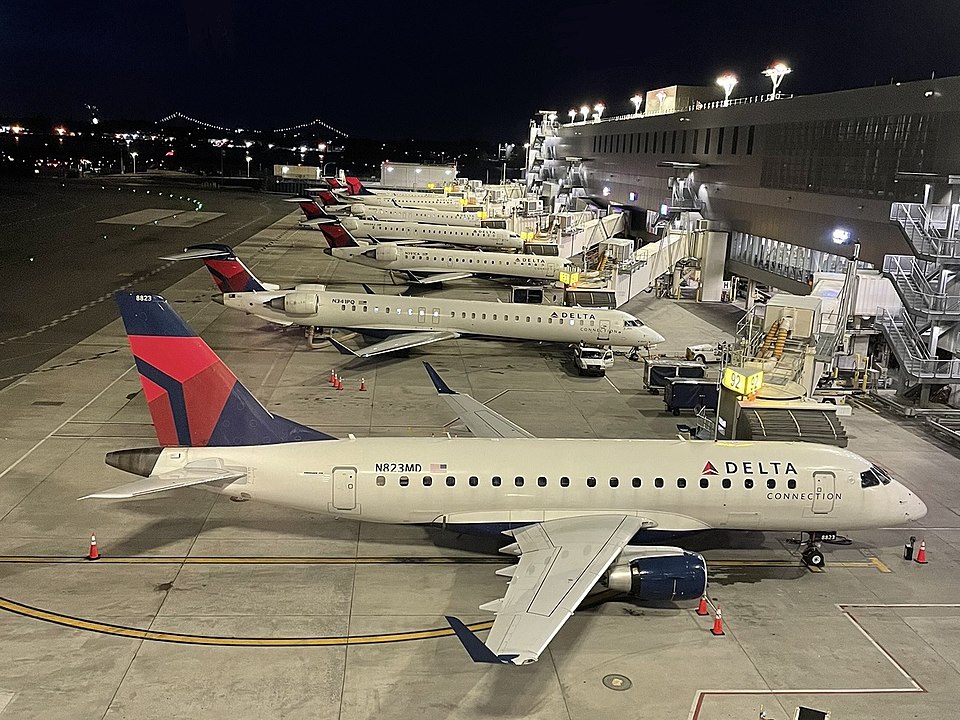
Delta Connection fleet at LaGuardia Airport Terminal C. Photo courtesy of Zheng Zhou under CC BY-SA 4.0.
Two Delta jets reportedly collided on the taxiway at New York’s LaGuardia Airport, leaving one flight attendant injured and forcing both planes out of service for inspection. The incident, which occurred shortly before 10 p.m., sent a jolt through passengers and aviation observers, raising fresh concerns about safety in one of the nation’s busiest and most congested airports.
A Collision on the Taxiway
The collision reportedly involved two CRJ-900 regional jets operated by Endeavor Air, a Delta Connection carrier. One plane, carrying approximately 30 passengers, was preparing for takeoff to Roanoke, Virginia, when its right wing clipped the nose and cockpit window of another jet arriving from Charlotte, North Carolina, with around 60 people aboard, as reported by PEOPLE. The impact shattered the windshield and caused significant damage to the nose of the Charlotte flight, while a large section of the wing was torn off the Roanoke-bound plane.
Passengers described the moment as “super jarring,” with CBS News producer Joey Annunziato telling the New York Post that everyone shot forward in their seats amid the chaos. Another passenger, William Lusk, told ABC News that his plane “stopped, jerked, and jumped to the right” after landing, followed by a tense silence before the pilot calmly announced the collision and urged everyone to remain calm, as reported by the Associated Press.
Emergency Response and Injuries
Despite the dramatic visuals and damage to both aircraft, no passengers were injured. A flight attendant reportedly suffered a minor knee injury and was taken to the hospital, but the airline confirmed the injury was non-life-threatening. Emergency vehicles rushed to the scene, and passengers were safely escorted to the terminal, where they were offered meals and hotel accommodations while awaiting rebooking on later flights.
Delta Air Lines issued a statement emphasizing that safety remains their top priority and that they would cooperate fully with the Federal Aviation Administration (FAA) and the National Transportation Safety Board (NTSB) in investigating the incident, as reported by the New York Post. The airline apologized to customers for the disruption and assured that teams at LaGuardia were working to assist affected passengers,
What Happened on the Taxiway?
The NTSB confirmed the collision occurred at the intersection of two taxiways. Flight recorders from both planes have been recovered and sent to the NTSB headquarters for analysis. The FAA noted that air traffic control had instructed the Virginia-bound plane “to hold short and yield to the other aircraft,” as reported by the Associated Press, however it remains unclear who is at fault.
Air traffic control audio captured one pilot reporting the collision, describing how the other plane’s right wing clipped their nose and cockpit windscreen, as reported by the New York Post. The pilot also mentioned damage to some of the cockpit’s screens, highlighting the severity of the impact despite the low speed of the collision.
Safety Concerns Amid Busy Operations
This incident has reignited concerns about ground operations at LaGuardia, an airport long criticized for its cramped layout and limited runway space. Aviation safety consultant Jeff Guzzetti explained that while air traffic controllers focus on keeping runways clear for takeoffs and landings, pilots are expected to maintain situational awareness on taxiways to avoid collisions, as reported by the Associate Press. He noted that taxiing planes move at slow speeds, and pilots should be able to see each other, but factors like night conditions and the turning off of nose lights can complicate visibility.
LaGuardia is among 35 major U.S. airports equipped with advanced surface radar systems designed to track aircraft and vehicles on the ground and alert controllers to potential conflicts. However, it is unclear whether this technology played any role in preventing or warning about the collision. Guzzetti pointed out that the system’s primary function is to prevent runway collisions, and it may not provide audible alarms for taxiway incidents.
The Broader Context of Aviation Safety
The collision comes amid heightened public scrutiny of aviation safety following several recent crashes and near misses. The deadliest U.S. plane crash in decades occurred earlier this year when an Army helicopter collided with an airliner preparing to land at Ronald Reagan Washington National Airport. Incidents like these have amplified fears about the reliability of air travel and the pressures on air traffic control systems, especially during government shutdowns or staffing shortages.
The timing of the LaGuardia collision is notable, as it happened within the first 24 hours of a government shutdown that disrupted federal services, including the FAA. Airlines had warned that the shutdown could strain aviation operations and slow flights due to air traffic controllers working without pay. It remains unclear if staffing levels or operational capacity at LaGuardia were affected at the time of the collision.
Passengers Left Unscathed, Operations Continue
Despite the collision and the damage to both jets, LaGuardia’s airport operations were not impacted, according to the Port Authority of New York and New Jersey. Passengers on both flights were provided with meals, hotel rooms, and rebooked on flights departing the following day. The airline and authorities continue to investigate the incident to determine the cause and prevent future occurrences.
For passengers, the experience was unsettling but ended without physical harm. The quick emergency response and effective communication underscore the protocols in place to handle such unexpected events at busy airports.
What’s Next?
Delta has pledged to work closely with the FAA and NTSB to review the incident thoroughly. The investigation will focus on the sequence of events leading to the collision, the role of air traffic control instructions, and the pilots’ situational awareness. The findings will be critical in addressing safety gaps and ensuring that ground operations at LaGuardia and other congested airports remain secure.
As air travel continues to rebound and airports face increasing traffic, incidents like this serve as a reminder of the challenges in managing complex ground movements. For now, passengers can take some comfort in knowing that despite the collision, safety protocols worked, and no one was seriously hurt.
References: NYC Delta jets collide at LaGuardia Airport | Delta regional jets collide on taxiway at New York’s LaGuardia Airport | AP News | 2 Delta Jets Collide on the Taxiway at New York’s LaGuardia Airport