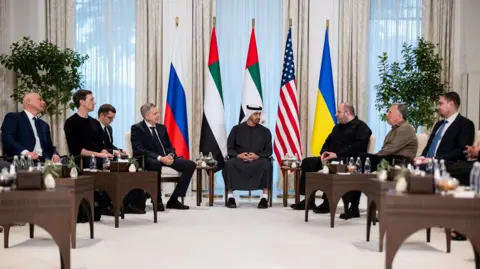
The negotiators sat down in Abu Dhabi. The missiles and drones came down in Kyiv and Kharkiv.
Ukraine says that timing is the point, that Russia is trying to shape the peace talks by attacking the country’s energy lifelines and civilian hubs. Russia, through senior aides, insists it wants diplomacy, but only if the map changes. The United States is in the room, and President Donald Trump is hovering over it with a new peace brand that Ukraine is openly ridiculing.
Here is what is known, what is claimed, and what still will not budge.
Talks resume, and Ukraine says the strikes were the message
Overnight Russian strikes killed one person and injured 23 others, Ukrainian officials said, as trilateral talks involving Russia, Ukraine, and the United States were set to continue in Abu Dhabi. The details were reported by the BBC, which described the Abu Dhabi meetings as the first such trilateral talks since Russia launched its full-scale invasion in 2022.
Ukraine’s Foreign Minister Andrii Sybiha framed the assault as an attack on the negotiating process itself, not just the country. “The brutal attack,” he said, had “hit not only our people, but also the negotiation table,” according to the BBC report.
Sybiha also aimed straight at the optics. With Washington talking up a path to peace, Kyiv is trying to make sure the headlines stay glued to the human cost and the infrastructure damage.
🇺🇦🇷🇺🇺🇸 First direct Ukraine ;
Russia talks are underway in Abu Dhabi with US mediation 🕊️ — but territory remains the main obstacle, especially Donbas.
President Zelensky says it’s “all about the land,” highlighting how tough the road to peace still is 🌍⚖️ pic.twitter.com/p61lINjAuX
— Fact scope (@Factnews2003) January 24, 2026
Kyiv without heat, Kharkiv under fire
In Kyiv, Mayor Vitali Klitschko said one person died, and four were wounded. He said three of the injured were hospitalised. Klitschko also said critical infrastructure was damaged, leaving 6,000 buildings without heating, according to the BBC.
In Kharkiv, Mayor Ihor Terekhov reported that 19 people were injured during a sustained assault in the early hours. He said a maternity hospital and a hostel for displaced people were damaged, the BBC reported.
President Volodymyr Zelensky, addressing the pattern, said: “The main target of the Russians was the energy infrastructure.”
It seems the first day of peace talks in Abu Dhabi didn’t go so well. Putin has launched another mass missile attack on Kyiv, trying to cut power supply routes linking the capital to nuclear power plants and make the city unlivable. Does he still believe he can force Zelensky to… pic.twitter.com/IrMwdGI502
— Svitlana Morenets (@SvMorenets) January 24, 2026
Trump’s ‘Board of Peace’ meets Ukraine’s tribunal talk
The diplomatic theater is getting louder. The BBC reported that Trump said Putin had accepted an invitation to join his ‘Board of Peace’, described as an organisation focused on ending global conflicts. Putin has not confirmed that, the BBC noted.
Ukraine’s response was not subtle. On the second day of talks, Sybiha said the overnight assault showed “that Putin’s place is not at the board of peace, but at the dock of the special tribunal,” per the BBC.
The clash matters because it spotlights two incompatible storylines being sold at the same time: a Putin being ushered toward peacemaking prestige, and a Putin being positioned for future accountability proceedings. The talks in Abu Dhabi are happening inside that contradiction.
The unresolved problem is territory, and everyone admits it
A source cited by the BBC said some progress had been made, but the key issue of territory remained unresolved. That tracks with the public messaging from Kyiv.
Russia occupies roughly 20% of Ukraine, including parts of the eastern Donbas region, the BBC reported. The Kremlin wants Ukraine to hand over large areas of territory. Ukraine has ruled that out.
Zelensky put it plainly in Davos, according to the BBC: “It’s all about the land. This is the issue which is not solved yet.”
Zelensky Signals Donbas Will Drive Critical Ukraine-Russia-US Talks in Abu Dhabi pic.twitter.com/u3wToeXfsJ
— Always First (@alwaysFTweets) January 24, 2026
There is also an international legal and diplomatic baseline that Ukraine leans on when it rejects territorial concessions under pressure. The UN General Assembly’s 2014 resolution A/RES/68/262 affirmed Ukraine’s territorial integrity after Russia’s move on Crimea, and the General Assembly’s 2022 resolution A/RES/ES-11/1 called on Russia to withdraw its forces from Ukraine. Those votes do not stop wars, but they do box in the “just redraw the border” pitches that keep reappearing at negotiating tables.
The Moscow meeting before Abu Dhabi, and the ‘Anchorage’ hook
The day before the Abu Dhabi talks began, the BBC reported that US special envoy Steve Witkoff and Trump’s son-in-law Jared Kushner met with Putin in Moscow.
After what the BBC described as a four-hour meeting, Kremlin aide Yury Ushakov said: “Vladimir Putin has emphasised Russia’s sincere commitment to settling the Ukraine crisis by political and diplomatic means.”
Then came the catch. Ushakov said a lasting settlement would be unlikely without addressing territory “based on the formula as agreed in Anchorage,” the BBC reported.
According to the BBC, Trump and Putin met in Anchorage, Alaska, last August to discuss ending the war, producing an agreement that would allow Russia to take the Donbas region and keep control of Crimea, which Russia annexed in 2014. Zelensky ruled out giving up the Donbas, the BBC reported, describing it as made up of Luhansk and Donetsk and partly occupied by Russia for 12 years.
Talks in Abu Dhabi between Ukraine, US & Russia ended without breakthrough. Russia pushes Anchorage formula from Alaska: full Donbas control, frozen lines.
Russia now appears set for decapitation strikes on Ukraine’s energy grid since Zelensky refuses to surrender. pic.twitter.com/H6DLjqbtis
— Geopoliti𝕏 Monitor (@GeopolitixM) January 24, 2026
The key detail here is not just the territory. It is the sequencing. Russia’s side is effectively arguing that peace requires pre-agreed land transfers. Ukraine’s side is arguing that peace cannot start with surrendering land, especially land taken by force and held under occupation.
Security guarantees are the other big lever, and Kyiv says it has a Trump deal
Zelensky also claimed a separate track is moving: future US security guarantees for Ukraine in the event of a deal. The BBC reported he said he had reached an agreement with Trump on that point, but provided no details and said it would need approval by both the US Congress and the Ukrainian parliament before signing.
That matters because it hints at the trade being discussed behind the scenes. Ukraine, resisting territorial concessions, wants credible deterrence. Russia, demanding territory, wants the postwar order to prevent Ukraine’s future military and political alignment. Washington is being asked to underwrite one side’s safety while coaxing the other side into a settlement it can sell at home.
What to watch next: energy hits, land lines, and the public readouts
Ukraine’s delegation head, Rustem Umerov, described the first day of the Abu Dhabi talks this way on social media, according to the BBC: “The meeting focused on the parameters for ending Russia’s war and the further logic of the negotiation process aimed at advancing toward a dignified and lasting peace.”
Abu Dhabi — brief (Umerov):
Tripartite talks with US mediation. Ukraine: Budanov, Arahmia, Kyslytsia; Gnatov & Skibitsky join tomorrow. US: Witkoff, Kushner, Greenbaum, Gens. Driscoll & Grinkevich. Russia: military reps. Focus on ending the war and next steps. Zelensky briefed. pic.twitter.com/aoYQQMPliS— StrarX (@HafeezShah7000) January 23, 2026
That sentence is a classic diplomatic bridge. It says the process is alive. It does not say the hard decisions are close.
For readers trying to gauge whether Abu Dhabi is a real turning point or another photo-op cycle, the tells are simple. Do the overnight strikes continue to hit energy infrastructure? Do the parties produce any shared language on territory, even vague language? And does the United States put concrete terms on “security guarantees,” beyond promises that still need legislative buy-in?
Until those pieces move, the line that will haunt these talks is still Sybiha’s, because it is built to survive every breakdown: Russia did not just hit cities, he said. It hit “the negotiation table.”