Trump wants world leaders in one room to talk peace and write checks for Gaza. The twist is where he wants to host it, and who is already signaling they might not show up.
What You Should Know
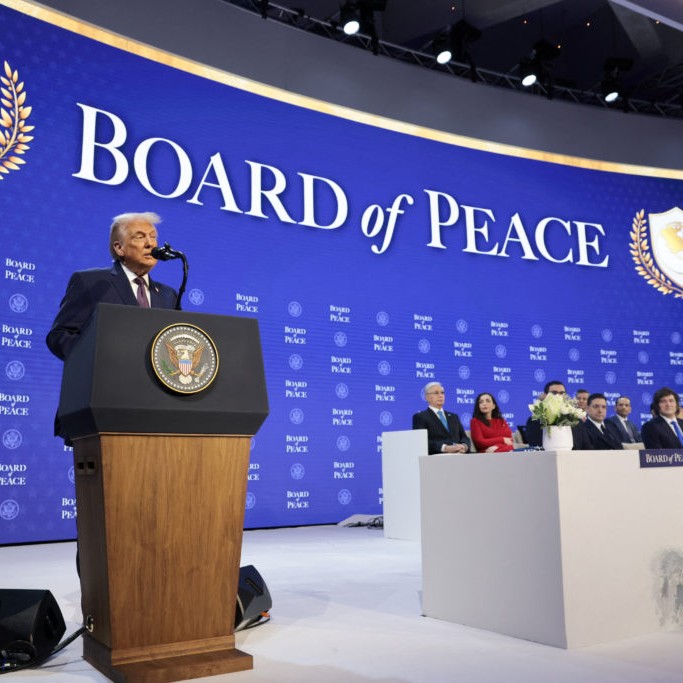
President Donald Trump plans to convene the first meeting of his Board of Peace on February 19th, 2026, in Washington to raise money for Gaza reconstruction. The Associated Press reported the meeting invitation names the U.S. Institute of Peace as the venue amid an ongoing legal dispute over the building.
The pitch is grand. A new board, a new global mandate, and a new Washington headquarters with Trump’s name on it. However, the early response from key allies has reportedly been colder, with some declining to join what they suspect could be a rival power center to the United Nations.
A Peace Board With a Price Tag
According to The Associated Press, Trump plans to convene the first meeting of his Board of Peace this month in Washington with a stated goal that is simple to describe and hard to execute, raising money for the reconstruction of Gaza.
The proposed guest list is where the project starts to look less like a typical U.S. diplomatic working group and more like a new club with membership implications. The AP reported the February 19th meeting would include world leaders who accepted Trump’s invitation in January, plus members of an executive committee for Gaza that would oversee governance, security, and redevelopment.
Two Trump administration officials, speaking to the AP on condition of anonymity because the meeting had not been formally announced, said details were still being determined. One of them predicted strong attendance anyway, saying the administration expected “robust” participation.
That word choice matters because “robust” is doing a lot of work. The administration is promising breadth and legitimacy at the same time, it is acknowledging that the invite count is not the same as a confirmed RSVP list.
The Venue Fight, Now Turned Into the Main Event
The invitation itself adds a layer of Washington muscle politics. A copy obtained by the AP said the meeting would be held at the U.S. Institute of Peace, which the invitation described as now known as the Donald J. Trump U.S. Institute of Peace. That new name is not just branding. It sits inside an ongoing legal battle with the former leadership of the nonprofit think tank, according to the AP.
The AP reported the administration seized the facility last year and fired almost all the institute’s staff. That makes the planned meeting location more than a conference room. It is a flag planted on contested ground, with foreign leaders potentially arriving to a building that is still being fought over.
This is where the Board of Peace turns into something else, a demonstration of who controls an institution, who can rename it, and who can make that rename stick by simply conducting business there.
Trump has made a career out of turning venues into signals. In this case, the signal is aimed in multiple directions at once, at the institute’s former leadership, at U.S. courts, and at global diplomats who may not want to be photographed walking into a headquarters whose ownership and governance are under dispute.
Why Allies Are Reading the Fine Print
Early on, Trump’s Board of Peace was seen as a mechanism focused on ending the Israel-Hamas war in Gaza, the AP reported. Now, it is being described as something broader, an instrument for resolving global crises and, crucially, a way to sidestep the United Nations as Trump looks to reshape the post-World War II international order.
That is an ambitious mission statement for a brand-new board, and the AP reported that many of America’s top allies in Europe and elsewhere have declined to join.
The reason cited is not a procedural complaint. It is a power complaint. Allies suspect the board could be an attempt to rival the U.N. Security Council, the AP reported.
From a distance, the board can look like a negotiation table. Up close, it looks like a potential alternative command center, one where access, money, and influence are filtered through Washington and, more specifically, through Trump.
That is also why attendance matters. A room full of major leaders turns a political idea into an institution. A room full of second-tier representation turns it into a photo op with a fundraising component.
Gaza Money, Global Mandate, and Who Gets the Keys
The stated purpose of the first meeting is fundraising for Gaza’s reconstruction. The practical questions start immediately after that sentence.
Who controls the reconstruction pipeline? Who decides which contractors get hired, which projects get prioritized, and which security conditions attach to the money? The AP reported that an executive committee for Gaza is part of the design, tasked with oversight of governance, security, and redevelopment.
That structure can be read two ways. Supporters can frame it as a blueprint for order and accountability after a war. Critics can frame it as a new layer of external control over a devastated territory, with decision-making tethered to political membership in Trump’s new board.
The AP also reported the board’s shape includes the idea that money can buy influence within the project. In a separate report carried by PBS NewsHour, the concept of a $1 billion contribution tied to a permanent seat on Trump’s Board of Peace was described as part of the broader ecosystem around the initiative.
Even if supporters argue that big funding requires big incentives, the optics are obvious. Peace and reconstruction become intertwined with a donor model, and that invites questions about legitimacy, accountability, and whether the board is primarily a diplomatic mechanism or a power mechanism.
The Contradiction Sitting in the Middle of the Table
Trump’s White House is asking the world to take the Board of Peace seriously as a global crisis forum. At the same time, the venue plan places the board inside a domestic institutional fight, one where the administration has already made aggressive moves that its opponents are challenging in court, according to the AP.
In other words, the board is asking other countries to buy into a process that is supposed to stabilize Gaza while its Washington headquarters is, at least for now, part of a separate stability test at home.
That contradiction can be dismissed as inside baseball. Or it can be seen as a warning flare about how the project will be run, top-down, brand-forward, and willing to treat disputed control as a settled fact if the cameras show up.
It also helps explain why allies might keep their distance. Joining the board is not just about Gaza. It is about endorsing the idea that a U.S.-run structure should compete with, or replace, U.N.-centered mechanisms that have defined global crisis management for decades.
What Happens Next, and What to Watch
The AP reported it was not immediately clear how many leaders would accept the invitation, and the administration officials spoke anonymously because the meeting had not been formally announced and the agenda remained in flux. That leaves several tells to watch.
First, the guest list. Names will reveal whether the board is drawing heavyweight participation or mostly symbolic attendance.
Second, the money mechanics. If the meeting is built around fundraising, observers will be watching for whether contributions are tied to seats, governance roles, or future leverage over Gaza’s redevelopment decisions.
Third, the U.S. Institute of Peace fight. Holding a signature international meeting in a contested building is a bet that momentum and optics can outrun legal uncertainty. If the court battle sharpens, the venue could become a headline of its own, separate from anything discussed about Gaza.
Trump is selling a new forum that promises speed and control. The rest of the world is deciding whether that sounds like peace-making or like a rebrand of power.