

He is not just talking about Greenland again. He is reportedly tying it to money, trade, and the one alliance Europe treats like a fire alarm.
According to a PBS NewsHour report published Jan. 19, President Trump ramped up pressure on NATO allies, threatening new tariffs if they do not allow the United States to acquire Greenland. European leaders, PBS reported, have been meeting to coordinate a response to the crisis that the tariff threats and the Greenland push have kicked up.
A Territorial Idea That Keeps Coming Back, Now With a Tariff Timer
The Greenland fixation is not new in Trump-world. In 2019, Trump publicly floated the idea of buying Greenland, a self-governing territory within the Kingdom of Denmark. Denmark’s prime minister at the time, Mette Frederiksen, dismissed the idea as “absurd.” Trump responded by calling her “nasty” and abruptly canceled a planned visit to Denmark.
That earlier episode mattered because it showed the core dynamic: Trump frames Greenland as a strategic asset the U.S. should control, while Denmark and Greenland treat the idea of a sale as a non-starter. The new twist, per PBS, is the leverage. Tariffs are not just a trade tool in this telling. They are the stick attached to the map.
What PBS Says Happened, and What the Conversation Revealed
PBS NewsHour’s Geoff Bennett reported that Trump “ramped up the pressure” by threatening tariffs on NATO allies if they do not allow the U.S. to acquire Greenland. The segment described European leaders meeting to coordinate a response, with officials warning that tariff threats could test long-standing alliances and NATO unity, especially as security concerns rise in the High North.
Bennett discussed the developments with Charles Kupchan, who served as senior director for European affairs on the National Security Council during the Obama administration, according to PBS.
One of the more telling points in the PBS transcript notes is that the discussion included ways the United States might secure access to Greenland through “military and strategic considerations rather than outright ownership.” In other words, the segment did not frame the issue as a simple real estate pitch. It framed it as an argument over power, basing, and influence, with ownership as the most explosive version of the same goal.
Greenland Is Not a Blank Spot, It Is a Strategic Choke Point
Greenland’s relevance is not celebrity gossip or a novelty headline. It sits in a region where military planners think in terms of early warning, air and sea routes, and great-power competition. The Arctic is also getting more attention as ice conditions change and the geography becomes more usable for transit and posture, even if it remains harsh and unpredictable.
The United States already has an operational footprint tied to Arctic security. The U.S. operates a major installation in northwest Greenland known today as Pituffik Space Base, previously Thule Air Base. That longstanding presence is part of why some national security voices argue that “access” is the real prize, not the flag.
This is where the story gets messy for NATO. If you already have basing, agreements, and operational access through Denmark and Greenland’s political arrangements, why pick a fight that looks like an attempted transfer of territory? Critics argue it injects distrust into an alliance built on mutual defense. Supporters argue it brings leverage and clarity, forcing allies to confront the Arctic’s strategic reality.
Europe’s Dilemma: Treat It as Bluff, or Treat It as Policy
The PBS framing suggests Europe is treating it seriously enough to coordinate. That response is understandable. Tariffs hit voters and industries quickly. Even a threatened tariff can spook businesses, disrupt planning, and scramble political leaders who have to explain why their economy is now collateral in a Greenland dispute.
There is also a protocol problem. NATO is built to deter external threats, not to referee internal pressure campaigns. When a U.S. president publicly links punitive trade action to a territorial aim involving a NATO member’s realm, the dispute stops being a normal disagreement. It becomes a question about how the alliance functions when the biggest member uses economic tools against the others.
European officials, PBS reported, are warning that the tariff threats could test NATO unity. That is the headline risk. The deeper risk is strategic: adversaries watch for cracks, and allies begin planning for a future in which U.S. support feels conditional.
Denmark and Greenland Are Not the Same Political Actor
One reason this topic tends to produce more heat than clarity is that Greenland has its own politics. Greenland is part of the Kingdom of Denmark, but it is self-governing with significant control over domestic matters. Questions of sovereignty, self-determination, and external security do not land the same way in Nuuk as they do in Copenhagen or Washington.
That is also why the optics of “acquisition” are so combustible. A purchase frame can look like bypassing the people who live there. Even if the debate is mostly about defense access, language about ownership triggers a different set of historical alarms.
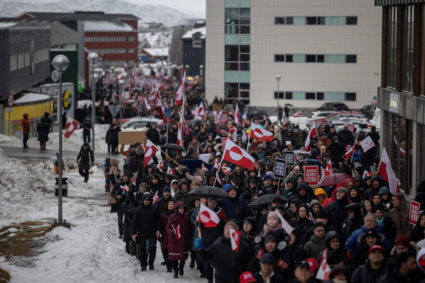
The PBS report included an image of protesters in Greenland rallying against an annexation threat, underscoring that this is not only a diplomatic argument among capitals. It is also a legitimacy argument with an electorate watching.
Tariffs as a Foreign Policy Weapon, and Why That Rattles Allies
Tariffs are familiar in Trump’s political brand. He has used them as bargaining chips in past trade fights, often arguing that economic pain is necessary to rebalance relationships. The issue in the PBS report is not merely whether tariffs are “good” or “bad.” It is what they are being used for, to demand.
Within NATO, allies are accustomed to pressure on defense spending and burden-sharing. They are less accustomed to a U.S. president framing a territorial outcome as a tariff condition. That shift changes the negotiating terrain. It also changes domestic politics inside allied countries, where leaders have to decide whether to negotiate, resist, or find a compromise that avoids humiliation.
Kupchan’s reported emphasis on securing access through strategic arrangements, rather than outright ownership, points to the possible exit ramp. If the real U.S. objective is operational freedom, basing, or enhanced presence, there may be diplomatic pathways that do not require a sovereignty showdown.
What To Watch Next: The Receipts Will Be in the Trade Moves
The next chapter will not be written by cable chatter. It will be written by documents and actions: tariff notices, formal trade investigations, NATO communiques, Danish and Greenlandic statements, and any concrete U.S. proposal that clarifies whether “acquire” means ownership, a lease-like arrangement, expanded basing rights, or something else.
If the tariff threat becomes an actual tariff step, Europe will likely face an immediate choice between retaliation and negotiation. If it stays at the level of pressure and messaging, the battle becomes about deterrence and credibility: will Europe hold the line, and will the White House escalate?
For now, the public record shows two realities colliding. Greenland is strategically valuable, and the U.S. already treats it that way. But Denmark and Greenland have also made clear, in the most memorable phrasing from the last round, that the idea of a simple transaction is “absurd.”
The question PBS put back on the table is whether tariffs can turn an “absurd” idea into a live negotiation, or whether they simply turn NATO’s Arctic problem into NATO’s political problem.