

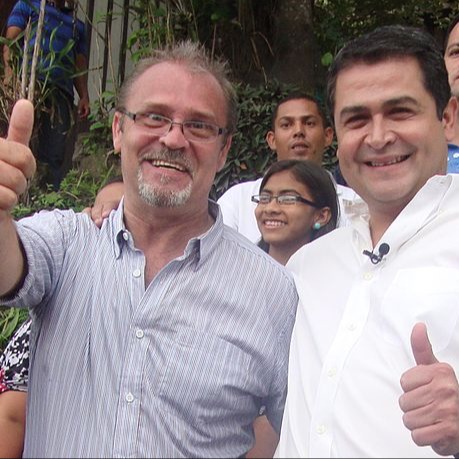
Then-President of Honduras, Juan Orlando Hernandez, with the Founder and CEO of ARPA, 2013. Photo courtesy of ARPA-ONGD under CC BY-SA 3.0.
Donald J. Trump’s announcement of a full pardon for Juan Orlando Hernández, the former Honduran president convicted of drug trafficking and weapons charges, sent shockwaves through the international anti-drug community. Hernández, who was sentenced to 45 years in a US prison, had been serving time at the US Penitentiary in West Virginia after his 2024 conviction. The pardon came just days before Honduras’s national election, raising questions about the timing and political implications of the move.
A Pardon With Political Overtones
Trump framed the pardon as a correction of an injustice, claiming Hernández was treated “very harshly and unfairly” and suggesting the conviction was politically motivated, as reported by POLITICO. The President’s statement on social media emphasized his belief that Hernández’s prosecution was a “Biden set up” and that the charges were the result of a politicized trial under the previous administration, as reported by The Guardian. White House press secretary Karoline Leavitt echoed this view, describing Hernández’s conviction as the product of a corrupt “over-prosecution” and “lawfare” by the leftist party, which she said struck a deal with the Biden-Harris administration, as reported by POLITICO.
Leavitt argued that Hernández’s defense was hampered by insufficient preparation time and that the conviction relied heavily on testimony from “many admitted criminals” seeking reduced sentences, as reported by POLITICO. She maintained that there was “virtually no independent evidence presented” against Hernández. Despite these claims, the administration said the pardon did not undermine its ongoing campaign against narcotics trafficking, with Leavitt stating that Trump’s goal was to “correct the wrongs” of the Biden Justice Department while continuing efforts to stop illegal drugs at the US border and internationally.
Hernández’s Conviction and Charges
Juan Orlando Hernández was convicted in a US federal court of conspiring to import cocaine into the United States and related weapons offenses. Prosecutors portrayed him as a key figure in creating a “cocaine superhighway” through Honduras, facilitating the transit of hundreds of tons of cocaine into the US, as reported by The Guardian. The former president was also accused of accepting millions in bribes from notorious drug traffickers, including Joaquín “El Chapo” Guzmán, to support his political campaigns.
The judge presiding over the case described Hernández as “a two-faced politician hungry for power,” as reported by POLITICO, highlighting the severity of the charges. Hernández’s younger brother, Juan Antonio “Tony” Hernández, had previously been sentenced to life in prison for similar drug trafficking offenses, including accepting $1 million from El Chapo to support Juan Orlando’s presidential campaign.
Reactions From Supporters and Critics
Hernández’s family expressed gratitude following the pardon. His wife and children were reportedly seen praying outside their home in Tegucigalpa, Honduras, shortly after Trump’s announcement. A family spokesperson said Hernández was emotional upon hearing the news, and his legal team called the pardon a “great injustice” being righted, as reported by the Associated Press. One of Hernández’s lawyers thanked Trump for ensuring “justice was served” and expressed hope for a strengthened partnership between the United States and Honduras.
However, the pardon drew sharp criticism from anti-drug officials and foreign policy experts. Mike Vigil, former DEA chief for international operations, called the move “hypocritical,” saying, “It just shows that the entire counter-drug effort of Donald Trump is a charade, as reported by The Guardian. Vigil noted that Hernández was responsible for moving billions of dollars worth of cocaine into the US, far exceeding the impact of the “kinetic strikes” Trump ordered against suspected drug boats in the Caribbean.
Vigil also questioned why Trump would pardon Hernández but not Joaquín “El Chapo” Guzmán, who is considered less influential in the drug trade than Hernández was. He described Hernández’s role in transforming Honduras into a narco-state, complete with coca plantations and makeshift cocaine labs, as unprecedented for a sitting president, as reported by The Guardian.
The Broader Context of US Policy in Latin America
Trump’s pardon comes amid heightened tensions in US relations with Latin America, particularly regarding drug trafficking and political influence. The Trump Administration has taken a hardline approach against Venezuelan leader Nicolás Maduro, whom he has labeled a “narco-terrorist” and targeted with military strikes and a $50 million bounty, as reported by The Guardian. Yet, critics argue that the evidence against Maduro and his alleged “Cartel of the Suns” is weak, and that Trump’s policies are inconsistent and politically motivated.
In Honduras, the pardon coincides with a critical election where Trump has endorsed Nasry “Tito” Asfura, a conservative candidate with a controversial past. Trump warned that if Asfura loses, Honduras could follow Venezuela’s path under Maduro, implying a loss of US influence in the region, as reported by the Associated Press. Asfura’s opponents include candidates from the leftist Libre party and the Liberal Party, making the election a focal point for competing political ideologies.
What Comes Next?
The timing of the pardon, just days before Honduras’s election, is widely seen as a strategic move by Trump to influence regional politics and reward an allied political bloc. While Hernández’s supporters hail the pardon as a victory against political persecution, anti-drug officials and analysts warn it could damage US credibility in the global fight against narcotics.
As Honduras prepares to vote, the pardon adds a new layer of complexity to the country’s political landscape and the broader US strategy in Latin America. Whether the move will strengthen or undermine efforts to combat drug trafficking remains a subject of intense debate.
References: White House defends pardon of ex-Honduran president convicted of drug trafficking | Trump says he plans to pardon former Honduran President Hernandez | Trump’s pardon of Honduras’s ex-president shows counter-drug effort is ‘based on lies and hypocrisy’ | US foreign policy