

Los Angeles got the mass march. It also got the part that public officials dread and activists argue over afterward, a chaotic bottleneck where a movement’s message can be replaced, in seconds, by smoke, skirmish lines, and video clips of a loading dock.
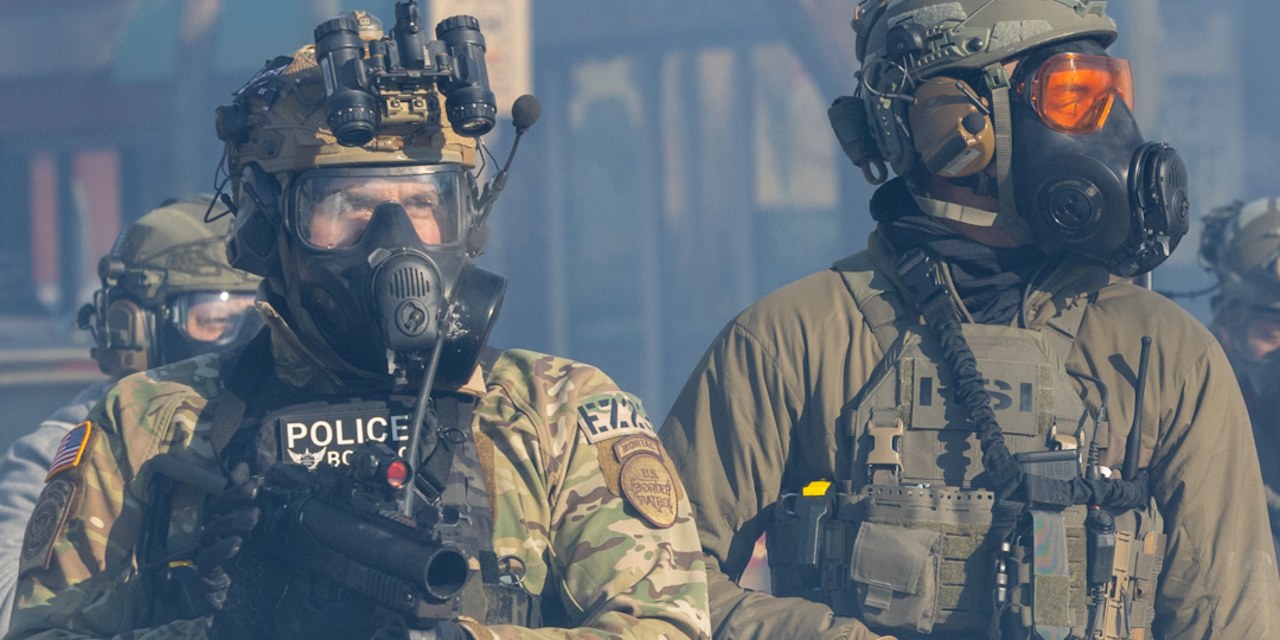
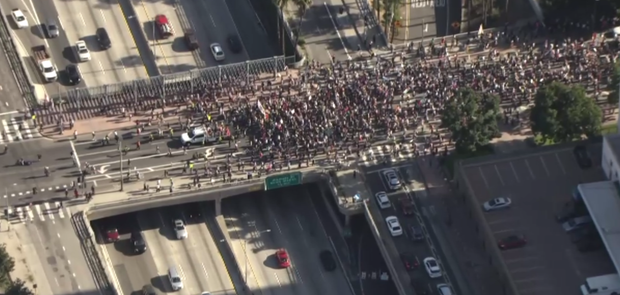
Thousands poured into downtown for a National Shutdown day of action tied to anger over federal immigration operations. By nightfall, the flashpoint had moved to the Edward R. Roybal Federal Building, where federal agents in riot gear guarded an entrance, the Los Angeles Police Department went to a tactical alert, and a dumpster ended up as both barricade and bonfire.
What made the day politically combustible was not just the size of the turnout. It was the split-screen: a broad, daytime coalition that included students and small business owners, and a later confrontation that gave authorities a different story to tell, and a reason to harden their posture.
A March That Swelled, Then Traveled
Demonstrators began gathering Friday afternoon outside the Los Angeles City Hall, then marched through downtown streets and into Boyle Heights, according to CBS News. For a time, it looked like the familiar L.A. protest template: loud, packed, mobile, and largely orderly.
But the march eventually settled outside the Edward R. Roybal Federal Building complex, a symbol-rich target for a protest aimed at federal immigration enforcement. That choice came with built-in stakes. Once a crowd posts up at a federal facility with controlled entrances, the next moves are predictable: barriers, warnings, dispersal orders, and the risk that a few dozen people set the terms for a few thousand.
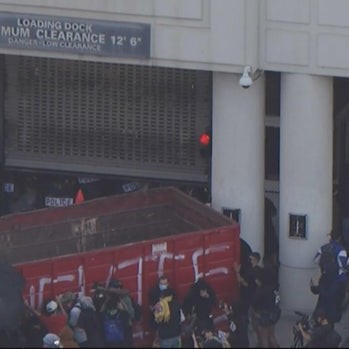
CBS News reported that at the complex’s loading dock, some protesters threw items at federal agents guarding the entrance. Agents deployed pepper balls and tear gas, and parts of the building were vandalized. A construction dumpster was pushed toward the loading dock entrance.
The Mayor’s Warning Was About Optics, Not Rights
Mayor Karen Bass tried to walk a thin line that city leaders often have to walk in real time: defend the principle, discourage the confrontation.
“Peaceful protest is a constitutional right,” Bass wrote on X, according to CBS News. “I urge Angelenos to exercise that right safely and not give this administration an excuse to escalate.”
Read that again and you can see the power dynamic hiding in plain sight. The mayor was not only talking about public safety. She was talking about leverage. In protest politics, escalation is not just what happens on the street. It is how the next press conference gets framed, how resources get deployed, and how quickly the conversation moves from the original grievance to property damage and arrest totals.
Tactical Alert, Dispersal Orders, and ‘Less Than Lethal’
The confrontation triggered a tactical alert from the LAPD, CBS News reported, keeping officers on duty beyond their normal schedules. Tactical alerts are a serious operational move. They signal that the department expects long hours, unpredictable flashpoints, and the possibility of wider spillover.
In an X post cited by CBS News, the LAPD described “violent agitators” on Alameda between Temple and Aliso and said federal authorities were taking “debris, bottles and other objects.”
Dozens of LAPD officers responded and formed skirmish lines. A dispersal order followed, telling protesters to leave by 5:56 p.m. or risk arrest, according to CBS News.
On the street level, those are the moments that separate a protest from a police operation. A dispersal order flips the burden onto the crowd. Anyone who stays becomes, at minimum, a possible arrest, and at maximum, a prop in someone else’s narrative.
CBS News also reported the LAPD said protesters were “actively fighting with Officers” after multiple dispersal orders, adding, “Less than lethal has been authorized due to the violence against officers.”
Arrests followed, although CBS News reported the number of people taken into custody was unclear.
The Late-Night Problem: A Dumpster Fire and the Firefighters Who Could Not Get In
Even after most of the crowd dissipated around 10 p.m., CBS News reported that a smaller group returned to the federal building and set a fire inside the dumpster near the loading dock.
It is one thing for city officials to argue about tactics and enforcement in abstract. It is another when fire is introduced, because it raises the risk for everyone, including people who did not come to fight and first responders who now have to enter an unstable scene.
According to CBS News, firefighters arrived within minutes but backed away after some protesters blocked their truck from reaching the loading dock. As they waited for LAPD officers to arrive, federal agents exited the building to disperse the crowd, while others worked to extinguish the flames.
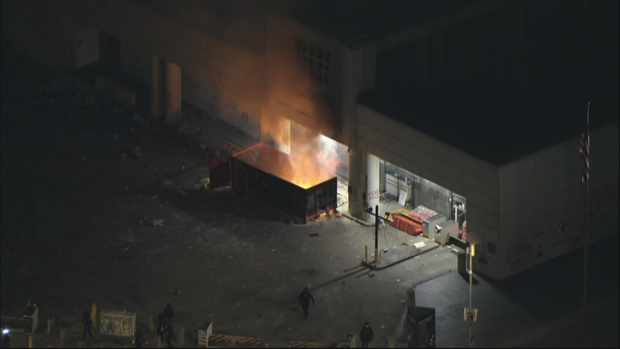
That detail matters because it shows how quickly a protest can create competing emergencies. A movement trying to spotlight federal immigration enforcement ends up in a situation where the most immediate question becomes: can the fire department do its job?
The Movement’s Other Front: Dollars, Storefronts, and School Walkouts
One reason the day drew attention was that the action was not limited to chanting and marching. It also involved economic and civic participation, the kind of pressure that is harder to dismiss as a one-night spectacle.
CBS News reported that some small business owners stayed open because they needed revenue, while others closed or shifted operations to show solidarity. Nikki High, the owner of Octavia’s Bookshelf in Pasadena, framed it as economic leverage.
“To let people know we can withhold our dollars, we can withhold the economy, to ensure that every person here is safe,” High told CBS News.
Other businesses attempted a middle path. CBS News reported that Sonder One, a yoga studio with multiple locations, said it could not close completely but planned to share some profits with immigrant rights groups.
Meanwhile, in Boyle Heights, CBS News reported that Picaresca Cafe closed for business and used its storefront as a community space for poster-making. “Ultimately, we thought that if we aren’t going to run the operation as usual, we have to do something for our community,” manager Reina Esparza told CBS News.
Students also joined in. CBS News reported that dozens from La Habra and Sonora high schools walked out Friday morning and marched toward the Los Angeles City Hall, with passing cars honking and shouting support.
“I’m really glad to see so many people, especially people that I know, having the courage to come out here and do this,” student Ysa Asi told CBS News.
LAUSD’s Tightrope: Support the Speech, Keep the Doors Open
The Los Angeles Unified School District added another layer to the day’s contradictions. According to CBS News, LAUSD posted a statement supporting students and their right to “advocate for causes that are important to them,” while emphasizing that schools would remain open.
“Schools have developed activities and spaces where students can exercise their First Amendment rights safely on campus, allowing them to make their voices heard while remaining in a secure learning environment,” LAUSD said in the statement cited by CBS News.
It is a classic institutional compromise: validate the principle, manage the risk. For a district responsible for student safety and attendance, encouraging activism off-campus is a liability. For students and organizers, keeping the action on-campus can feel like a release valve that reduces street pressure. Either way, the district is signaling that it wants the message without the mayhem.
What To Watch Next
Big protest days do not end when the streets clear. They continue in arrest processing, internal movement debates, and the fight over what the day will be remembered as.
Based on what CBS News reported, the next questions are straightforward and consequential: How many arrests were made, and what were the charges? Will there be investigations into vandalism or use of less-lethal munitions? Will organizers distance themselves from the loading dock confrontation, or argue it was an inevitable response to enforcement tactics they see as aggressive?
For city leaders, the test is whether they can maintain space for protest while preventing a repeat of the scene at the federal building. For federal authorities, the question is whether the clash becomes a justification for expanded security posture. For the broader coalition that showed up for the daytime march, the risk is that a single dumpster, shoved into a loading dock, becomes the headline that drowns out everything else.