

Donald Trump just tried to sell the world on a promise that sounds like a postcard, a “sprawling seaside metropolis” rising from Gaza. The missing detail is the one that changes everything: who gets to decide what Gaza becomes, and who does not.
At the World Economic Forum in Davos, Trump unveiled what he calls the “Board of Peace,” a U.S.-chaired effort meant to oversee a ceasefire and post-war planning for Gaza, according to a PBS NewsHour transcript. The rollout came with glossy-sounding numbers, a marquee cast, and a blunt note from the reporting: “There are no representatives from Gaza on the board overseeing its future.”
The Davos debut that mixed diplomacy with a developer’s eye
PBS NewsHour reported that Trump returned to Washington after a trip to Davos for the World Economic Forum, and used the summit to introduce the Board of Peace and a Gaza reconstruction vision. In the on-stage remarks aired by PBS, Trump framed the board as a generational reset.
Trump’s ‘Board of Peace’ is the nail in Gaza’s coffin https://t.co/2oQr0FkcKQ
Jonathan Cook
Jan 23, 2026 pic.twitter.com/yKG9w0kP1T— Wodjah Bilderberg (@WodjahB) January 23, 2026
“Together, we are in a position to have an incredible chance, I don’t even call it a chance, I think it’s going to happen, to end decades of suffering, stop generations of hatred and bloodshed, and forge a beautiful, everlasting and glorious peace,” Trump said, per the PBS transcript.
Then came the real estate language. “See, I’m a real estate person at heart, and it’s all about location. And I said, look at this location on the sea. Look at this beautiful piece of property, what it could be for so many people,” Trump said in the same transcript.
That contrast, lofty peace language followed by a property pitch, is the tell. The plan is being presented as a humanitarian rebuild, but marketed like a megaproject.
$25 billion, 100,000 housing units, and a GDP target
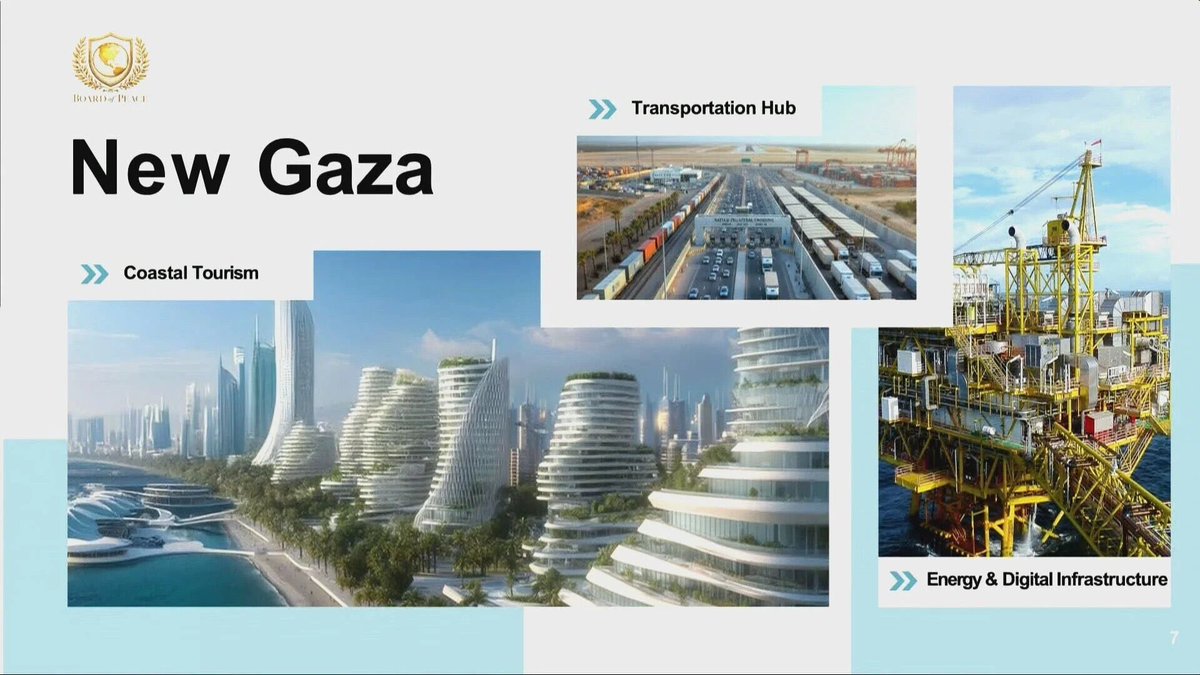
The architecture of the pitch, at least as described so far, is intentionally concrete. PBS reported that special envoy Steve Witkoff and Trump’s son-in-law Jared Kushner presented a $25 billion vision for “gleaming skyscrapers,” 100,000 housing units, 75 medical centers, and an expected GDP of $10 billion by 2035.
Those figures are specific enough to sound engineered, but broad enough to invite hard questions. Who funds it? Who owns it? Who governs it? Who gets displaced, compensated, or invited back? The PBS segment, and transcript excerpt, place the numbers in the open while also flagging the missing seat at the table: Gaza itself.
For readers trying to map the stakes, Gaza is not just a development site. It is a densely populated territory on the eastern Mediterranean, generally described as the Gaza Strip, with a political history that is inseparable from its geography. Basic background on the territory’s status is summarized in Wikipedia’s Gaza Strip entry, including its location and administrative context.
The membership problem: who signed on, and who rejected it
PBS reported that “some 35 nations” had signed onto the Board of Peace concept, and that the list spanned a wide range of countries. The transcript also notes that some countries joined but were absent at the ceremony, while others rejected the invitation.
Even without a full roster published in the transcript excerpt, the shape of the coalition matters because it tells you what the board is, and what it is not. It is not a universally embraced peace architecture. It is a voluntary club chaired by the American president, introduced at a global business and political summit, with immediate geopolitical consequences attached.
Spain Opts Out of Trump’s Gaza-Linked “Board of Peace,” Citing Lack of Palestinian Role
Joining a wider EU holdout, Spain rejected the invitation, noting the board excludes the Palestinian Authority and conflicts with its commitment to UN-led conflict resolution. pic.twitter.com/vvWbxRsxS8— The Ground Narrative (@GroundNarrative) January 23, 2026
Caretaker Government Defers Decision on Trump’s ‘Board of Peace’ Invitation
Thailand’s caretaker government has acknowledged an invitation from US President Donald Trump to join a proposed Board of Peace under Washington’s Comprehensive Plan to End the Gaza Conflict, but any… pic.twitter.com/Uq09I3ibr6
— Thai Enquirer (@ThaiEnquirer) January 23, 2026
That creates a familiar tension: is this a diplomatic framework with enforceable legitimacy, or a Trump-branded forum that can be widened, narrowed, or redirected depending on political leverage?
US President Donald Trump rescinded Canada’s invitation to join the #Gaza ‘Board of Peace’ after Prime Minister Mark Carney criticized economic coercion at Davos.https://t.co/GaiGwHtZqb pic.twitter.com/6lXTd9uRTJ
— The Palestine Chronicle (@PalestineChron) January 23, 2026
Scope creep by design, and the United Nations question
The PBS reporting highlights that Trump has already expanded the board’s scope beyond Gaza to other conflicts around the world, raising concerns about “how the group he chairs works with or around the United Nations.” That is not a footnote. It is the point of the fight.
If the Board of Peace is positioned as parallel to existing international structures, it will attract countries that want faster deals and fewer constraints. It will also alarm governments and diplomats who view U.N.-linked processes as the baseline for legitimacy, however imperfect those processes can be.
This is where Trump’s style becomes the story. A board can be a bureaucracy, or it can be a stage. Davos is a stage. And Trump has long treated stages as negotiating tables.
Greenland floated again, and the hard edge behind the soft branding
The Davos trip also carried a separate, sharper message. PBS reported that Trump “seems to have defused a crisis he created” by insisting the U.S. acquire Greenland, a self-governing territory of Denmark. In the transcript, Trump’s language on Greenland is about access and security, not partnership.
“We’re going to have all military access that we want. We’re going to be able to put what we need on Greenland, because we want it. We’re talking about national security and international security,” Trump said, per the PBS transcript.
Greenland’s political status is widely described as self-governing within the Kingdom of Denmark, and the basics are summarized in Wikipedia’s Greenland entry. The key connection is not that Gaza and Greenland are similar, they are not. The connection is the governing philosophy revealed in the language: strategic access, territorial framing, and a willingness to talk like ownership is the starting point.
Why the missing Gaza seat is the whole story
PBS’s line that there are no representatives from Gaza on the board is the kind of detail that turns a grand promise into a legitimacy crisis. If the board is meant to oversee post-war plans for Gaza, the absence of Gazan representation invites predictable pushback from humanitarian groups, diplomats, and regional leaders who will argue that reconstruction without local participation can become reconstruction without consent.
It also puts the plan in a political vise. If it does include representatives later, who chooses them, and what qualifies them. If it does not, it risks looking like a future decided by outsiders with money, security priorities, and public relations deadlines.
Trump’s own quote, that it is “all about location,” will be repeated for a reason. It is an easy line to weaponize, because it sounds like a sales pitch in a place defined by loss, displacement, and contested sovereignty.
What to watch next: receipts, governance, and who writes the fine print
So far, the plan is heavy on skyline imagery and light on governance specifics, at least in the material reflected in the PBS segment and transcript. The next phase will determine whether the Board of Peace becomes a policy engine or a branding vehicle.
Watch for three receipts that will clarify the power behind the pitch.
First, any written framework describing the board’s membership rules, authority, and relationship to existing international bodies. Second, any documented funding commitments or investment structures behind the $25 billion figure. Third, any formal mechanism for Gaza participation, whether through civic leaders, technocrats, or internationally recognized representatives.
Until then, Trump has placed a big bet on a simple narrative: peace through construction, legitimacy through a coalition, and momentum through scale. The contradiction is already baked into the rollout, and PBS summed it up without adding adjectives: the board is being introduced as Gaza’s future council, while Gaza has no seat.
And in Davos, in Trump’s own words, the sales pitch is not subtle. It is “all about location.”