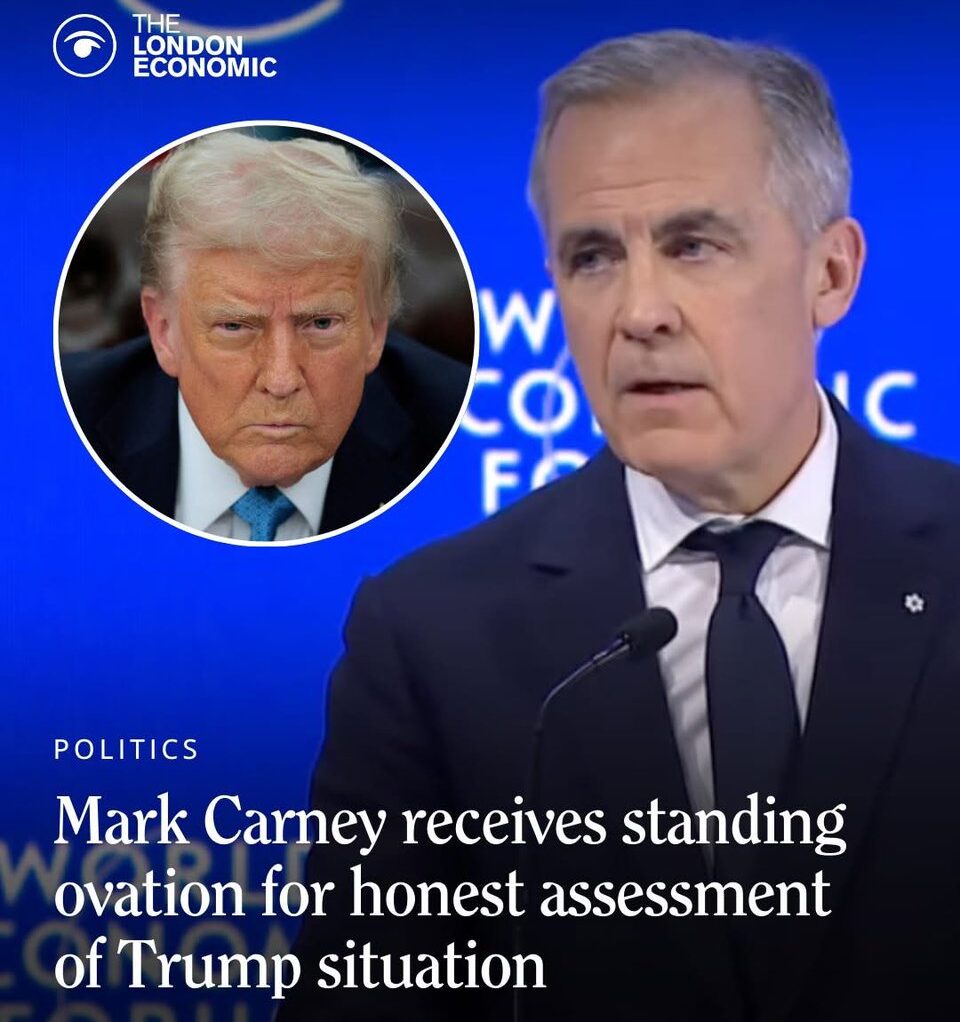
Mark Carney walked into Davos with a warning that doubles as a dare. If the old global script is dead, he argued, then the countries stuck between superpowers have to stop pretending it still works.
The Canadian prime minister used his World Economic Forum speech to point the finger directly at President Trump, accusing him of “rupturing the world order” through economic coercion. Then Carney pitched an alternative: middle powers like Canada should link up, build resilience, and create a values-based order less reliant on the United States.
Those are not small words for a room packed with CEOs, financiers, and political operators who built careers on the assumption that U.S.-led globalization was messy but stable. Carney’s message, published as a transcript by the World Economic Forum and carried by CBS News, was simpler. The era of “no limits, no constraints” is here, and the countries in the middle either coordinate or get cornered.
Carney’s Target: ‘Economic coercion’ and a World Running on Leverage
In the CBS News report, Carney accused Trump of driving the rupture “through economic coercion,” and warned that the world is entering a “harsh reality” where major powers observe “no limits, no constraints.” The setting mattered. The World Economic Forum is built for polished consensus talk, not for naming names.
Carney did both, and he did it in a way meant to land with people who think in risk models. In the transcript, he describes a world where tariffs, financial infrastructure, and supply chains become tools of pressure rather than neutral plumbing. It is not just that geopolitics is back. It is that interdependence itself becomes a weapon.
He also warned against the easiest response, which is retreat. A future of fortresses, he argued, would be “poorer, more fragile and less sustainable.”
The Provocative Part Was Not the Diagnosis, It Was the Instruction
Carney’s core pitch was aimed at what he called “middle powers,” the countries with serious economies and influence but without the ability to dictate terms alone. He told them to join together, build on their strengths, and form a new order “based on our values” that is less reliant on the U.S., according to CBS News.
That is a high-wire argument in a country like Canada, where geography and trade bind the relationship to Washington even when politics turns sour. Carney’s speech also tried to head off a predictable critique. He framed the project as pragmatic, not dreamy, and talked about “risk management” and shared resilience.
One line from the transcript was built to travel: “If we’re not at the table, we’re on the menu.”
His Rhetorical Weapon: Vaclav Havel and ‘Living Within a Lie’
Carney reached for a Cold War dissident to make a modern point. In the transcript, he recounts Vaclav Havel’s essay ‘The Power of the Powerless’ and the image of a shopkeeper who posts a political slogan he does not believe just to avoid trouble. Havel called it “living within a lie.”
Carney’s translation for 2026 was blunt. For decades, he said, countries like Canada prospered under what was called a “rules-based international order.” It was useful, even when imperfect. But he argued the bargain is broken, and repeating the old phrases has become its own ritual.
“Stop invoking rules-based international order as though it still functions as advertised,” he said in the transcript.
Receipts, Not Vibes: Trade, Defense, and a Push for ‘Strategic Autonomy’
Carney’s speech, as published by the World Economic Forum, tried to show that he was not just scolding the room. He described a policy posture built around two themes: building strength at home and diversifying abroad.
Among the specific claims in the transcript:
- He said Canada has removed “all federal barriers to interprovincial trade” and is fast-tracking “a trillion dollars of investments” across sectors, including energy, AI, critical minerals, and trade corridors.
- He said Canada plans to double defense spending by the end of the decade, framed as both security and industrial policy.
- He said Canada has pursued major diversification moves, including a strategic partnership with the EU and participation in SAFE, which he described as European defense procurement arrangements.
In other words, he didn’t just argue that middle powers should stand taller. He claimed Canada is already rearranging its economy and alliances to do it.
Where Trump Shows Up Again: Greenland, Tariffs, and the Arctic
Even inside a big philosophical speech about world order, Carney repeatedly returned to the kind of pressure politics he says is remaking alliances. In the transcript, he said Canada “stands firmly with Greenland and Denmark,” and he added that Canada “strongly opposes tariffs over Greenland” while calling for talks on Arctic security and prosperity.
BREAKING: President Trump takes aim at Canada
In Davos address, President Trump criticized Canadian Prime Minister Mark Carney, saying Canada “gets a lot of freebies,” and argued that a U.S. acquisition of Greenland would ultimately benefit Canada. pic.twitter.com/hIrx30ehIu— Bluekurtic Market Insights (@Bluekurtic) January 21, 2026
The CBS News summary tied Carney’s critique to Trump directly. Carney’s broader argument was that economic integration is now being used as leverage, and middle powers need alternatives that are not dependent on a single hegemon.
‘Canada lives because of United States. Remember that Mark’- Trump tells Canadian PM Carney.
Watch his Davos speech LIVE:https://t.co/ymcHcd2cMZ pic.twitter.com/N4CFXYmd6I
— ThePrintIndia (@ThePrintIndia) January 21, 2026
What was missing from the CBS report was any on-the-record response from Trump or the White House to Carney’s remarks. The speech itself, though, was written as if the response is already baked into the system. Carney’s warning was that accommodation does not buy safety. “Well, it won’t,” he said in the transcript.
Why the Business Crowd Should Care, and Why They Might Disagree
Carney’s argument lands in a place Davos understands. When tariffs and financial chokepoints become bargaining chips, supply chains stop being a cost-optimization game and turn into a sovereignty issue. That raises prices, reshapes investment, and forces uncomfortable choices about where capital and technology flow.
But his pitch also collides with a reality he acknowledged. Great powers can still go it alone, at least for now, because of market size and military capacity. Middle powers do not have that luxury. They either pool leverage or they compete against each other to be “the most accommodating,” as he put it in the transcript.
There is also a quiet contradiction inside the solution. Carney argued for a values-based order anchored in human rights, sovereignty, and territorial integrity. At the same time, he urged “variable geometry,” meaning different coalitions for different issues. That flexibility is practical, but it also invites the criticism he warned about: inconsistent standards, selective outrage, and values that bend when the deal is good.
What To Watch Next
Carney framed his plan as an invitation to other countries. The test is whether any significant bloc follows his lead in ways that show up in trade corridors, defense procurement, AI governance, and critical minerals supply chains.
The other test is political. Calling out the U.S. by name inside Davos, while urging less reliance on Washington, forces allies, companies, and investors to pick a vocabulary. Are they still selling the “rules-based order,” or are they ready to admit, as Carney put it, that “we are in the midst of a rupture, not a transition”?
Carney closed with the line that explains the whole performance. The powerful will keep their power. The question, he insisted, is whether everyone else keeps the sign in the window.