Donald Trump has a familiar talent: turning a few seconds of ugly video into a multi-day loyalty test. First comes the repost, then the delete, then the non-apology. The only question is who gets stuck explaining it.
What You Should Know
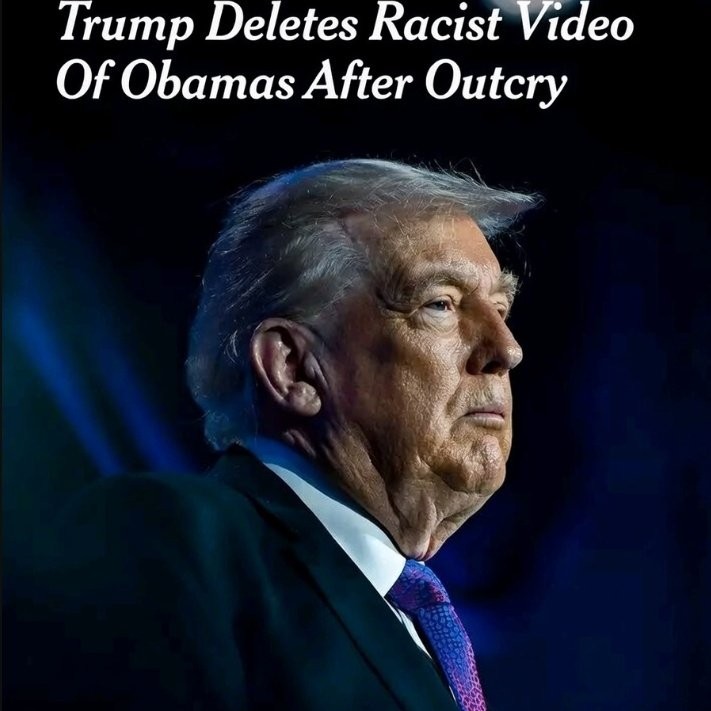
CBS News reported that Donald Trump shared a video described as racist on Truth Social, later removed it, and declined to apologize. The episode echoes prior repost-and-delete flare-ups that have repeatedly raised questions about how he uses his platform.
The immediate facts are simple, and the consequences are not. A former president and current political force used his social platform to boost content others labeled racist, then pulled it down. The refusal to apologize is the part that keeps the story alive, because it shifts the fight from one post to a pattern.
🚨 Trump refuses to apologize for that racist Truth Social video showing the Obamas as apes – White House deleted it after backlash, but the damage is done! 😡
Meanwhile, on Polymarket, the odds of Trump being out as President before 2027 are climbing to 17% YES amid scandals… pic.twitter.com/HBCtWDf64m
— Mosterin | Web3 Insights (@Mosterin_0) February 7, 2026
The Post, the Delete, and the Non-Apology
According to CBS News, Trump shared a video on Truth Social that drew condemnation as racist, removed it, and refused to apologize. That sequence matters because it is not just about content moderation. It is about command and control.
For Trump, social media has never been a diary. It is a lever. A post can test allies, bait opponents, and force journalists and party leaders into a familiar bind: respond loudly and risk amplifying, or stay quiet and risk normalizing.
The delete, meanwhile, does not erase the blast radius. In a screenshot economy, deletion often reads less like regret and more like risk management. The post did what it needed to do, and the cleanup begins.
A Pattern With Receipts, Not a One-Off
This is not the first time Trump has been pulled into controversy over a provocative repost.
In June 2020, Trump retweeted a video that included a supporter shouting “white power,” then deleted the tweet after backlash, according to BBC News. The mechanics were the same as the modern playbook: viral clip, instant outrage, rapid rollback, and a political argument that kept burning after the content disappeared.
More recently, the repost-and-delete cycle showed up again in May 2024, when a video shared on Trump’s account included the phrase “unified Reich” in on-screen text. Reuters reported that the video was removed after criticism, and the Trump campaign blamed a staffer and said the president was in court when it was reposted.
The connective tissue between these episodes is not just offensive language or extremist-adjacent imagery. It is the repeated gap between the reach of the original post and the thinness of the accountability that follows.
Plausible Distance Is the Point
Trump’s political operation has long benefited from what you could call plausible distance: the ability to signal to a wide online audience while keeping the official message slippery enough to deny intent.
A campaign can argue that a repost is not an endorsement. A spokesperson can point to staffers, algorithms, or the speed of the internet. The post can vanish, and the candidate can keep the upside, which is attention, while pushing the downside, which is responsibility, outward onto everyone else.
That dynamic is also why these fights rarely end with a clean resolution. Even when content is removed, the argument over what it meant and who it was for becomes its own product.
Trump has also shown, in other moments, that he is comfortable leaving interpretive space for sympathetic audiences. During the 2017 debate over Charlottesville, Trump said, “You had some very fine people on both sides.” That line, preserved in the White House archive, is still cited because it captures the same core tension: condemnation framed as selective, distance framed as fairness, and a controversy that survives because the wording never fully closes the door.
Why the Stakes Are Bigger Than One Post
There are two overlapping stakes here, one cultural and one operational.
The cultural stake is the boundary-setting question: what kind of rhetoric gets treated as disqualifying, what gets brushed off as trolling, and what gets quietly absorbed as background noise. Every repost-and-delete controversy is a small referendum on those boundaries.
The operational stake is more transactional. Trump’s influence is partly a function of message discipline inside a campaign that thrives on improvisation. When controversial content shows up under the candidate’s name, the campaign has to answer a basic question that donors, allies, and voters notice: who is steering the account, and what controls exist when the content is radioactive?
Even the best defense, which is that something slipped through, still admits something important. It suggests the most powerful megaphone in the movement can be hijacked by impulse, poor judgment, or staff-level chaos.
The Media Trap Built Into the Cycle
Controversial posts create a repeatable trap for media and opponents.
If critics respond with maximal outrage, they risk turning the original content into free distribution. If they respond narrowly, they risk looking evasive. If they ignore it, they risk letting supporters translate silence into permission.
Trump’s advantage is that he rarely pays an immediate cost for the confusion itself. The confusion is the terrain, and he has spent years fighting on it.
That does not mean there is no cost. Deletions and walk-backs can harden narratives about temperament, judgment, and tolerance for extremist-adjacent material. They can also complicate coalition politics, especially when swing-state voters, suburban donors, or party officials are forced to answer for content they did not post.
What to Watch Next
Three next steps determine whether these episodes fade or compound.
First, watch for whether Trump or his campaign offers a specific explanation that matches the documented timeline, including who posted the content, when it was removed, and what review process exists for future posts. Vague statements tend to prolong controversies, because they create room for competing interpretations.
Second, watch how allied politicians and conservative media handle the script. Do they deny the underlying content, concede the optics, or shift the blame to opponents for “weaponizing” outrage? Each response tells you whether the party is trying to narrow the tent or simply manage the smoke.
Third, watch Truth Social itself. The platform is not a neutral venue in Trump’s orbit. It is tied to his political identity, and its moderation decisions can be read as political choices, even when they are framed as routine enforcement.
For readers trying to make sense of the latest controversy, the most revealing detail is not the delete. It is the refusal to apologize. A deletion suggests a calculation about downside. A non-apology suggests the upside is still worth it.