

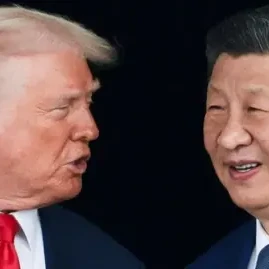
Xi Jinping picked his moment and his message with the kind of precision that makes diplomats sweat.
On a phone call with President Donald Trump, China’s leader put Taiwan front and center, calling it “the most important issue” in U.S.-China relations, according to Chinese state media, as reported by BBC News. He also delivered a direct warning about U.S. weapons for the island: be “prudent.”
Trump, meanwhile, sold the same conversation as a win for vibes and dealmaking. “Excellent,” he called it, “long and thorough,” while hyping trade talk and a trip to China, he said he “very much” looked forward to.
So which is it, a friendly reset or a hard-edged warning? The answer is usually yes.
Taiwan as the Price of Admission
Xi’s framing was blunt. Taiwan, he said, is “China’s territory,” and Beijing “must safeguard [Taiwan’s] sovereignty and territorial integrity,” BBC reported. Then came the line that cuts through every cheerful trade headline: “The United States must handle the issue of arms sales to Taiwan with prudence.”
This is not new language, but timing is everything. The Trump administration announced a major arms sale to Taiwan in December, worth around $11bn, according to BBC News. It included advanced rocket launchers, self-propelled howitzers, and a range of missiles.
Beijing, in that same BBC reporting, said the sale was an “attempt to support [Taiwan’s] independence” and warned it would “accelerate the push towards a dangerous and violent situation across the Taiwan Strait.”
In other words, the phone call was not just a chat. It was a reminder of what China says the relationship is really about.
Trump’s Version: Soybeans, Oil, and the Personal Touch
Trump did not ignore Taiwan, but his public emphasis leaned heavily toward commerce and personal rapport. On Truth Social, he described his relationship with Xi as “an extremely good one,” adding, “we both realize how important it is to keep it that way,” according to BBC.
He also said Beijing was considering buying 20 million tonnes of U.S. soybeans, up from 12 million tonnes, BBC reported. It is the sort of detail that signals what Trump wants voters, markets, and negotiators to hear: the big guy is calling, and deals are on the table.
Trump also said the pair discussed Russia’s war in Ukraine, the situation in Iran, and China’s purchase of U.S. oil and gas, per BBC’s account of his post.
That list matters because it stretches the agenda beyond Taiwan. It also gives Beijing an opening to present itself as a global player, not just a regional power with a chip on its shoulder.
The Diplomatic Tightrope Is the Policy
The United States has formal diplomatic ties with Beijing, not Taipei, and has long tried to balance deterrence, reassurance, and ambiguity. That balancing act is not academic here. It determines whether arms packages become routine transactions or flashpoints.
Publicly, Taiwan is self-governed, has its own military, and runs its own elections. The CIA’s World Factbook describes Taiwan as a “self-governing” entity, while also documenting Beijing’s claim and the island’s contested international status.
Washington’s position is famously careful. The U.S. Department of State’s fact sheet on U.S. relations with Taiwan lays out an approach built on unofficial ties, security cooperation, and long-standing policy frameworks that attempt to preserve stability without granting Beijing a veto over U.S. decisions.
That is the context Xi is pushing against when he says “prudent.” It is also the context Trump is leaning on when he tries to talk about soybeans like they are separate from missiles.
Taiwan’s Readout: Rock Solid, Keep It Moving
Taipei, for its part, offered a simple reassurance aimed at domestic audiences and foreign investors. Taiwan’s leader, Lai Ching-te, told reporters that relations with the U.S. remained “rock solid” and that “all ongoing cooperation projects are continuing,” BBC reported.
That statement does two things at once. It projects calm, and it dares anyone, in Beijing or Washington, to admit they are the ones introducing instability.
Xi’s Two Calls, One Message
There was another detail in the BBC report that sharpened the picture. Hours before Xi spoke with Trump, he held a virtual meeting with Russia’s President Vladimir Putin, with both sides praising the strengthening of China-Russia ties. Russian media said Putin accepted Xi’s invitation to visit China in the first half of the year, according to BBC.
Then, Chinese state-linked commentary tried to frame Xi’s outreach as proof that China is a steady hand. A China Daily editorial said the calls showed China would “continue to act as a stabilising force” as “confrontation and unilateralism are on the rise,” BBC reported.
It is a neat narrative: China as the adult in the room.
The complication is that the “adult” message is paired with a red-line warning about Taiwan arms, plus a public display of closeness with Moscow. That contrast is part of the leverage. Beijing can talk stability while reminding everyone it has a list of nonnegotiables.
Why the April Trip Raises the Stakes
Trump has said he is due to visit China in April, a trip he said he “very much” looked forward to, according to BBC News. That looming date creates a pressure cooker for both sides.
For Trump, a high-profile China visit can be staged as proof of command, especially if he can point to a commodity purchase, an energy commitment, or a headline deal.
For Xi, the visit is a chance to appear indispensable on trade, global conflicts, and economic stability, while tightening boundaries on Taiwan. In this dynamic, Taiwan becomes the recurring test of who is setting the terms.
And for Taiwan, every U.S.-China “reset” comes with a question: what exactly is being traded for calm?
What to Watch Next
Three things will signal whether this was just a ritual call or an early-stage negotiation with sharp edges.
- Arms package follow-through: Whether the December $11bn sale proceeds smoothly, and whether new notifications appear, will shape Beijing’s next moves.
- Trade specifics: Soybean numbers make for easy headlines. The real test is whether commitments show up in contracts, shipping data, and policy changes.
- Trip choreography: If April is still on, watch how both sides script it. If it slips, watch who blames “scheduling” and who starts talking about “prudence” again.
Xi told Trump, “Just as the United States has its concerns, China for its part also has concerns,” and added, “If the two sides work in the same direction in the spirit of equality, respect and mutual benefit, we can surely find ways to address each other’s concerns,” according to BBC.
In U.S.-China relations, that kind of symmetry is never just philosophy. It is a demand for tradeoffs. Taiwan, once again, is where those tradeoffs get measured.