

Donald Trump keeps saying he wants honest elections. Now, he is flirting with a word that sounds less like a policy tweak and more like a takeover plan.
In a podcast conversation with former FBI deputy director Dan Bongino, the president urged Republicans to “nationalize” voting, then repeated familiar claims about illegal voting that have repeatedly run into a wall of evidence, court rulings, and basic constitutional architecture.
The new wrinkle is not the allegation. It is the power play. Who gets to run elections, and what happens when the White House starts acting like it does?
A Big Word With a Specific Target
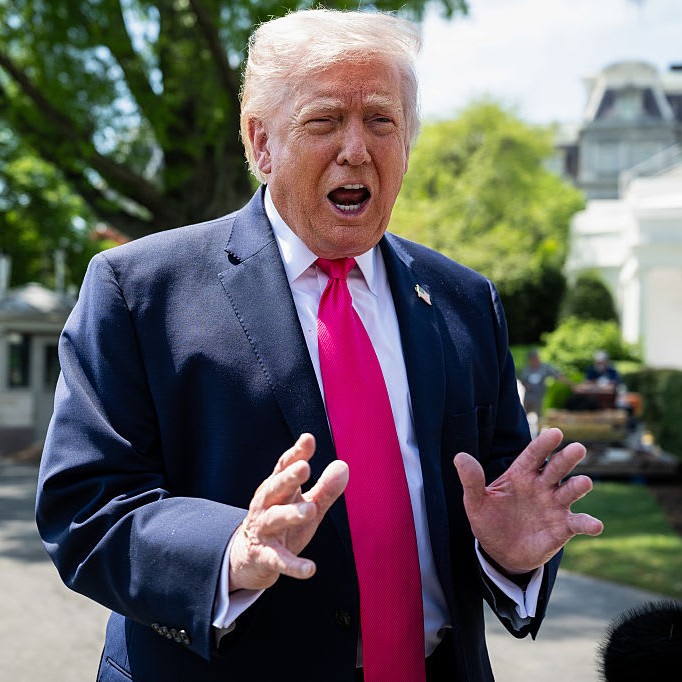
According to CBS News, Trump told Bongino that Republicans should “take over the voting” in at least 15 states. He framed it as a response to states he called corrupt and suggested the GOP should treat election administration as something to be centralized.
“The Republicans ought to nationalize the voting. And then we have states that are so crooked, and they’re counting votes,” Trump said.
The next day, at an Oval Office event with lawmakers and Cabinet officials around him, Trump kept the theme. He argued that if a state cannot run an election, federal action should follow.
That is the tension at the heart of this moment. Trump is describing elections as a problem that the executive branch can solve, while the Constitution and decades of practice treat elections as an area where presidents have little direct authority.
The Constitution Cuts the President Out
The Elections Clause, in Article I of the Constitution, puts the mechanics of federal elections in state hands, while giving Congress authority to regulate in certain ways. It is a system designed to scatter power, not concentrate it.
David Becker, a CBS News election law contributor and the executive director of the Center for Election Innovation and Research, put it bluntly on CBS News’s “The Takeout with Major Garrett.”
“The Elections Clause of the Constitution couldn’t be any more clear,” Becker said. “It’s actually one of the areas the Founders carved out, specifically to exclude the executive from any power over elections.”
Trump was asked about those limits, and he did not concede them as a hard stop. He said states can administer elections, but only if they do it honestly. He also referred to states as “agents of the federal government,” a phrase that signals the broader argument his team has been making: that Washington should have a bigger hand, even if the normal chain of command does not run through the Oval Office.
Federal Pressure Is Already Ramping Up
Trump’s “nationalize” talk lands in a political environment where his administration has already been pushing the federal government deeper into election disputes, not by rewriting the Constitution, but by using tools that create leverage.
CBS News reported that Trump signed an executive order aimed at overhauling elections, including a requirement for documentary proof of citizenship to register to vote. Those provisions ran into immediate legal resistance, and federal judges have blocked parts of the directive, including the proof-of-citizenship requirements.
Separately, the Justice Department has demanded complete voter registration lists from nearly every state and Washington, D.C., according to a Brennan Center for Justice tracker. Those records can include highly sensitive personal information. The Brennan Center also reports that the Justice Department has filed lawsuits against two dozen states and the District of Columbia over refusals to turn over the data.
That is not a nationalized election system. It is something else, a Washington-backed data grab, fought out in court, that effectively dares states to resist.
Then there is Georgia, where elections remain a recurring stage for Trump’s post-2020 narratives. CBS News reported that the FBI executed a search warrant at a Fulton County elections office and seized ballots from the 2020 presidential election. Trump has repeatedly claimed, without evidence, that the election in Georgia was rigged.
Trump told Bongino, “You’re going to see some interesting things come in” regarding Georgia, while again asserting he won the 2020 election. The search also drew attention because Director of National Intelligence Tulsi Gabbard was present at the scene, and CBS News reported that her involvement raised alarms among Democrats.
Gabbard, according to CBS News, told lawmakers in a letter that Trump requested she be at the search location. She also said she facilitated a phone call between FBI agents in Atlanta and the president, and that Trump wanted to thank the agents for their work. Gabbard said he did not ask questions and did not issue directives.
Taken together, that is the storyline Democrats are warning about: not one dramatic seizure of election power, but a steady accretion of federal presence around election infrastructure, election records, and election offices.
Trump’s Fraud Claims Keep Colliding With the Record
Trump’s pitch is built on the idea that illegal voting and systemic fraud are rampant. Yet the 2020 election became one of the most litigated elections in modern history, and CBS News reported that dozens of lawsuits filed by Trump’s campaign and allies were dismissed.
Also, in widely cited public comments reported by CBS News, Bill Barr, Trump’s first-term attorney general, said the Justice Department did not uncover evidence of widespread fraud.
That contradiction is the fuel here. Trump’s political brand relies on describing a system as broken. The legal record, at least on broad fraud claims, has repeatedly failed to validate the scale he argues exists. So the fight shifts from proving fraud to restructuring control, from arguing about what happened to trying to decide who gets to run the next one.
Even Republicans Are Telling Him No, in Public
Trump’s own party is not fully on board with the word “nationalize,” at least not when it sounds like federalizing elections in a way that strips states of power.
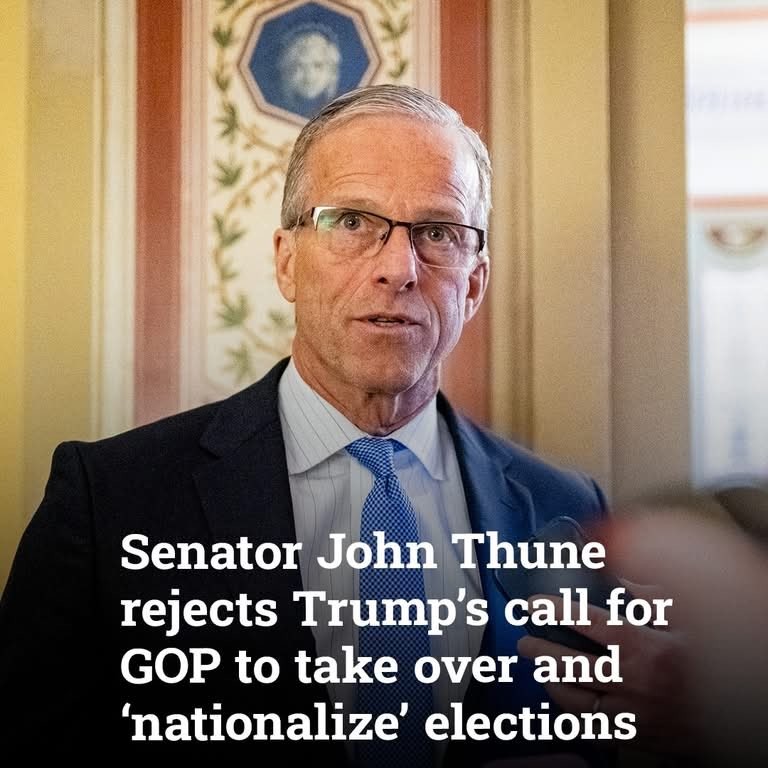
CBS News reported that Senate Majority Leader John Thune said he supports requiring photo identification to vote, but does not favor federalizing elections.
Senate Majority Leader John Thune (R-S.D.) on Tuesday rejected President Trump’s call for Republicans in Washington to “nationalize” voting in the United States and “take over” the management of elections in 15 states – The Hill pic.twitter.com/HNrJPAnoqc
— AlexandruC4 (@AlexandruC4) February 4, 2026
‘I’m a big believer in decentralized and distributing power, and I think it’s harder to hack 50 election systems than it is to hack one,’ Thune said. ‘So in my view, that’s always a system that’s worked quite well.’
House Speaker Mike Johnson also defended the state-run system, according to CBS News, while framing Trump’s comments as frustration about election integrity. The split is telling. Trump is talking like a centralizer. Congressional Republicans, many of whom campaign on states’ rights and limited federal power, are trying to keep the dispute on safer ground, such as voter ID and registration rules.
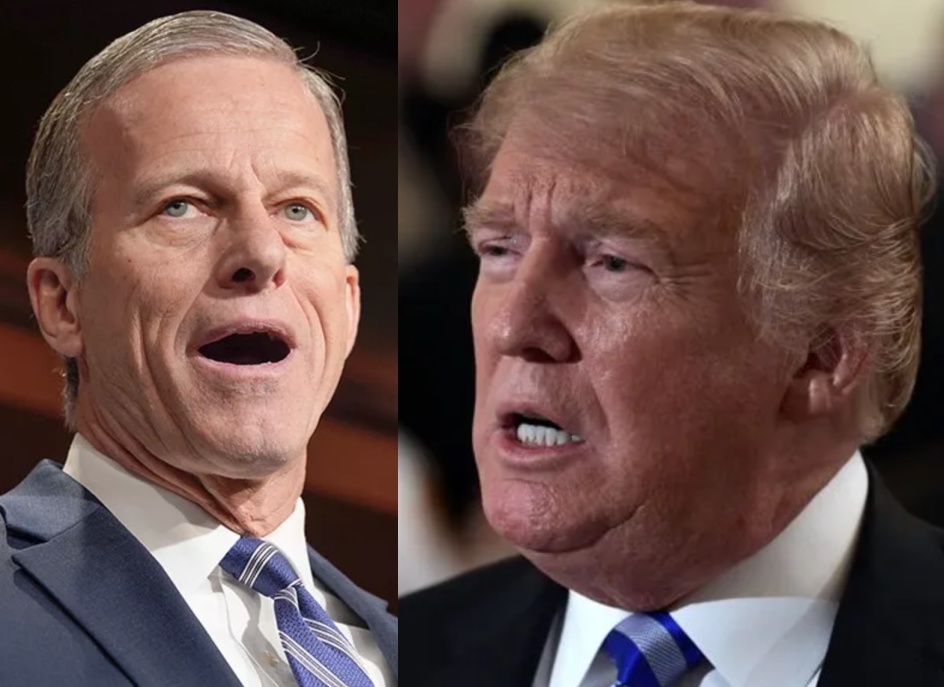
That creates a visible power dynamic inside the GOP. Trump can define the party’s messaging, but he still needs lawmakers to pass legislation, and he still needs courts to accept whatever executive actions follow. His biggest asset is attention. His biggest constraint is the legal system.
What Trump Might Mean by ‘Nationalize’
White House press secretary Karoline Leavitt told CBS News that Trump believes in the Constitution, while also claiming there has been fraud and irregularities. The White House also pointed toward the SAVE Act, legislation backed by Republicans that would require in-person proof of citizenship for voter registration.
In other words, the administration is trying to translate “nationalize” into a legislative agenda, one that moves election rules toward uniform national standards without openly claiming the president can run elections.
But the word Trump used matters because it signals intent. National standards are one thing. National control is another. If the push becomes a contest over who oversees voting infrastructure, who gets voter data, who shows up at election offices with federal badges, and who sets the boundary between legitimate oversight and intimidation, the courts will end up refereeing the meaning of “nationalize” for him.
The Stakes: Midterms, Maps, and a Test of Limits
This is happening ahead of the 2026 midterms, where control of Congress is on the line. CBS News reported that Trump has urged Republican state lawmakers to redraw congressional district lines to protect the GOP House majority, while Democrats have pursued their own map changes in response.
That is the practical side of the story. Election power is not just philosophical. It determines who writes the rules, who draws the maps, and who wins close races. A fight over election administration becomes a fight over governing power itself.
Watch for three next steps.
- Court battles over voter data, including how far the Justice Department can push for sensitive registration information.
- New executive actions that try to achieve national standards through federal agencies, and the legal challenges that follow.
- Congressional maneuvering, as Republicans decide whether they want Trump’s rhetoric, Trump’s policies, or both.
Trump is selling a simple promise: trust Washington more than the states he dislikes. The Constitution, and parts of his own party, are signaling that the promise is harder to cash than it is to chant.